Studies show that the choice of tank orientation can influence system efficiency by up to 20%, yet many overlook the subtle differences between vertical and horizontal designs. These distinctions impact installation, maintenance, and operational stability, which are critical for optimizing performance and space utilization. Understanding these nuances is essential for making informed decisions that align with specific industrial or workshop needs, prompting us to explore the core differences that ultimately determine the best fit for your application.
Key Takeaways
- Vertical tanks save space with a compact, tall design, ideal for limited-floor environments; horizontal tanks require more footprint but are better for spacious areas.
- Vertical tanks are easier to install and maintain due to accessible drainage and inspection points; horizontal tanks may need additional structural support.
- Horizontal tanks often provide better heat dissipation during continuous use, suitable for high-volume applications.
- Vertical tanks generally have higher initial costs but are more portable in tight or irregular spaces.
- The choice depends on space constraints, application needs, and system integration considerations.
How Do Vertical and Horizontal Tanks Differ in Design?
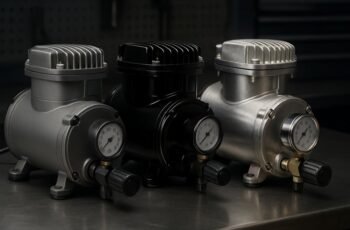
Vertical and horizontal air compressor tanks primarily differ in their orientation, which influences their structural design and installation considerations. Vertical tanks are built with a tall, cylindrical shape, emphasizing height to maximize storage capacity in limited floor space. Their stability relies on a sturdy base, often requiring reinforced foundations. Horizontal tanks, on the other hand, are designed with a low, elongated profile, distributing weight evenly across a broader footprint. This layout simplifies placement in areas with limited vertical clearance. Structurally, vertical tanks often feature a rounded top to withstand internal pressure, while horizontal tanks utilize a similar rounded design but emphasize lateral strength. The choice of orientation affects not only installation but also maintenance access, pressure vessel design, and integration with existing systems.
Which Applications Are Best Suited for Vertical Tanks?
When space constraints and accessibility are critical considerations, vertical tanks emerge as the most suitable choice for various applications. Their compact footprint makes them ideal for environments with limited floor space, such as manufacturing facilities, workshops, or confined utility rooms. Vertical tanks also facilitate easier installation and maintenance since their design allows for straightforward access to valves and connections at the top or bottom. Additionally, their shape promotes efficient air compression and pressure stability, making them suitable for applications requiring consistent pressure delivery, such as powering pneumatic tools or spray systems. The vertical orientation also simplifies integration into existing systems where height clearance is less restrictive than floor area. Overall, vertical tanks excel in settings where space optimization, ease of maintenance, and steady pressure output are prioritized.
When Should You Choose a Horizontal Air Compressor Tank?
Choosing a horizontal air compressor tank often depends on available space, as these tanks typically require a wider footprint. We also consider portability and mobility needs, since horizontal tanks may be less suitable for frequent transportation. Additionally, the specific application and usage patterns influence whether a horizontal configuration provides the best performance and efficiency.
Space Availability Considerations
Have you considered how available space influences the decision between horizontal and vertical air compressor tanks? Space constraints are a critical factor in selecting the appropriate tank orientation. Horizontal tanks typically require a broader footprint, making them suitable for spacious environments where width isn’t limited. Conversely, vertical tanks are more space-efficient in height, ideal for confined or narrow areas, such as workshops with limited floor space. The decision hinges on spatial layout and the need for efficient utilization of available real estate. It’s essential to analyze the environment’s dimensions and consider future expansion or equipment integration. Proper assessment guarantees the chosen tank orientation maximizes operational efficiency while minimizing spatial constraints, ultimately supporting long-term productivity and safety.
Portability and Mobility Needs
Horizontal air compressor tanks are often preferred in applications requiring frequent relocation or flexible positioning, as their design inherently facilitates mobility. Their low profile and broad footprint enable easier movement across uneven surfaces and tighter spaces. This makes them suitable for job sites where portability is critical, such as construction or mobile service operations.
Consider the following factors when evaluating mobility needs:
| Feature | Advantage | Limitation |
|---|---|---|
| Low center of gravity | Enhanced stability during transport | Larger footprint, harder to store |
| Handles and wheels | Ease of movement | Additional weight and complexity |
| Size and weight | Compatibility with transport methods | May require special equipment |
| Flexibility in placement | Adaptability to changing sites | Less space-efficient |
| Durability | Suitable for rugged environments | Potentially higher cost |
Application and Usage Type
When determining the ideal air compressor tank for specific tasks, understanding the application and usage context is essential. Horizontal tanks generally excel in stationary setups where space constraints are less restrictive, making them suitable for continuous or high-volume operations. Their wider footprint provides increased surface area for heat dissipation, beneficial for prolonged use. For large-scale manufacturing, auto repair shops, or woodworking facilities, horizontal tanks guarantee stable operation and easier integration into existing workflows. Conversely, they are less portable, so applications requiring mobility or frequent relocation favor vertical tanks. Choosing a horizontal tank is ideal when consistent, high-capacity air supply is needed, and space allows for their installation. Their design supports long-term, heavy-duty use cases demanding durability and efficient thermal management.
How Do Size and Capacity Impact Your Tank Choice?
The size and capacity of an air compressor tank directly influence space efficiency and operational requirements. Larger tanks support higher air delivery volumes, which is critical for demanding applications, but may require more space and structural support. Balancing these factors guarantees the best performance without unnecessary footprint or resource expenditure.
Space Efficiency Considerations
Choosing the right air compressor tank size involves carefully evaluating how capacity and physical dimensions influence space utilization. Vertical tanks typically occupy less floor space due to their compact, upright design, making them suitable for confined areas. Horizontal tanks, on the other hand, generally have a broader footprint, which can be a limiting factor in tight spaces but may offer easier access for maintenance. Larger capacity tanks, regardless of orientation, demand more space, potentially restricting installation options. When assessing space efficiency, it’s vital to consider ceiling height, layout constraints, and access points. Analyzing these factors helps determine whether a vertical tank maximizes vertical space or a horizontal tank better suits available footprint, ensuring ideal use of limited installation areas without compromising performance.
Air Delivery Needs
How does the size and capacity of an air compressor tank influence your air delivery requirements? Larger tanks generally provide a steadier, more consistent air supply by buffering pressure fluctuations, which is crucial for continuous operation. They also enable higher CFM (cubic feet per minute) demands, supporting tools that require substantial airflow over extended periods. Conversely, smaller tanks are suitable for intermittent use, where short bursts of high pressure suffice. The capacity directly affects the compressor’s ability to maintain pressure during peak demand. When selecting a tank, it’s important to match its volume with your operational airflow needs to prevent pressure drops or compressor cycling inefficiencies. Precise assessment ensures peak performance, minimizes downtime, and prolongs equipment lifespan, aligning tank choice with specific air delivery requirements.
What Are the Space and Installation Considerations?
When evaluating space and installation requirements for air compressor tanks, it’s essential to take into account the physical dimensions and layout constraints of your facility. Vertical tanks generally have a smaller footprint but require sufficient overhead clearance for height, which can be restrictive in low-ceiling environments. Horizontal tanks, conversely, occupy more floor space but are easier to position in confined areas with limited overhead clearance. Installation considerations also include access for maintenance, proximity to power sources, and structural support. Additionally, the choice between vertical and horizontal tanks influences piping configurations and space utilization efficiency. Proper assessment of available space, structural capacity, and operational workflow ensures ideal tank placement, minimizing installation complexities and maximizing safety and functionality within your facility.
How Do Maintenance and Durability Vary Between Designs?
Maintenance requirements and durability considerations differ considerably between vertical and horizontal air compressor tanks, impacting long-term operational efficiency. Vertical tanks often feature easier access to drain valves and inspection points, simplifying routine maintenance. Horizontal tanks, however, may be more susceptible to structural stress due to their shape, affecting longevity if not properly supported. Factors influencing durability include:
- Material quality and corrosion resistance
- Design complexity and weld integrity
- Support structure stability
- Ease of access for inspections
- Resistance to environmental stresses
Vertical tanks generally require less frequent maintenance due to better natural drainage and reduced sediment buildup, but their taller profile demands careful support. Horizontal tanks, while easier to monitor, may need more frequent inspections to address potential stress points and corrosion vulnerabilities.
What Are the Cost Differences Between Vertical and Horizontal Tanks?
The initial investment and ongoing costs of vertical versus horizontal air compressor tanks vary considerably, driven primarily by design complexity and material requirements. Vertical tanks generally involve increased manufacturing complexity due to their height and structural support needs, which can elevate initial costs. Conversely, horizontal tanks often require simpler fabrication, leading to lower upfront expenses. Material costs are also influenced by size and shape; taller tanks may demand thicker or more reinforced materials to ensure stability, impacting overall cost. Additionally, installation costs differ; vertical tanks may necessitate specialized mounting or foundation work, increasing expenses. Maintenance costs are relatively comparable, but vertical tanks might incur higher inspection and cleaning costs due to accessibility challenges. Overall, horizontal tanks tend to offer a more economical option initially, while vertical designs may incur higher long-term structural expenses.
Which Tank Type Offers Better Portability and Flexibility?
Vertical tanks often provide better portability and flexibility in constrained or variable spaces because their compact footprint allows for easier installation in tight areas or locations with limited floor space. Their vertical orientation reduces horizontal space requirements, making them ideal for environments where space optimization is critical. Additionally, vertical tanks are easier to relocate or reposition due to their stable base and manageable height.
Key advantages include:
- Reduced floor space occupancy
- Easier access for maintenance and inspection
- Simplified transportation and installation
- Better fit for confined or irregular spaces
- Enhanced stability in restricted environments
These features make vertical tanks more adaptable for mobile setups or facilities with spatial constraints, offering a strategic advantage in versatile applications.
Frequently Asked Questions
How Do Vertical and Horizontal Tanks Affect Overall System Efficiency?
Vertical tanks typically save space and promote better heat dissipation, enhancing efficiency, while horizontal tanks offer easier maintenance and stability. Both designs impact system efficiency based on installation environment and operational needs, influencing performance and longevity.
Are There Any Safety Concerns Specific to Each Tank Orientation?
Vertical tanks minimize space and reduce stress on tank supports, but may pose stability risks if not secured properly. Horizontal tanks are easier to inspect and maintain, yet require sturdy mounting to prevent tipping or structural failure.
How Does Tank Orientation Influence Airflow and Pressure Stability?
Like a well-oiled machine, tank orientation impacts airflow and pressure stability; vertical tanks often promote consistent pressure with better space efficiency, while horizontal tanks can reduce turbulence, ensuring smoother airflow and more reliable pressure regulation in demanding applications.
Can Vertical or Horizontal Tanks Be Customized for Special Requirements?
Yes, vertical and horizontal tanks can be customized with features like reinforced materials, specialized connectors, or internal coatings to meet specific operational needs, ensuring peak performance, durability, and compatibility with unique industrial applications.
What Are the Long-Term Maintenance Costs for Each Tank Type?
We find that vertical tanks generally cost 10-15% less over their lifespan due to easier maintenance access, while horizontal tanks may incur slightly higher long-term costs because of their complex structure, but both require regular inspections and routine upkeep.
Conclusion
In brief, selecting between vertical and horizontal tanks hinges on space constraints, operational needs, and maintenance considerations. Especially, vertical tanks can save up to 30% more space in compact environments, making them ideal for small workshops. Understanding these technical distinctions allows us to optimize system efficiency and longevity, ensuring we choose the right tank for specific applications. Making an informed decision ultimately enhances productivity and minimizes operational costs.