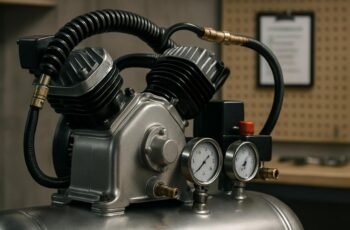
When choosing between rubber and polyurethane air compressor hoses, understanding their distinct properties is essential for ideal performance. Each material offers specific advantages and limitations depending on environmental conditions and application demands. We’ll explore how these hoses compare in durability, flexibility, weight, resistance, and cost—factors that markedly influence selection. By examining these differences carefully, you can identify which hose best suits your operational needs and long-term maintenance considerations.
Key Takeaways
- Rubber hoses are more durable and resistant to low temperatures but less resistant to UV and ozone, affecting outdoor longevity.
- Polyurethane hoses are lighter, more flexible, and resistant to kinking, making them easier to handle in tight or demanding spaces.
- Rubber hoses typically have a higher initial cost but offer longer service life in harsh conditions; polyurethane hoses are more affordable but may wear faster outdoors.
- Polyurethane hoses excel in chemical and weather resistance, suitable for outdoor applications, whereas rubber hoses perform well in demanding, low-temperature environments.
- Regular inspection and proper storage are essential for both, but polyurethane hoses generally require less maintenance due to better environmental resistance.
What Are the Main Differences Between Rubber and Polyurethane Hoses?
While both rubber and polyurethane hoses are designed to transfer compressed air efficiently, they differ markedly in material properties and performance characteristics. Rubber hoses are composed of natural or synthetic rubber, offering excellent elasticity, high resistance to abrasion, and superior flexibility at lower temperatures. They tend to be heavier and less resistant to environmental factors like UV exposure and ozone, which can cause degradation over time. Polyurethane hoses, made from thermoplastic polyurethane, are lighter and possess higher tensile strength, offering superior abrasion resistance and chemical compatibility. They maintain flexibility across a broader temperature range and are less prone to kinking. However, polyurethane hoses may be less flexible in extremely cold conditions compared to rubber. These fundamental differences influence their suitability for specific applications and operational demands.
Durability and Flexibility: How Do Rubber and Polyurethane Compare?
Rubber hoses generally offer superior wear resistance and longer service life, making them suitable for demanding applications. Polyurethane hoses, however, excel in flexibility and ease of handling, which can enhance maneuverability in tight spaces. Comparing these attributes helps determine the most suitable choice based on specific operational needs.
Wear Resistance and Longevity
When evaluating wear resistance and longevity, polyurethane hoses generally outperform rubber due to their superior abrasion resistance and ability to withstand repeated flexing without degrading. Polyurethane’s molecular structure provides enhanced durability against mechanical wear, reducing surface deterioration over time. Its resistance to cuts, tears, and ozone exposure contributes to a longer service life, especially in demanding environments. Rubber hoses, while initially resilient, tend to deteriorate faster under constant abrasion and repeated flexing, leading to cracks and leaks. Polyurethane’s stable performance under cyclic stress minimizes material fatigue, extending operational lifespan. Overall, polyurethane hoses offer a more consistent, long-term solution for applications requiring sustained wear resistance, making them a preferable choice for durability-focused operations.
Flexibility and Ease of Handling
Polyurethane hoses are widely recognized for their superior flexibility and ease of handling compared to rubber counterparts. Their inherent elasticity allows for easier maneuverability in tight spaces and around obstacles, reducing operator fatigue during extended use. The lightweight nature of polyurethane hoses enhances portability and simplifies installation and storage, especially in confined or complex environments. Additionally, polyurethane maintains consistent flexibility over a broad temperature range, resisting stiffening in cold conditions. In contrast, rubber hoses tend to be heavier, more rigid, and prone to kinking under stress, which hampers ease of handling. Overall, polyurethane hoses provide a more responsive and manageable solution, improving efficiency in various industrial applications requiring frequent movement or positioning.
Weight and Handling: Which Material Is Easier to Manage?
Because weight directly impacts ease of handling, understanding the differences between rubber and polyurethane hoses is essential for ideal equipment performance. Rubber hoses tend to be heavier due to their dense, resilient material composition, which can increase fatigue during prolonged use and make maneuvering more difficult. Conversely, polyurethane hoses are considerably lighter, offering improved manageability and reduced operator fatigue. This lighter weight facilitates easier installation, repositioning, and storage, especially in confined or extended applications. However, the reduced weight of polyurethane hoses can sometimes compromise structural rigidity under high pressure, though this does not affect handling directly. Overall, polyurethane hoses generally provide superior ease of handling due to their lower weight, making them preferable for tasks requiring frequent movement or extended operation.
Resistance to Kinks and Environmental Factors
Both rubber and polyurethane hoses exhibit distinct behaviors under pressure and environmental exposure. Rubber hoses generally maintain flexibility in low temperatures but can be prone to kinking and weather degradation, while polyurethane hoses offer superior resistance to kinks and harsh conditions. Understanding these differences is essential for selecting a hose optimized for durability and performance in various environments.
Flexibility Under Pressure
While flexibility under pressure is essential for air compressor hoses, polyurethane hoses generally offer superior resistance to kinks and environmental factors compared to rubber hoses. Polyurethane’s inherent elasticity allows it to maintain flexibility without cracking or becoming brittle under high-pressure conditions. This elasticity minimizes the risk of kinking, even when the hose is bent sharply or subjected to repeated flexing. Additionally, polyurethane resists environmental stressors such as UV exposure, ozone, and chemicals, preserving its flexibility over time. Rubber hoses, while initially flexible, tend to degrade faster under continuous pressure and environmental exposure, leading to increased stiffness and susceptibility to kinking. Consequently, polyurethane hoses provide more consistent, reliable flexibility under pressure, making them suitable for demanding industrial applications.
Weather Resistance Properties
Polyurethane hoses demonstrate notable resilience against environmental stressors such as UV radiation, ozone, and chemical exposure, which can compromise the integrity of rubber hoses over time. This superior resistance minimizes degradation caused by prolonged sunlight, ozone exposure, and chemicals like solvents, oils, and fuels. Polyurethane’s molecular structure provides enhanced flexibility and durability, reducing the likelihood of kinks and cracks under fluctuating outdoor conditions. In contrast, rubber hoses tend to become brittle and crack when exposed to harsh environmental factors, leading to potential failure. Overall, polyurethane hoses offer consistent performance in outdoor settings, maintaining their structural integrity longer than rubber counterparts. Their ability to withstand environmental extremes makes them a reliable choice for demanding applications where weather resistance is critical.
Cost Considerations: Which Hose Offers Better Value?
When evaluating the cost-effectiveness of rubber versus polyurethane air compressor hoses, it’s essential to contemplate not only the initial purchase price but also the long-term expenses associated with each material. Rubber hoses tend to have higher upfront costs but often demonstrate greater durability, reducing replacement frequency. Conversely, polyurethane hoses typically feature lower initial prices, but their susceptibility to wear can lead to more frequent replacements.
Key cost considerations include:
- Initial purchase cost
- Durability and lifespan
- Replacement frequency
- Maintenance requirements
- Compatibility with operational conditions
A thorough analysis indicates that rubber hoses may offer better long-term value in demanding environments, while polyurethane hoses can be more economical for short-term or light-duty applications.
Best Use Cases for Rubber vs Polyurethane Hoses
Rubber and polyurethane hoses each excel in different operational environments, making it important to match their characteristics with specific use cases. Rubber hoses are ideal for heavy-duty applications requiring superior durability, flexibility, and resistance to harsh conditions, such as construction sites or industrial settings. Their resilience to abrasion, ozone, and temperature fluctuations guarantees longevity under demanding use. Polyurethane hoses, on the other hand, excel in applications demanding lightweight, high flexibility, and ease of maneuverability, such as automotive or precision shop work. They typically resist kinking and have excellent abrasion resistance, but are less suited for extreme temperatures or prolonged exposure to harsh chemicals. Understanding these distinctions helps in selecting the most suitable hose type for specific operational needs, ensuring efficiency and equipment longevity.
How to Choose the Right Air Compressor Hose for Your Needs?
Selecting the appropriate air compressor hose requires a clear understanding of your specific operational demands and working environment. To choose effectively, consider factors such as pressure requirements, flexibility, durability, temperature range, and chemical exposure.
- Pressure ratings: Verify the hose can withstand system pressure and potential surge conditions.
- Flexibility: Choose a hose that maintains flexibility in your working conditions, especially in tight spaces.
- Durability: Evaluate abrasion, puncture, and weather resistance based on your environment.
- Temperature range: Match the hose’s operational temperature limits with your application’s temperature fluctuations.
- Chemical compatibility: Confirm the hose material resists any chemicals or oils it may contact regularly.
Maintenance Tips to Extend the Life of Your Hose
Proper maintenance of your air compressor hose is vital to guarantee peak performance and longevity. Regular inspections identify wear, cracks, or leaks early, preventing failures. Avoid sharp bends and kinks that can weaken the hose structure. Make sure hoses are stored in a cool, dry place away from direct sunlight to prevent material degradation. Use appropriate fittings to minimize undue stress. Additionally, regularly clean the hose exterior with a damp cloth to remove debris.
| Maintenance Step | Purpose | Recommended Frequency |
|---|---|---|
| Visual inspections | Detect damage early | Weekly |
| Proper storage | Prevent material deterioration | Off-use periods |
| Cleaning and fittings check | Maintain integrity | Monthly |
Frequently Asked Questions
Are Rubber or Polyurethane Hoses More Environmentally Friendly?
We believe rubber hoses are generally more environmentally friendly due to biodegradability and lower manufacturing impact. Polyurethane hoses, while durable, involve chemicals that may pose environmental concerns during production and disposal, making rubber a slightly greener choice overall.
How Do Temperature Extremes Affect Each Hose Type’s Performance?
Extreme temperatures can severely impact hose performance; rubber hoses remain flexible in cold, resisting cracking, while polyurethane hoses excel in high heat, maintaining their integrity without deformation—each adapts uniquely to the climatic battlefield.
Can Rubber or Polyurethane Hoses Be Recycled Easily?
Rubber hoses are generally recyclable through specialized industrial processes, while polyurethane hoses pose more challenges due to chemical composition. We recommend checking local recycling facilities’ capabilities to determine proper disposal options for each material type.
Which Hose Type Is Safer to Use in High-Pressure Applications?
We believe polyurethane hoses are safer for high-pressure applications because they resist kinking, maintain pressure integrity, and have a higher burst strength, ensuring reliable, safe operation even under extreme conditions, unlike rubber hoses which may degrade faster.
Do Rubber or Polyurethane Hoses Emit Fewer Odors During Use?
Polyurethane hoses tend to emit fewer odors during use because they have minimal volatile organic compounds (VOCs) and are made from materials that produce less off-gassing, making them more suitable for odor-sensitive environments.
Conclusion
In choosing between rubber and polyurethane hoses, we recognize that the right option depends on your specific environment and application needs. Rubber offers unmatched durability for demanding industrial use, while polyurethane excels in portability and resistance to environmental factors. Remember, “a chain is only as strong as its weakest link.” By carefully evaluating your requirements, you can select a hose that guarantees reliable performance and longevity, ultimately optimizing your operational efficiency.