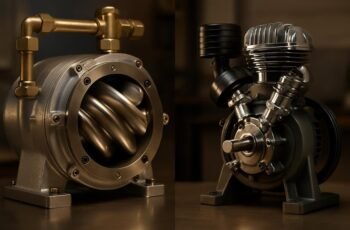
We’ll compare reciprocating and rotary screw air compressors by tying duty cycles to performance, cost, and maintenance. Reciprocating units excel with intermittent, high-peak demands but bring higher noise and piston-valve wear; rotary screws provide steady, continuous flow with smoother pressure and longer intervals between service. The right choice hinges on use-case profiles, cooling and lubrication interfaces, and total cost of ownership. Let’s examine where each type truly fits and what trade-offs matter most for you.
Key Takeaways
- Reciprocating compressors are better for intermittent, high-peak loads due to rapid start-stop strokes and high pressure per cycle.
- Rotary screw compressors excel for continuous, steady duty with smoother pressure curves and lower pulsation.
- Reciprocating units tend to have higher noise and more wear on valves/pistons; screws have smoother operation and longer intervals between major overhauls.
- Efficiency varies with load: reciprocating shines at partial loads, screws are more efficient under steady, moderate-to-high duty.
- Maintenance focus differs: reciprocating emphasizes valve/piston wear, screws emphasize bearing seals and oil management.
Which Type Should You Pick: Intermittent vs Continuous Demand
Choosing between reciprocating and rotary screw compressors hinges on demand patterns: intermittent versus continuous. We analyze how usage shape fits, focusing on efficiency, maintenance windows, and lifecycle costs. For intermittent demand, we prefer reciprocating units due to rapid start-stop cycles, higher part-load efficiency under brief runtimes, and simpler control schemes. For continuous demand, rotary screws sustain steady flow with lower idle losses and smoother pressure profiles, reducing thermal cycling and wear. We evaluate compatibility testing to confirm electrical, control, and lubrication interfaces align with existing plant systems. Warranty coverage matters too; we compare coverage scope for wear elements, seals, and crank mechanisms under varying duty cycles. Our conclusion: match the compressor type to duty pattern, validate integration, and verify warranty terms to minimize risk and maximize uptime.
How Reciprocating Compressors Work, at a Glance
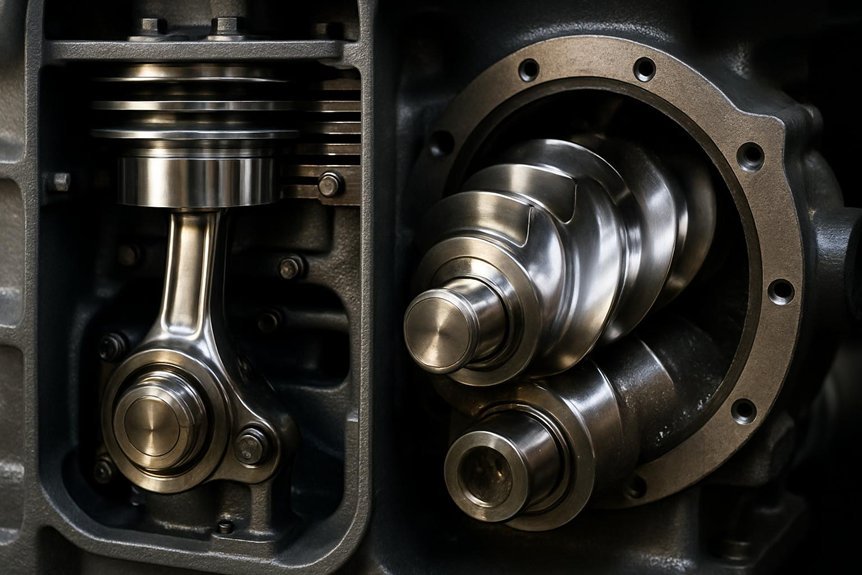
Reciprocating compressors convert electrical energy into pressurized air through a piston-driven cylinder arrangement: the crankshaft drives a piston that, on intake, draws in air, and on compression, reduces volume to raise pressure before discharge. We operate with a clear, cycle-based sequence: intake stroke fills the cylinder, compression stroke raises pressure, and exhaust releases the final air bundle to the system. This arrangement yields high pressure per cycle and reliable duty capability, with performance closely tied to discharge pressure targets and piston geometry. Efficiency hinges on cooling, lubrication, and sealing integrity, plus motor control and vibration management. Two word discussion ideas: oil free, portable power. We emphasize predictable response, compact sizing, and straightforward maintenance, while distinguishing fixed-speed versus variable-speed drives for steady or fluctuating loads.
How Rotary Screw Compressors Work and How They Differ
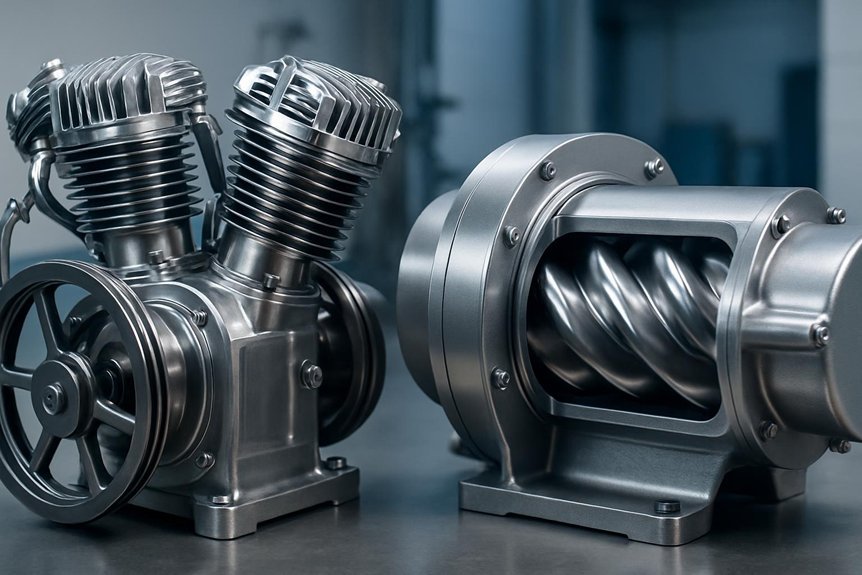
We’ll examine how rotary screw compressors operate, focusing on the meshing rotors, intake/volume control, and how sealing and compression are achieved throughout the rotation. We’ll compare key differences in function—torque profiles, gas handling, and load response—to the reciprocal style, clarifying what that means for efficiency and maintenance. We’ll also assess efficiency and maintenance implications, highlighting wear patterns, lubrication needs, and routine service considerations.
How Rotary Screws Operate
Rotary screw compressors operate by trapping and compressing air between two intermeshing rotors, typically a male and a female, whose profile creates continuous, crescent-shaped air spaces. We inspect the capture and compression cycle to understand volume change, timing, and flow. As air enters through the inlet, rotors shear and trap it in meshing pockets, then advance it to the discharge, where pressure rises to setpoints. Efficiency depends on rotor profile, lubrication, gap control, and seal wear. Maintenance objectives focus on sustaining tight tolerances, minimizing leakage, and ensuring proper oil-air separation. We highlight rotary maintenance practices that reduce energy loss and extend life. Unlike reciprocating systems, noise characteristics differ; we assess emitted harmonics and how shaft speed influences reciprocating noise signatures and overall acoustics.
Key Differences In Function
Despite their shared goal of delivering pressurized, dried air, rotary screw compressors differ fundamentally in how they trap and move air. We analyze internal-flow dynamics, rotor geometry, and sealing patterns to reveal functional contrasts. In rotary screws, air is captured by meshing rotors, compressed through continuous displacement, and discharged via ports with minimized pulsation. By comparison, reciprocating units rely on discrete piston strokes, crank-driven phases, and valve timing to fill and pressurize cylinders. The result is smoother flow in screws and higher average pressures with lower pulsation, versus greater impulse loads in pistons.
| Column A | Column B | Column C |
|---|---|---|
| continuous | displacement | pulsation |
| meshing | rotors | discharge |
| efficiency | sealing | dynamics |
Efficiency And Maintenance Aspects
Efficiencies in rotary screw compressors hinge on continuous displacement and optimized sealing, which reduce unloading losses and pulsation compared with reciprocating units. We examine the core efficiency tradeoffs: rotor profile, timing, and end-clearance collectively determine leakage and volumetric efficiency under varying loads. Rotary screws excel at steady-state duty but exhibit higher parasitic losses during start-up and light-load conditions; strategic unloading and VSD use mitigate this. Maintenance cadence focuses on bearing wear, seal integrity, and oil management, since proper oil volume and quality sustain film strength and cooling. Routine checks of air-end integrity, oil cleanliness, and filter condition directly impact efficiency retention. In contrast, reciprocating units demand more frequent component lubrication refreshes and valve adjustments. Overall, lifecycle cost hinges on load profiles and disciplined maintenance.
Efficiency Overview: Reciprocating vs Rotary Screw
How do you gauge efficiency differences between reciprocating and rotary screw compressors in practical use? We compare heat generation, volumetric efficiency, and mechanical losses with a focus on real-world operating curves. Reciprocating units show high efficiency at partial loads due to good volumetric performance but incur higher mechanical friction and cooling demands at full load. Rotary screw systems excel in steady duty, delivering lower specific power and smoother pressure delivery, yet efficiency declines with oversized clearance and parasitic losses in start/stop cycles. Table below summarizes relationships, while two word discussion ideas and non relevant topics appear as context anchors to avoid bias.
| Metric | Reciprocating | Rotary screw |
|---|---|---|
| Load response | Peak efficiency at partial load | Best at steady load |
| Thermal behavior | Higher cooling need | More stable temperature |
| Maintenance | Frequent valve and piston wear | Sealed bearings, fewer valve resets |
Duty Cycle and Load Profiles: When Each Type Excels
We’ll examine how duty cycle nuances and load profile variances influence performance, rating each type for typical operating hours and duty factors. We’ll contrast how reciprocating units handle intermittent, high-pressure bursts versus rotary screw units sustaining continuous loads, with timing considerations for startup and cycling. This framing helps pinpoint application fit and timing when choosing between these compressors.
Duty Cycle Nuances
Duty cycle behavior and load profiles differentiate reciprocating and rotary screw compressors by how they respond to varying demand. We examine duty cycle as a control axis: reciprocating units typically feature stepwise loading with peak efficiency at moderate, intermittent duty, while rotary screws maintain steady output across broader load ranges. Load profile matters because constant, high-demand periods favor screw compressors for smoother operation and reduced thermal cycling. In intermittent or process-driven demands, reciprocating models handle large pressure swings and startup surges more predictably, provided staging and controller logic manage cycling. Efficiency curves reveal that mechanical losses in pistons escalate with frequent starts, whereas screw designs minimize ramping losses during mid-to-high loads. Overall, duty cycle nuances guide selection toward reciprocating for burst demand and rotary screw for sustained, moderate-to-high duty cycles.
Load Profile Variances
Are load profiles the deciding factor when choosing between reciprocating and rotary screw compressors, or do other performance traits dominate under typical operating conditions? We examine duty cycle and load variability with a focus on how each technology responds to demand swings. Reciprocating units handle high-variance, intermittent loads more predictably due to individual cylinder ramping and rapid pressure changes, while rotary screws excel under steady, moderate-to-high duty cycles with smoother pressure curves. We assess effects on inlet filtration requirements and the impact of ambient temperature, since these influence compressor cooling, lubrication, and volumetric efficiency across load bands. In practice, matching a system’s profile to a compressor’s response spectrum minimizes unloading losses and improves energy use, irrespective of nominal capacity.
Application Fit Timing
What timing patterns maximize each technology’s advantages? We analyze duty cycle and load profiles to reveal fit. Reciprocating units excel under high-peak, intermittent demands, while rotaries favor steady, continuous loads. Our assessment highlights practical timing decisions that reduce total cost of ownership and optimize performance.
1) Peak-shaving intervals where reciprocating machines handle brief surges before rotor-driven units stabilize output
2) Continuous-day operations where rotary screw maintains steady pressure with minimal fluctuation
3) Frequent cycling scenarios where reciprocating noise rises but maintenance windows allow timely rotary maintenance
4) Long, flat production runs that maximize efficiency and lower energy per CFM with a rotary configuration
We emphasize monitoring, minimizing reciprocating noise, and scheduling rotary maintenance during low-demand periods to sustain reliability.
Noise and Vibration: Comfort in the Shop
Noise and vibration are critical for shop comfort because they directly affect operator fatigue, focus, and overall work quality. We compare reciprocating and rotary screw designs through acoustic and vibrational metrics, focusing on measurable impact rather than impressions. Our assessment uses quantitative noise levels, octave-band spectra, and vibration transfer data to determine practical comfort outcomes. Reciprocating units typically exhibit higher peak sound pressure and intermittent pulse tones, while rotary screws achieve smoother spectra with lower overall dB. Oil free benefits influence bearing and seal friction, reducing lubricant-derived noise. Cleanroom suitability aligns with tighter control of particles and acoustic noise, relevant when enclosure integrity matters. Silent operation is rare in heavy-duty systems but achievable with effective vibration isolation and compliant mounting, delivering quieter performance without compromising flow.
Maintenance and Durability: Which Lasts Longer and Why
Both reciprocating and rotary screw compressors show distinct maintenance and durability profiles that drive total ownership costs. We assess wear patterns, component life, and service intervals to predict longevity and downtime.
- Maintenance schedules: reciprocating units demand frequent valve and piston checks, while rotary screws benefit from longer intervals between major overhauls.
- Oil life: oil quality and change frequency differ, with screws often tolerating longer life cycles when properly filtered.
- Bearing and seal wear: dynamic stresses in pistons vs gears influence replacement timing and spindle integrity.
- Downtime impact: simpler diagnostics on rotaries usually shorten mean time to repair, yet piston ecosystems can be more forgiving with proactive care.
Cost of Ownership: Upfront and Ongoing
Is the total cost of ownership the decisive factor when choosing between reciprocating and rotary screw air compressors? We approach ownership by dissecting upfront and ongoing costs. Upfront, capital expenditures reflect unit price, installation complexity, and ancillary equipment—controls, filters, and electrical upgrades. Rotary screw units typically command higher initial costs but offer simpler integration and longer service intervals. Ongoing costs hinge on maintenance frequency, parts availability, and downtime impact. Energy pricing drives consumables and reliability, since electrical efficiency translates to lower operating expenses over time. We perform a cost comparison across load profiles, considering duty cycles and ambient conditions. Although maintenance economics can level differences, the long-run annualized cost often favors the more efficient rotary screws in steady production. Energy pricing sensitivity remains paramount for total ownership.
Choosing by Use Case: Scenarios to Consider
When we choose between reciprocating and rotary screw air compressors by use case, we shift from total-cost considerations to how the equipment aligns with production patterns and process demands. We assess duty cycles, load variability, and maintenance windows to map suitability. The goal is predictability, not just efficiency.
When choosing compressors, prioritize how production patterns drive equipment alignment and predictability over pure efficiency.
- Identify peak-demand periods and whether constant or intermittent air is required.
- Align compressor sequencing with process steps to minimize start-stop stress.
- Match pressure tolerance and air quality needs to equipment response times.
- Consider facility constraints like space, power quality, and maintenance access.
Note that an unrelated topic can bias the decision, while an off topic comparison may mislead if not anchored to actual process data. Clear use-case framing avoids misinterpretation.
Frequently Asked Questions
Which Compressor Is Better for Variable Airflow Requirements?
We handle variable airflow best with rotary screw for steady output, while reciprocating excels at high efficiency under intermittent demand; overall, reciprocating efficiency matters for spikes, and rotary noise control reduces nuisance in continuous operation.
How Do Maintenance Intervals Differ by Type?
“Measure twice, cut once.” Maintenance intervals differ: reciprocating require shorter, more frequent checks; rotary screw extends intervals. Lubrication schedules, diagnostics software, and vibration analysis tighten oversight, ensuring reliable performance across both, with proactive maintenance driving uptime.
Can Hybrids or Dual-Technology Systems Exist?
We can confirm that hybrids or dual-technology systems exist, offering hybrid efficiency and dual technology viability. We analyze integration strategies, control schemes, and reliability trade-offs, showing how blended compressors balance startup loads, efficiency curves, and process flexibility for readers like you.
Which Type Handles Altitude and Temperature Changes Best?
We’ll say: reciprocating durability generally handles altitude and temperature changes more predictably, while rotary efficiency can suffer with extreme conditions, so we choose based on environment: we prioritize reciprocating durability and monitor rotary efficiency under stress.
What Are Common Failure Modes by Design?
We’ll note that about 20% of compressor failures stem from design flaws. In reciprocating design, valve and piston wear are common, while in rotary screw design, premature wear of rotors and seals often dominates. We’ll quantify and compare risks.
Conclusion
We’ve weighed the gears, gas, and grimace-worthy noise, and yet the verdict isn’t a single fuse-flick. If your beads of sweat come with steady, nonstop flow, we’ll lean rotary screw for the long haul. If your demand spikes like a boss battle, the reciprocating unit earns its keep—brief, brutal, and loud. In short: match the duty cycle, mind the maintenance cadence, and armor your uptime with the right type for the right job.