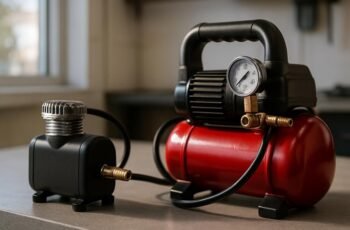
We understand that 60–70% of a compressor’s total cost over its life comes from fuel and maintenance when gas is involved. As we compare gas engines to electric motors, we weigh readiness and peak performance against cleanliness, noise, and upkeep. We’ll break down tradeoffs for portability, duty cycles, and total cost of ownership, then map them to real-use scenarios. If you want a pragmatic, data-driven decision, we’ll show you where to start.
Key Takeaways
- Gas vs electric: gas delivers instant readiness and longer runtime but incurs fuel costs and louder operation; electric offers cleaner, quieter, lower maintenance with grid-reliant run time.
- Portability and footprint: lighter electric units excel for mobile tasks and tight spaces; heavier gas models provide higher CFM but require stable setup and fuel storage.
- Maintenance and reliability: electric motors have fewer moving parts and lower routine maintenance; gas engines need regular fuel, oil, filters, and ignition service.
- Performance characteristics: gas delivers strong peak CFM with high RPM torque but PSI stability can vary; electric provides steady PSI with smoother startup and less surge.
- Use-case fit: for remote job sites and downtime-sensitive work, gas may win; for home shops, limited ventilation, or grid-connected tasks, electric is typically preferable.
Gas or Electric: Which Is Best for Your Workshop?
Gas and electric air compressors each have trade-offs that matter in a workshop setting. We weigh how gas selection affects mobility, noise, fumes, and runtime against electric units’ cleaner operation and simpler maintenance. For portable, remote or backup needs, gas models offer instant readiness and extended run time without frequent recharges, but fuel economy and storage considerations drive operating costs. In contrast, electric compressors deliver consistent performance with regulated power, lower emissions, and quieter operation, improving indoor suitability. Our assessment targets workflow impact: startup reliability, duty cycle, and total cost of ownership. When space is tight or ventilation is limited, electric becomes favorable; when downtime costs spike, gas may excel. Ultimately, decision alignment with fuel economy goals and site constraints guides the best choice.
How Power Delivery Differs: Gas Engines vs. Electric Motors
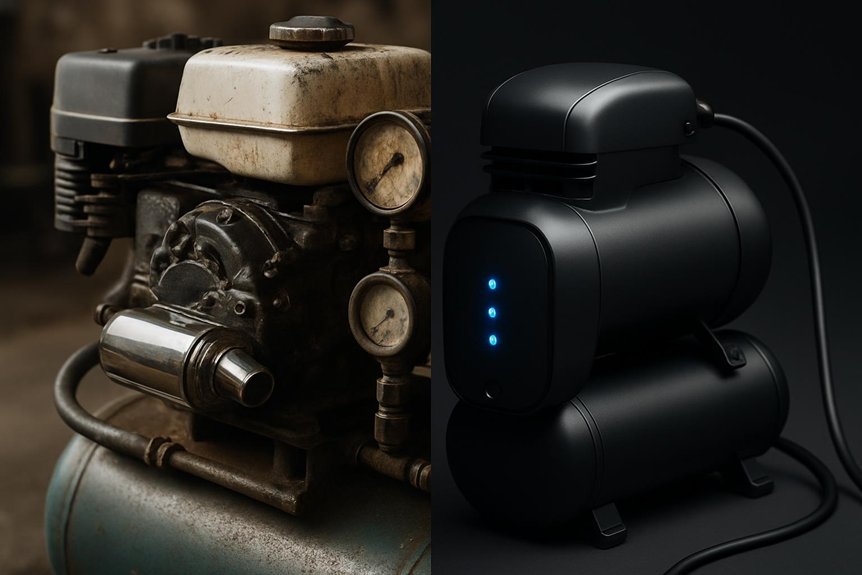
Power delivery between gas engines and electric motors hinges on how each source converts fuel or electrical energy into usable air pressure and flow. We compare the two: efficiency curves, response, and control dynamics shape performance under load.
Power delivery depends on how fuel or electricity creates usable air pressure and flow, shaping efficiency, response, and control under load.
1) gas engine: builds pressure through piston compression and turbine dynamics, delivering high peak power but with combustion lag and fuel system losses.
2) electric motor: converts electrical energy directly into rotation, yielding instant torque and smoother regulation, but limited by supply voltage and controller design.
3) tradeoffs: warm-up, cooling, and maintenance impact long-run consistency; energy source reliability dictates duty cycles.
Ultimately, the choice hinges on application demands for steady pressure versus rapid response, and how the gas engine and electric motor integrate with your system.
Portability Matters: Weight, Size, and Where You’ll Work
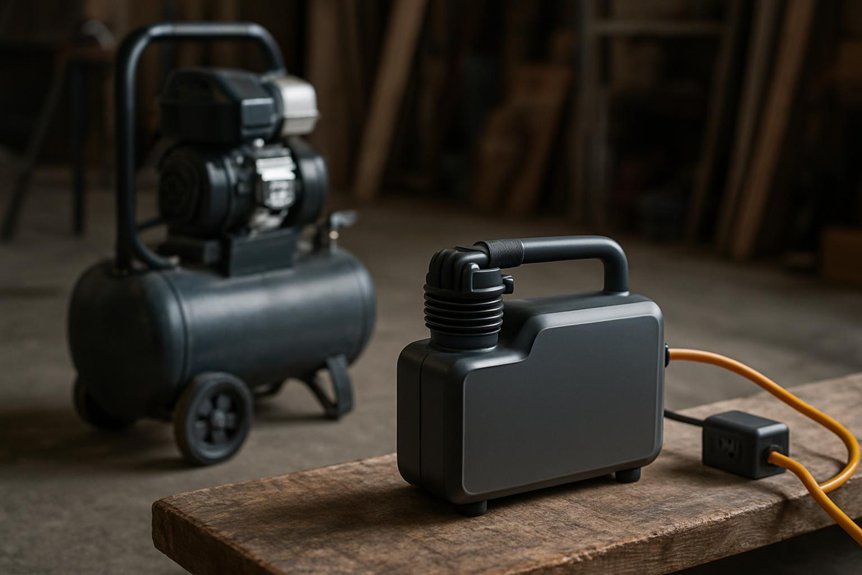
We weigh how weight and footprint influence where you’ll work, since portability affects setup time and ergonomics. We’ll compare the tradeoffs between heavier gas units and lighter electric models, focusing on practical handling and storage in tight spaces. By outlining how size and weight constrain job sites, we set the stage for selecting the right compressor for your workspace.
Weight Tradeoffs
How heavy a compressor is directly shapes where you’ll use it. We balance mobility against capability, because weight changes how you access jobsites, stairs, and overhead work. Heavier units offer higher CFM and longer run times, but demand a sturdy setup and more handling effort. Lighter models trade power for portability, yet fit compact spaces and quick tasks. We weigh gas efficiency and fuel availability when selecting a unit, since that affects long shifts and remote locations. Our approach is data-driven: quantify weight, power, and duty cycle to predict on-site practicality.
1) Weight vs. performance: parse the tradeoffs between mass, CFM, and compressor duty cycle.
2) Mobility vs. stability: assess handles, wheels, and chassis design for transport efficiency.
3) Fuel logistics: evaluate gas efficiency, storage, and fuel availability at sites.
Compact Footprint
Compact footprints matter because size and weight directly shape where you’ll actually use an air compressor. We evaluate portability by considering weight, dimensions, and surface compatibility, not just peak performance. Small, lighter units reduce fatigue and widen job-site options, while bulkier models demand staging, hooks, or wheels. In gas-powered designs, the footprint often reflects fuel storage and intake plumbing, which can affect maneuverability as gas dynamics come into play during startup and runtime. For combustion chemistry, tighter packaging can influence cooling and thermal strategies, impacting sustained operation. The table below contrasts layouts that balance weight with stability, guiding practical workspace decisions.
| Dimension/Weight | Usable Space Impact |
|---|---|
| Placement Footprint | Stability under load |
| Wheel/Handle Configuration | Transport ease |
| Service Access | Field maintenance accessibility |
| Fuel Tank Size | Refuel frequency and safety |
Running Costs: Fuel vs. Electricity and Long-Term Costs
Running costs hinge on energy source and usage patterns: electric compressors generally deliver lower per-hour energy costs and fewer maintenance items than gas units, though fuel prices and duty cycles can tilt the balance.
Electric compressors usually cost less to run per hour and require less maintenance, though fuel prices and duty cycles can shift the balance.
We cover three key points that affect long-term budgeting:
1) fuel costs versus electricity costs over cycles, including regional price fluctuations.
2) maintenance intervals and their impact on uptime and service costs for gas versus electric models.
3) total cost of ownership, considering depreciation, replacements, and efficiency over the compressor’s life.
In practice, electric units often offer lower ongoing expenses due to simpler fuel-free operation and longer service intervals. Gas units may excel where duty cycles are extreme or fuel availability is reliable.
Maintenance Burden: Servicing a Gas Engine vs. Electric Motor
We compare maintenance burden by examining engine maintenance frequency versus electrical reliability factors, and how serviceable components age over time. We’ll weigh routine tune‑ups, part replacement cycles, and failure modes for gas engines against motor life, insulation degradation, and controller durability. Our aim is a precise, data-driven view of overall servicing needs for each technology.
Engine Maintenance Frequency
How often do you need to service a gas engine versus an electric motor, and what does that imply for maintenance burden? We compare maintenance frequency, not capability. Gas engines demand regular consumable checks (fuel system, oil, air filters) and periodic component replacement, raising total service intervals. Electric motors require fewer routine interventions, with bearings and belts as primary items and longer intervals between servicing. Overall burden shifts toward ignition-related maintenance for gas units, including spark plugs, and toward preventive inspections for reliability in both designs. We quantify by replacement cadence rather than hours of downtime, favoring predictable schedules for electric motors.
- Gas engines: spark plugs, fuel filters, oil changes
- Electric motors: bearing checks, belt/tan adjustments, thermal monitoring
- Shared tasks: lubrication, intake cleanliness, general system inspection
Electrical Reliability Factors
Electrical reliability hinges on how each drive system manages loads, tolerances, and wear paths. We compare maintenance burden between gas engines and electric motors by examining failure modes, mean time to repair, and preventive service needs. Gas engines demand regular fuel system checks, ignition timing, exhaust conditioning, and cooling service, all of which contribute downtime and variation with environment. Electric motors emphasize winding insulation, bearing wear, and thermal control, typically offering simpler, more predictable maintenance cycles. Reliability is influenced by startup surges, lubrication regimes, and contamination protection in both categories, but electric motors generally present fewer moving parts and fewer consumables. Ultimately, we measure available uptime, service interval consistency, and fault isolation speed to determine which drive system better preserves compressor readiness under operational loads. gas engines, electric motors.
Serviceable Components Longevity
Gas engines and electric motors differ notably in the longevity of serviceable components, which drives maintenance burden over time. We compare how wear items and consumables dictate downtime, parts costs, and inspection frequency for each technology. gasoline engines rely on frequent spark plugs, belts, filters, and lubrication intervals, while electric motors emphasize bearings, seals, insulation, and electrical terminations. Over the life of the compressor, component fatigue and thermal cycling influence downtime more in gas engines, whereas electric motors benefit from fewer moving parts and simpler cooling, reducing service events. In practice, total maintenance effort hinges on running hours, duty cycle, and environmental exposure, with gasoline engines typically needing more frequent interventions. fuel system integrity and lubrication management remain key contrasts between gasoline engines and electric motors.
- Part wear and replacement cadence
- Inspection and lubrication scheduling
- Downtime impact and total maintenance cost
Performance Under Load: CFM, PSI, and Duty Cycle Explained
Under load, air compressors prove their mettle through three key metrics: CFM, PSI, and duty cycle. We measure CFM as the actual volume delivered at a given pressure, revealing flow stability under load. PSI reflects the usable pressure available to tools, indicating headroom before performance drops. The duty cycle, expressed as a percentage of on-time per hour, caps continuous operation without overheating. Gas engine units typically show strong peak CFM due to torque at higher RPMs, yet fuel dynamics can affect sustained PSI. Electric motor models often sustain steadier PSI with cleaner startup, though peak CFM may lag under heavy duty. In practice, compare CFM at target pressure, ensure duty cycle matches usage, and align the drive system—gas engine or electric motor—to your workload.
Use-Case Scenarios: Home Shop vs. Remote Job Site
Home shop setups prioritize convenience, consistency, and access to power, while remote job sites demand portability, fuel independence, and rugged endurance. We compare gas-powered and electric models through use-case realities, focusing on operational efficiency and practical constraints. In our analysis, gas efficiency and battery compatibility drive choice, balancing runtime, maintenance, and startup simplicities. We outline scenarios to help readers select appropriately without overpromising performance.
- Home shop: prioritize steady air supply, minimal refueling, and compatibility with shop tools; favor electric units where grid access is reliable.
- Remote job site: emphasize extended runtime, rapid refueling or self-sufficiency, and rugged build; gas units often outperform in mobility.
- Hybrid considerations: evaluate battery compatibility for auxiliary tools, ensuring a cohesive, efficient workflow across platforms.
Noise and Emissions: Environmental and Comfort Considerations
How do noise and emissions shape user experience and compliance in air compression choose-and-use scenarios? We examine two axes: noise levels and exhaust byproducts. Gas-powered models typically generate higher acoustic output, with peak dBA values varying by displacement and shielding. Electric units usually operate more quietly, often meeting workplace or residential limits without specialized dampening. Emissions testing reveals chemical and particulate outputs that influence odor, background contamination, and regulatory status. From a user perspective, lower noise levels reduce fatigue, while compliant emissions profiles minimize permits, inspections, and neighbor concerns. We weigh installation distance, enclosure viability, and duty cycle against performance needs. Informed choices balance acceptable noise exposure, regulatory requirements, and achievable efficiency without sacrificing reliability or maintenance practicality.
Choose Your Fit: A Practical Decision Framework
So, how do we select the right air compressor fit without overengineering the choice? We approach this with a practical framework, balancing requirements with constraints. We focus on load profile, duty cycle, and portability, then map these to power type, tank size, and accessories. We treat blogging and keywording as inputs to clarify buyer intent and capture relevant use cases, ensuring our model stays applicable across scenarios. The goal is a repeatable, data-driven selection path, not a guess.
- Define use case and duty cycle to size the compressor
- Match power source and tank capacity to workload and mobility
- Assess reliability, maintenance, and total cost of ownership
This framework keeps decisions precise, actionable, and easy to communicate.
Frequently Asked Questions
How Long Do Gas and Electric Compressors Last Under Typical Use?
We typically see gas compressors lasting 1500–3000 hours while electric models exceed 5000–15000 hours, depending on use. Durability comparisons favor electric units for reliability; maintenance scheduling impacts lifespan more than fuel type, with routine service extending both.
Can Inverters or Generators Power Electric Compressors Effectively?
We can run electric compressors on inverters if inverter compatibility matches surge and continuous loads; generator sizing must account for startup surges and continuous running. Ensure inverter compatibility and precise generator sizing for reliable performance.
Do Warranties Differ Between Gas and Electric Models?
Gas warranties tend to be longer, but electric warranties often cover more electronics. We weigh reliability versus components; electric models have stricter coverage for motors, while gas warranties emphasize engine parts. We’re comparing terms, exclusions, and service networks closely.
How Quickly Can Each Type Recover After Peak Demand?
Gas-powered units recover slower after peak, due to higher heat and cycling; electric models rebound faster with lower noise levels and stable pressure. We note gas efficiency varies by load, while noise levels remain higher across cycles.
Are There Safety Concerns Unique to Gas-Powered Units?
We should note gas safety concerns include fuel handling, ignition sources, and exhaust emissions risks; exhaust emissions can affect operator exposure and air quality, so proper ventilation and maintenance are essential and enforced by safety standards.
Conclusion
We’ve weighed the tradeoffs and mapped how power, space, and duty cycle shape each option. Gas shines on remote workloads and peak performance, while electric units win on cleanliness, footprint, and lower maintenance. The right choice hinges on availability of fuel or power, noise tolerance, and desired uptime. If you want a guiding maxim: don’t put all your eggs in one basket—hybrids or a staged approach often deliver the best fit for varied jobs.