We weigh oil-free and oil-lubricated compressors by duty cycle, air quality, and maintenance cadence, parsing total cost of ownership with concrete trade-offs. Oil-free units reduce contamination paths but may demand more frequent filter or membrane changes, while oil-lubed machines offer robust wear resistance yet require oil management and condensate handling. Our goal is a clear framework that matches shop needs to performance and cost, leaving you with a decisive implication—a next step to align with your exact use case.
Key Takeaways
- Oil-free compressors reduce contamination risk and filtration needs, but may have higher filter and energy penalties and different wear under heavy cycles.
- Oil-lubricated units offer robust wear resistance and longer service intervals, with maintained lubrication film and cooler management under demanding duty cycles.
- Oil-free designs simplify downstream air quality control but require tighter monitoring of particulates, humidity, and seal integrity.
- TCO varies by use: oil-free often lower maintenance leaks but higher ongoing filtration costs; oil-lubed may have lower friction losses but oil management costs.
- Choose based on duty cycle, environment, and maintenance tolerance: oil-free for cleanrooms/low-contamination needs; oil-lubed for high-cycle, tough conditions.
Evaluation Criteria for Oil-Free vs Oil-Lubricated Compressors
What criteria should we use to compare oil-free and oil-lubricated compressors? We approach evaluation with objective metrics, standardized tests, and meaningful performance signals. We weigh oil-free durability by assessing component wear, seal integrity, and corrosion resistance under representative duty cycles. For oil-lubed longevity, we examine lubrication film stability, pump thermal management, and bearing wear over extended operation. We track energy efficiency, pressure stability, and leakage rates in both configurations, reporting mean time between failures and maintenance intervals. We quantify startup resilience, form factor, and noise profiles to establish practicality. We document contaminant control, including oil carryover and particulate filtration. Our comparison emphasizes reproducibility, traceable measurement, and clear applicability to real-world uses. oil free durability and oil lubed longevity anchor our precise, technical conclusions.
Oil-Free vs Oil-Lubricated: Side-by-Side Performance
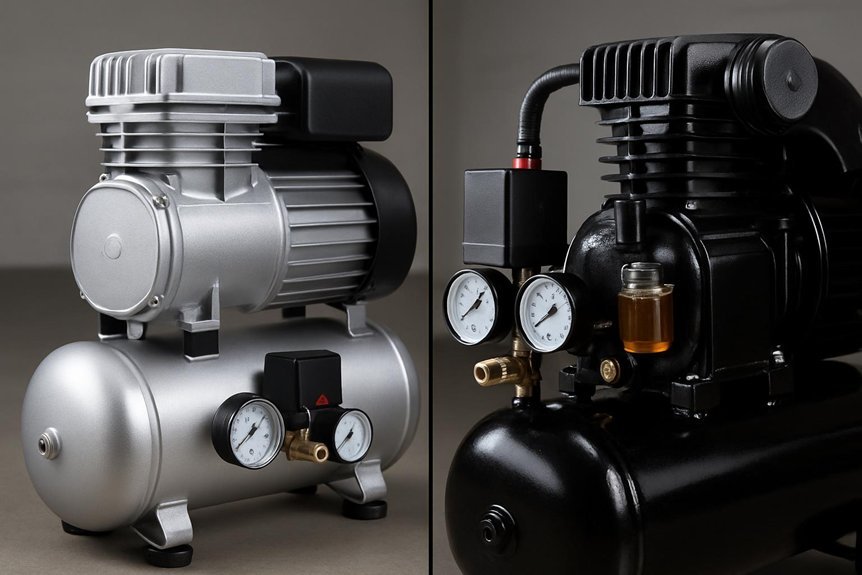
We now compare oil-free and oil-lubricated compressors side by side, grounding the assessment in the objective metrics and test protocols outlined earlier. Our analysis focuses on performance consistency, wear indicators, and lifecycle implications, with emphasis on real-world duty cycles. Oil-free durability emerges as a key differentiator when cycles are high and maintenance windows are tight, while oil-lubed longevity shows resilience under heavy use and extended intervals between service. We present a balanced view, noting that total cost of ownership can hinge on user environment and component quality.
- Comparative wear rates under identical duty cycles
- Maintenance cadence and downtime impact
- Long-term reliability under varied ambient conditions
Air Quality and Maintenance Implications
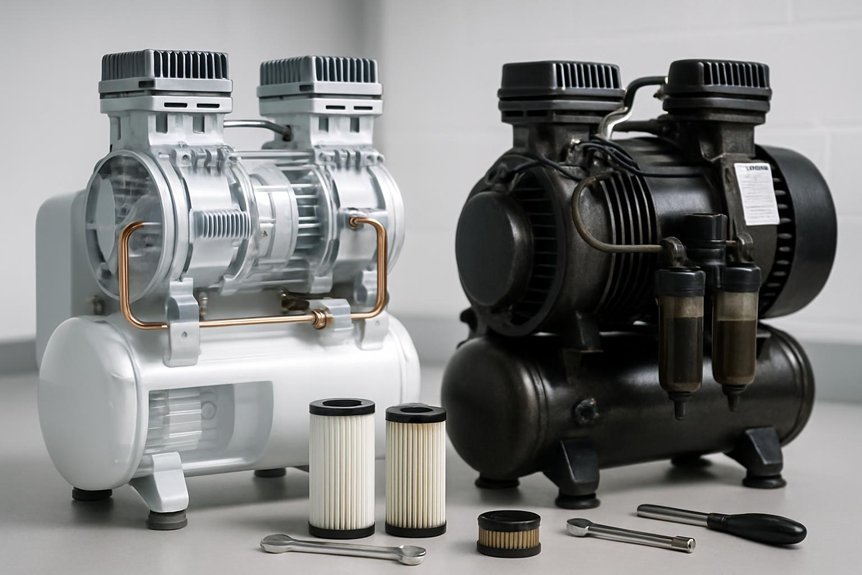
How do air quality and maintenance demands shift between oil-free and oil-lubricated compressors, and what practical implications do these differences have on operation? We examine how oil-free designs inherently reduce oil carryover risk, yielding higher oil purity expectations at point-of-use, while oil-lubricated systems can introduce trace oil that must be managed through filtration and condensate handling. Consequently, oil-free setups simplify downstream air quality controls, but demand tighter monitoring of particulate ingress and humidity. For maintenance cadence, oil-free units favor more frequent filter inspections and filter replacements, whereas oil-lubricated models prioritize crankcase oil health, cooler maintenance, and condensate drainage. Overall, we balance filtration integrity, moisture control, and seal wear, ensuring consistent air quality and operational reliability.
Total Cost of Ownership Compared
Total cost of ownership (TCO) for oil-free versus oil-lubricated air compressors hinges on more than upfront purchase price. We analyze operating costs, reliability, and maintenance cadence to determine true value differences. Oil free systems eliminate oil leaks and filtration overhead but may incur higher filter and membrane replacements and potential energy penalties from tighter tolerances. Lubricated units often show lower friction losses and longer intervals between service events, yet require continuous oil management and periodic changes that add cost and downtime. Our goal is to quantify tradeoffs across lifecycle stages and equipment duty cycles.
- Maintenance and part costs
- Energy consumption patterns
- Downtime and reliability impact
Oil free and Lubricated options each present distinct TCO curves; choose based on exposure, uptime goals, and total required throughput.
Best Use Cases by Shop Type
We compare oil-free and oil-lubed compressors to determine the best fits for different shop environments. We’ll map oil-free durability scenarios, oil-lubed longevity considerations, and shop-type performance matches to practical use cases, highlighting where each design minimizes maintenance and maximizes reliability. This framework guides precise selection based on workload, space, and operational constraints.
Oil-Free Durability Scenarios
Oil-free compressors excel in durability when run in environments that demand low maintenance and minimal contamination risk. We quantify oil-free durability by consistent output, reduced contamination incidents, and predictable wear patterns, especially in moderate duty cycles. Our analysis shows lubrication free wear is minimized where seals and diaphragms handle moisture without oil carryover, and where filtration maintains air purity. In shop categories prioritizing cleanliness, oil-free units reduce maintenance overhead and downtime, enabling steadier performance over time. However, durability hinges on ambient conditions, duty cycle, and component quality.
- Low contamination environments yield fewer rework cycles
- Filtration and moisture control maximize lubrication free wear resistance
- Stable duty profiles preserve long-term efficiency and reliability
Oil-Lubed Longevity Considerations
Oil-lubed systems offer longevity advantages in shops with higher duty cycles, tougher operating conditions, or where continuous duty and downstream air quality demand robust wear resistance. We assess longevity by examining wear-prone components, thermal management, and lubricant retention under load. Durability claims for oil-lubed setups emphasize improved piston rings, crankcase protection, and valve train stability, especially in sustained cycling environments. Relative to oil-free designs, oil-lubed compressors benefit from a structured maintenance cadence that targets oil quality, filter integrity, and sump cleanliness, reducing abrasive ingress and oxidation risk. We quantify life expectancy through Mean Time Between Failures (MTBF) and service intervals derived from temperature profiles and duty patterns. Given these metrics, selection should align with expected duty cycle, ambient conditions, and the shop’s maintenance capabilities to ensure reliable performance.
Shop Type Performance Matches
What shop type do you operate in when oil-free versus oil-lubed air compressors truly matter? We analyze performance matches by environment and workload, focusing on reliability, maintenance cycles, and total cost of ownership. Oil free durability drives contamination resistance in cleanroom-adjacent or dust-prone spaces, while oil lubed longevity supports long-running tools in high-cycle production lines. Our assessment targets operational consistency, where compressor selection aligns with duty cycle, air quality specs, and downtime sensitivity.
- Duty cycle alignment with shutdown margins
- Air quality and filtration compatibility
- Maintenance cadence and part availability
In practice, oil free durability and oil lubed longevity guide shop-type choices, ensuring stable output, predictable service intervals, and minimized rework across diverse applications.
Quick Decision Framework for Your Situation
We start with a concise comparison of Quick Comparison Factors to map your needs against oil-free and oil-lubricated options. We’ll align Suitability By Use to shop type, required air quality, maintenance tolerance, and cost impact, so you can see where each choice fits. This framework keeps our discussion sharp, data-driven, and oriented toward practical decision points.
Quick Comparison Factors
Are you weighing oil-free against oil-lubricated air compressors, and need a quick decision framework that maps your priorities to concrete factors? We present a concise set of comparison levers, focusing on how each option aligns with performance, maintenance, and total cost of ownership. Our framework highlights durability comparisons and lubrication mechanics as core determinants, while translating specs into actionable choices.
- Long-term maintenance footprint
- Filtration and oil handling requirements
- Downtime risk and reliability under load
We treat each factor with precision: oil-free units minimize contamination pathways and simplify upkeep, but may exhibit different endurance under heavy cycles; oil-lubricated models offer robust lubrication mechanics and proven longevity in demanding applications. Our framework helps you quantify trade-offs without guessing outcomes.
Suitability By Use
Suitability by use hinges on aligning compressor characteristics with your operational demands and environment. We assess oil free and oil lubricated options by mapping performance to duty cycle, air quality, and maintenance load. Oil free units minimize contamination risk and simplify filtration, but may trade peak efficiency and longevity under high-duty loads. Oil lubricated systems offer robust wear resistance and extended life at sustained pressures, yet introduce potential contaminant pathways requiring filtration and oil management. Consider your production rate, humidity, and ambient temperature to determine acceptable leakage, condensate handling, and emission constraints. For clean facilities or food/pharma contexts, oil free often yields lower risk profiles, while high-throughput, continuous operation benefits from oil lubricated reliability. We recommend a needs-focused comparison matrix to guide selection, aligning material specs, warranty terms, and total cost of ownership.
Frequently Asked Questions
How Do Noise Levels Differ Between Oil-Free and Oil-Lubricated Models?
We hear that noise levels differ: oil-free models tend to run louder due to unlubricated components, while oil-lubricated units smooth vibrations; this is the noise comparison we analyze, though lubrication differences can also affect resonance and tonal characteristics.
Are There Health Risks From Oil-Free Compressor Emissions?
Yes, there are health concerns, but we address them directly. We’re confident that oil-free health risks are minimized when emissions safety standards are met, ensuring safe operation and compliant filtration for workers and environments.
Can Oil-Free Units Reach the Same Pressure as Lubricated Ones?
Yes, oil-free units can reach similar pressures as lubricated ones; however, lubrication affects long-term reliability and sealing. In oil free vs lubricated performance, we quantify efficiency, duty cycle, and temperature to determine suitability for demanding tasks.
What Maintenance Tasks Are Unique to Oil-Free Systems?
We’ll picture a clean room, bolts gleaming—unique maintenance tasks for oil-free systems include inspecting filters, replacing cartridges, and checking seals; we monitor lubricant contamination risks, ensuring moisture levels stay low and condensate traps function correctly.
Do Oil-Free Compressors Require Special Air Filtration or Storage?
Yes, oil-free compressors require dedicated oil-free filtration and careful ambient storage considerations. We analyze filtration efficiency and storage conditions, saying we should use oil free filtration compatible components and assure ambient storage minimizes moisture and contaminants for reliability.
Conclusion
We’ve weighed oil-free and oil-lubricated options, balancing duty cycles, air quality, and maintenance. For cleaner environments, oil-free minimizes contamination but may raise filter costs; for heavy, continuous use, oil-lubed offers durability and lower friction losses despite oil management needs. Our framework guides you to match your shop’s profile, budget, and downtime tolerance. In short, choose the path that aligns with your operational tempo—quality without compromise, or longevity with disciplined maintenance—each trade-off shaping your ownership horizon.