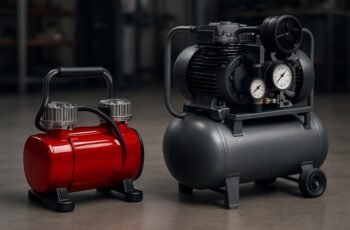
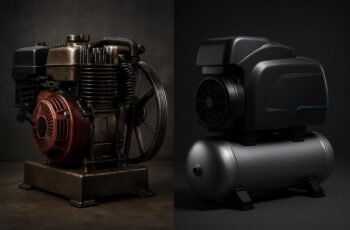
We’ll break down pancake versus hot dog compressors by how they deliver air, run time, and real-world usability, focusing on task duration, noise tolerance, and pressure needs. We’ll compare airflow, tank size, and portability with a practical eye for tires, brad-nailing, and light spray work. The goal isn’t just specs but how these tools meet your project demands, cost, and value. Tune in as we outline a decision framework you can apply to your next task.
Key Takeaways
- Pancake compressors offer compact storage and light-duty use, while hot dog models provide longer runtimes and better accessory compatibility.
- Compare CFM under load, tank size, and duty cycle to judge real-world performance over simple size.
- Noise, weight, and handle ergonomics influence portability and comfort during extended use.
- Use cases: inflating tires/goods favor pancake; framing or high-volume nailing benefits from hot dog’s bursts.
- Total cost of ownership matters: pancakes are cheaper upfront but may require more replacements; hot dogs trade higher initial cost for reliability.
Pancake vs Hot Dog: What They Are and When to Use Each
Pancake air compressors and hot dog air compressors differ primarily in form factor and how you’re likely to use them. We’ll compare their shapes, typical applications, and the implications for portability and stability. In practice, pancake vs hot dog models favor compact storage and quick tasks, but they diverge in air delivery efficiency and duty cycle for sustained work. For casual, light-duty inflations and quick repairs, the pancake form often suffices, minimizing bulk without sacrificing reliability. In contrast, hot dog units tend to offer longer runtime between charges and better accessory compatibility, supporting intermittent use on small projects. Be wary of compressor myths—size isn’t the sole indicator of capability. Choose based on task duration, noise tolerance, and required pressure, not popularity.
Key Specs: Airflow, Tank Size, and Runtime
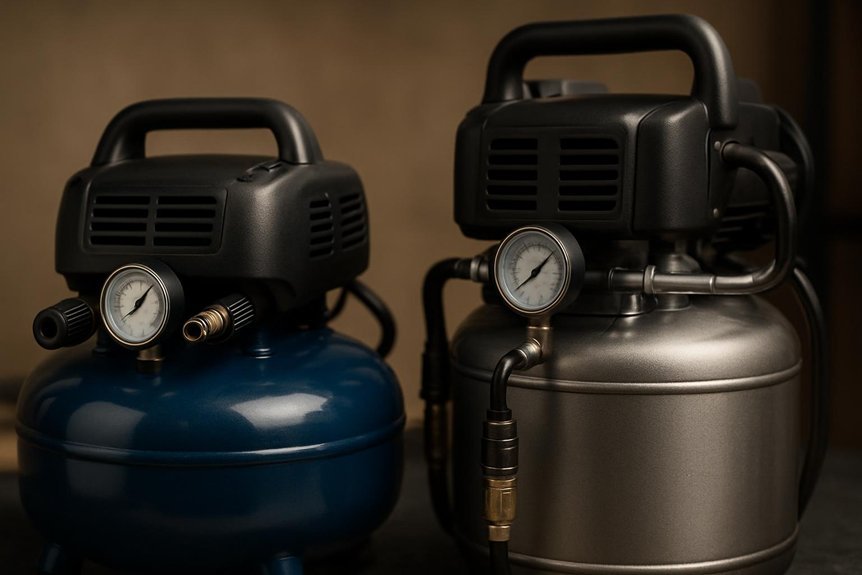
When we compare pancake and hot dog models on key specs, airflow, tank size, and runtime become the deciding factors for sustained tasks. We focus on objective performance metrics to guide selection, avoiding fluff while delivering actionable comparisons. Our analysis highlights airflow differences, tank capacity, and runtime implications for real work.
1) Airflow differences: CFM under load, steady deliverables, and regulator behavior influence finish quality.
2) Tank capacity: Larger tanks sustain bursts longer, reducing cycle starts and heat generation risk.
3) Runtime efficiency: Duty cycle and auto-shutoff settings determine continuous usability.
4) System tradeoffs: Pancake units favor portability with modest airflow, hot dog models offer higher sustained output at cost of bulk.
Noise, Portability, and Real-World Usability
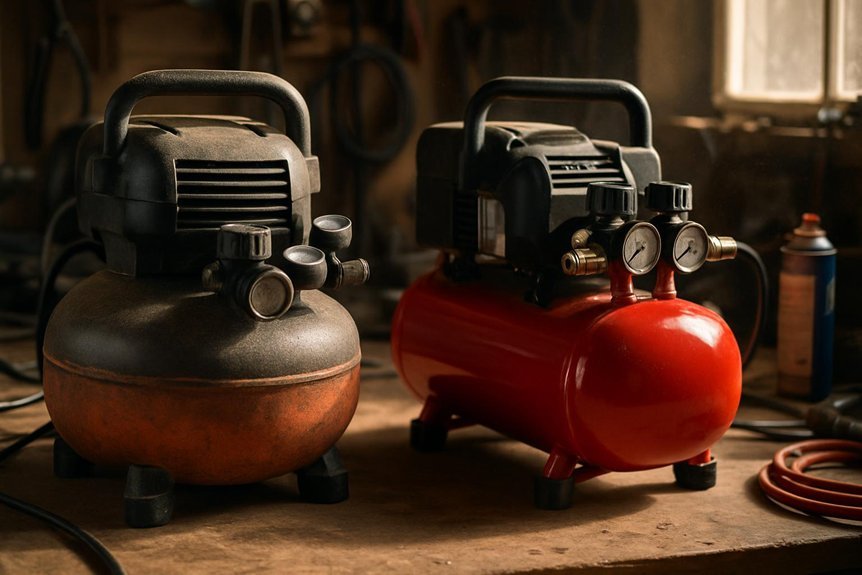
How much does noise level and portability shape real-world usability? We compare both models through a practical lens, focusing on how sound output and weight influence field performance. Our noise comparison centers on decibel ranges during typical tasks, noting that lower noise aids communication, reduces fatigue, and enables use in noise-sensitive environments. We then assess portability benefits, examining handle ergonomics, overall weight, and footprint when stored or transported between sites. We quantify impact on setup time, tool-cabinet fit, and adjacent equipment interaction, avoiding unnecessary fluff. Real-world usability emerges from a balance: adequate air delivery with minimal vibration, and a form factor that supports quick relocation. Both factors collectively determine user satisfaction, efficiency, and continuous operation.
Best Tasks for Each: Inflating, Nailing, and Light-Duty Jobs
In practical terms, inflating routine items, nailing tasks, and light-duty applications map to distinct duty cycles and delivery needs for pancake and hot dog compressors. We compare capability, efficiency, and control to match task demands, not just capacity.
- Inflating tires and sporting goods aligns with moderate CFM and steady pressure, leveraging pancake durability for consistent performance.
- Nailing light trim or fasteners benefits from precise, low-oz startup bursts and controlled delivery, where hot dog versatility shines in compact, accessible setups.
- Light-duty sanding or brad-nailing requires quick responsiveness and minimal run-time without overheating.
- Small spray or inflating air tools demand stable pressure and rapid refill cycles, favoring a design that tolerates frequent cycling.
Together, these tasks reveal how each tool’s strengths suit specific, minimal-load workflows.
Price, Availability, and Value for DIYers
Pancake and hot dog compressors differ markedly in price, availability, and value to DIYers, and those differences hinge on build quality, motor size, and intended duty cycles. We assess cost structures, sourcing, and resale value to quantify total cost of ownership. Pancake economics, driven by compact cast components and simpler motors, yields lower upfront prices but tighter duty cycles, affecting long-term efficiency and replacement risk. Hot dog value reflects higher materials tolerance, larger motors, and extended runtimes, which raises initial outlay yet improves reliability for continuous tasks and faster recovery. Availability varies by retailer, with broader stock for standard ports and consumer brands. We recommend aligning purchase choice with project tempo, expected duty cycles, and anticipated lifecycle costs rather than base price alone.
Quick Decision Framework: Pick the Right Tool for Your Projects
Are you selecting the right tool for the job based on real-world usage, not just price tags? We’ll apply a concise decision framework to choose between pancake design and hot dog form factor tools by project requirements, performance, and lifecycle costs. Our approach emphasizes measurable criteria, not impression.
- Define workload: continuous duty vs. intermittent bursts, CFM and PSI targets.
- Assess form factor trade-offs: portability, storage, vibration, and noise tolerance.
- Match maintenance profile: seal life, filter access, and service intervals.
- Evaluate total cost of ownership: initial price, energy use, repairs, and replacement cadence.
Frequently Asked Questions
Which Scenarios Maximize Pancake Air Compressor Efficiency?
We maximize pancake efficiency in short, intermittent runs with light loads; operate within rated CFM at appropriate pressure, avoid overloading, and maintain duty cycles. Also consider hot dog durability for system resilience under cycling, startup stresses, and heat.
How Do Hot Dog Compressors Handle High-Demand Tasks?
We, hot dog vs pancake, handle high demand by sustaining output with larger displacement and robust duty cycles, though heat and airflow limits constrain runtime. We monitor pressure, duty, and temp to prevent stalls during high demand.
Are Maintenance Requirements Different Between the Two Types?
Maintenance differences exist: pancake units typically require more frequent lubrication checks and filter changes, while hot dog compressors emphasize seal integrity and oil quality. We monitor lubrication needs closely and document deviations to prevent performance declines.
Can Either Handle Continuous-Use Projects or Only Intermittent Jobs?
We can handle continuous use only with models designed for high demand; pancake compressors typically struggle under continuous use, whereas hot dog units may manage higher duty cycles, though both require cooling, oversized tanks, and proper duty ratings.
What Safety Considerations Apply to Both Compressor Types?
We should tread carefully: safety labeling guides us, and hot surfaces demand respect. We consider both compressors’ safeguards, including guarding, overheat alarms, and proper shutdowns; we’ll keep hands clear of hot surfaces and follow labeling instructions.
Conclusion
We stand with you at the crossroads of air and effort, where each choice inflates your project’s future. Like a piston and a bellows, pancakes and hot dogs symbolize balance—portability versus endurance, speed versus stamina. We’ve mapped their strengths, so you won’t misread the gauge. Choose the pancake for quick, light tasks; the hot dog for steady, bulk work. In every fill, remember: the right tool expands your possibilities while honoring your time and budget.