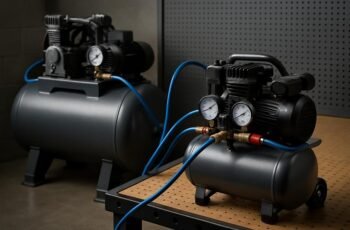
We don’t want to pretend there’s a simple winner here, but the choice between rotary screw and piston compressors hinges on duty cycle, pressure needs, and total cost of ownership. We’ll compare continuous versus intermittent demands, steady efficiency versus fast-response regulation, and maintenance implications. This discussion will expose where each type excels and where trade-offs appear, leaving you with a framework to assess your exact workflow and space constraints before you decide.
Key Takeaways
- Rotary screw delivers continuous, steady flow with low pulsation, ideal for constant-load applications; piston delivers high-pressure bursts for intermittent, peak demands.
- Rotary screw is efficient for prolonged runs but struggles at light loads; piston excels with accurate regulation under sporadic, high-pressure needs.
- Piston compressors require dampening of pulses and are better suited for variable duty and tight pressure control.
- Maintenance planning and downtime minimization differ: rotary screws favor data-driven condition monitoring; pistons rely on precise cycle timing and regulator upkeep.
- Consider total cost of ownership, footprint, and noise: rotary screws are typically quieter and space-efficient for steady production scenarios.
Rotary Screw vs Piston: Core Differences and Use Cases
Rotary screw and piston compressors both convert electrical energy into compressed air, but they achieve this in fundamentally different ways and suit different operating profiles. We assess core differences by considering capacity, efficiency, and control. Rotary screw units provide continuous, steady flow with low pressure fluctuations, making them ideal for constant-load applications and long run times. Piston compressors, by contrast, deliver high pressure in short bursts and excel under intermittent duty or peak demands. In terms of efficiency, rotary screw systems typically struggle to maintain peak efficiency at light loads, while piston configurations can optimize for higher compression ratios when cycles are infrequent. Use-case alignment matters: we favor rotary screw for constant, steadier output and piston compressor for variable, demand-driven needs.
How Each Type Works: Rotary Screw Mechanics and Piston Reciprocation
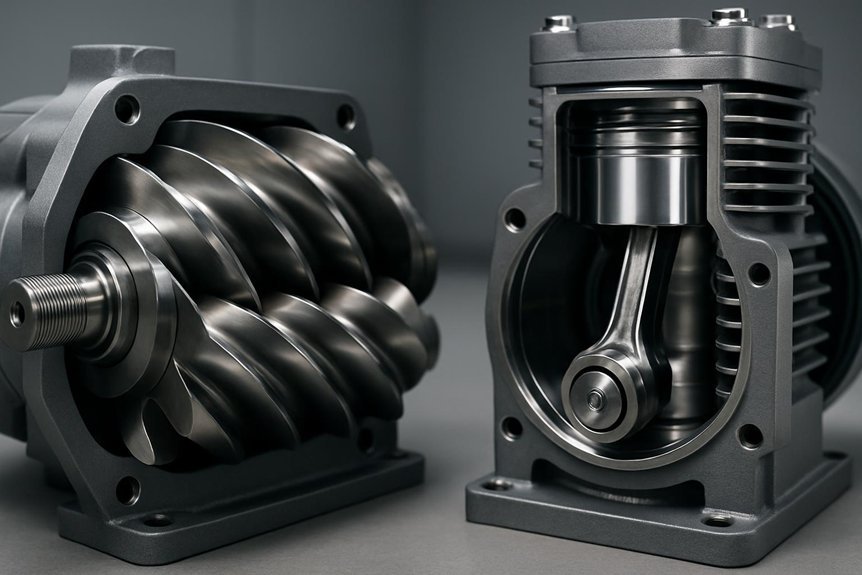
We next examine how each type actually achieves compression, focusing on rotary screw mechanics and piston reciprocation. In a rotary screw system, two meshing rotors trap and move air from intake to discharge, creating sealing chambers that reduce clearance and generate pressure as the rotors rotate in sync. This continuous, positive-displacement action avoids dead zones and sustains steady flow under variable demand. By contrast, a piston compressor uses reciprocating motion: a crank-driven piston travels within a cylinder, alternately drawing in intake gas and compressing it during the return stroke, delivering pulses that require dampening. We assess efficiency via the piston comparator, which contrasts effective displacement against volumetric losses, identifying where leakage, clearance, and valve timing impact performance. Both approaches rely on tight tolerances and robust sealing to maximize compression.
Decision Framework: When to Pick Rotary Screw for Continuous Air
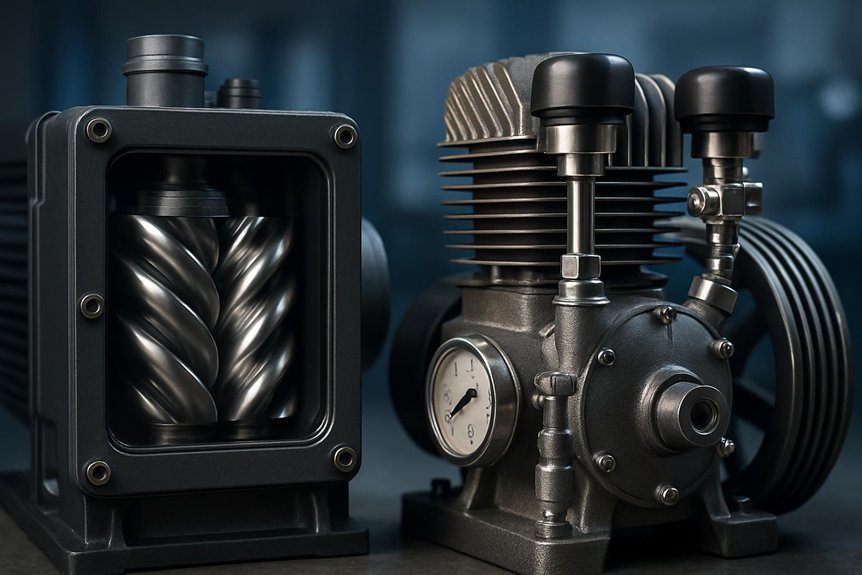
Is continuous production a decisive factor for choosing a compressor type? We analyze reliability, run-time demands, and total cost of ownership to frame a decision. For continuous duty, rotary screw units offer stable flow with lower pressure pulsation, reducing process variability and downstream equipment cycling. We quantify maintenance budgeting by projecting mean time between failures, service intervals, and spare-part costs, then compare to piston-based solutions under sustained load. Noise considerations matter in enclosed facilities; rotary screws typically sustain quieter operation at full load due to smoother compression. We also assess energy efficiency during prolonged runs, startup inertia, and purge losses. Our framework prioritizes consistent airflow, predictable maintenance, and lifecycle economics, guiding when a rotary screw is the optimal compromise for uninterrupted production.
Decision Framework: When to Pick Piston for Intermittent High Pressure
We start by outlining intermittent high-pressure needs, where piston systems can offer straightforward, high-PSI bursts with predictable cycling. We’ll weigh piston reliability over time against operability demands and maintenance cadence to assess total cost of ownership. Finally, we compare operating costs and call out how reliability and duty-cycle limits influence the choice for sporadic high-pressure tasks.
Intermittent High-Pressure Needs
When intermittent high-pressure demands arise, the piston compressor often becomes the preferred choice due to its ability to deliver brief, peak pressures with tight regulation. In this section, we analyze how intermittent use aligns with piston design, emphasizing rapid pressure spikes and controlled cutoffs. We contrast with rotary screws, which sustain volume rather than peak load, and we highlight efficiency implications during short-duty cycles. Our focus remains on decision criteria, not long-term reliability, ensuring precise pressure control in high-pressure mode operation. We assess cycle timing, regulator accuracy, and compressor sizing to meet transient requirements without overshoot. This framework helps identify when piston units deliver superior peak performance for targeted tasks.
- Accurate response to transient demand
- Tight regulation during brief high-pressure mode
- Proper sizing to avoid overshoot and cycling
Piston Reliability Over Time
How does piston reliability evolve under intermittent high-pressure duty, and what decision criteria should guide choosing pistons for short-duty, high-peak cycles? We present a concise assessment of piston reliability over time under these loads. We observe that short, high-peak bursts stress piston rings, gudgeon pins, and material interfaces differently than continuous duty, influencing fatigue progression and surface wear. Our framework emphasizes material compatibility, proper clearance, and lubrication regime stability to sustain piston reliability across cycles. We evaluate rotary longevity risks, including crest-factor loading, thermal transients, and ring-seat micro-motions that can accelerate wear. System selection should balance component hardness, coating options, and serviceability, ensuring predictable performance. In summary, targeted design margins and robust lubrication preserve piston reliability and protect overall compressor response during intermittent high-pressure operation.
Operating Cost Implications
Is the up-front cost trade-off justified by long-run operating expenses when selecting pistons for intermittent high-pressure duty? We assess operating cost implications by comparing energy usage, maintenance cycles, and downtime impact. Piston systems often incur higher efficiency tradeoffs at high pressures, increasing electric consumption during peaks while rotor-based units may outperform in duty cycles with steadier loads. We weigh capital costs against long-term savings from reduced load fluctuations, oil handling, and component wear. The decision hinges on load profile, maintenance accessibility, and part pricing. In intermittent scenarios, pistons may win when peak pressure dominates only briefly, but overall operating cost may favor rotaries when duty is frequent or extended. Careful modeling of annual energy, parts, and downtime clarifies the optimal choice.
- Key cost drivers: energy, maintenance, downtime
- Efficiency tradeoffs vs duty cycle
- Break-even horizon assessment
Key Metrics You Must Compare: CFM, PSI, Efficiency, and Duty Cycle
Key metrics like CFM, PSI, efficiency, and duty cycle are the benchmarks we use to compare rotary screw and piston compressed air systems. We frame CFM as available flow at a given pressure, and PSI as the system’s pressure target, since real-world use hinges on both delivery and constraints. Efficiency measures, typically specific power or kilowatts per CFM, reveal energy cost per output unit. Duty cycle reflects utilization stability and allowable continuous operation versus load variability. We assess how each compressor maintains target CFM at required PSI with minimal energy waste and cycling. Our discussion ideas focus on concrete, measurable performance rather than marketing claims, ensuring apples-to-apples comparisons. We invite readers to weigh how these metrics translate to reliability, cost, and operational predictability.
Maintenance and Longevity: Downtime, Wear Parts, and Service Intervals
We’ll outline how downtime minimization and a disciplined wear-parts replacement schedule impact overall reliability and operating cost. We’ll compare proactive maintenance vs reactive fixes, quantify spare parts readiness, and define service intervals tied to runtime, load, and environment. This sets the foundation for choosing maintenance practices that maximize mean time between failures for both rotary screw and piston systems.
Downtime Minimization Strategies
Downtime minimization hinges on proactive maintenance and clear interval planning, because predictable service reduces unplanned outages and prolongs compressor life. We approach downtime as a systems issue, focusing on data-driven intervals, condition monitoring, and disciplined traceability. Our method weighs component aging, load profiles, and vibration signatures to optimize service timing without over-maintenance. We distinguish critical wear parts from nonessential concept items, prioritizing guardrails that minimize disruption while preserving performance. Our goal is to reduce event-driven failures and align maintenance with actual wear rather than calendar-only schedules, avoiding irrelevant topic distractions during planning. By documenting results and adjusting baselines, we maintain reliability and predictable production cycles.
- Establish data-driven service windows with clear ownership
- Implement vibration and thermal trend analysis for timing
- Schedule audits that distinguish essential vs irrelevant topic maintenance tasks
Wear Parts Replacement Schedule
What governs wear parts replacement timing is a data-driven balance between reliability and cost, ensuring replacements occur before failure without triggering unnecessary downtime. We approach the wear parts strategy with a systematic lens, mapping failure modes to inspection intervals and part life expectancies. Our replacement schedule prioritizes critical components first, such as seals, filters, and vanes, then lesser wear items based on historical wear rates and operating conditions. We couple condition monitoring with manufacturer guidelines, comparing actual runtimes, pressures, temperatures, and vibration to thresholds. By documenting mean time between failures and service intervals, we optimize uptime while controlling spare inventory. This disciplined approach minimizes unplanned outages, extends compressor longevity, and yields clearer maintenance calendars for both rotary screw and piston configurations. Wear parts management remains integral to overall cost efficiency.
Cost and Space Considerations: Upfront Price, Operating Cost, and Footprint
When evaluating cost and space, the upfront price, ongoing operating costs, and physical footprint must be weighed together to avoid hidden expenses and misaligned expectations. We compare total cost of ownership, factoring maintenance, energy efficiency, and service intervals, then translate footprint variance into space planning for install and access. cost contrast emerges as a practical metric: upfront capital versus long-run savings from efficiency gains and reduced downtime. We quantify compressor class, warranty terms, and lifecycle costs to minimize surprises. Footprint considerations include service clearances, noise zoning, and venting requirements, reducing retrofit risk. Aligning these elements early prevents overcommitment and underutilization.
- Upfront vs. lifecycle costs and energy efficiency
- Footprint variance and layout implications
- Maintenance impact on total cost of ownership
Quick Match Guide: Align Your Tools, Workflow, and Space With Your Choice
In choosing between rotary screw and piston compressors, we start with a quick match grounded in tool, workflow, and space alignment: we map how each unit’s duty cycle, start/stop behavior, and maintenance cadence fit our process timings and accessibility constraints. We evaluate compatibility with existing tooling batches, ambient conditions, and maintenance windows to minimize downtime. Our assessment weighs noise level implications for operator environments and facility zoning, ensuring alignments don’t erode productivity. We also compare cooling requirements, particularly for continuous or high-demand runs, to prevent thermal throttling. By correlating start/stop patterns with shift cycles and serviceability, we identify which model preserves takt times and simplifies scheduling. The outcome is a precise, actionable fit that reduces waste and sustains reliability.
Frequently Asked Questions
How Long Do Rotary Screws Typically Run Before Major Service?
We typically schedule major service after 8,000 to 12,000 hours of operation, depending on load and oil quality, to inspect durable bearings and guarantee proper airend cooling remains effective, preventing wear and optimizing reliability.
Can Piston Compressors Deliver Continuous High Airflow Without Overheating?
Typically, piston compressors can deliver high airflow briefly but not continuously without overheating; piston limits become evident, while rotary efficiency sustains reliability. We juxtapose raw output against thermal risk, guiding you toward sustained performance and safer duty cycles.
Do Rotary Screws Require Oil Management for Duty Cycles?
We do: yes, rotary screws require oil management for duty cycles. Oil-free vs oil-lubricated matters, and maintenance scheduling is critical to avoid overheating and assure stable flow during varied loads. We monitor sump levels and filter health continuously.
Which Compressor Type Handles Humidity and Temperature Swings Better?
Humidity challenges and temperature swings are better managed by rotary screw systems; we handle these with robust control. Like a weathered compass, we stay precise, analyzing performance to minimize variance under humidity challenges and temperature swings.
Are Noise and Vibration Levels Higher in Pistons or Rotaries?
Pistons produce higher noise and more pronounced vibration patterns than rotaries; the noise comparison shows sharper spikes, while rotaries offer smoother operation. We assess damping and mounting to reduce vibration impacts across varying load and temperature conditions.
Conclusion
We conclude with clear, concise consistency: choose rotary screws for reliable, relentless, refined reliability in continuous loads, and pistons for precise, pulsatile pressures under intermittent demands. With duty cycles, pressures, maintenance, and costs in mind, match machinery to motive, maximize efficiency, and minimize downtime. Prioritize performance, predictability, and footprint in your framework. Weigh wear parts, warranties, and maintenance windows, then wield the right tool for the work—optimizing output, uptime, and overall ownership.