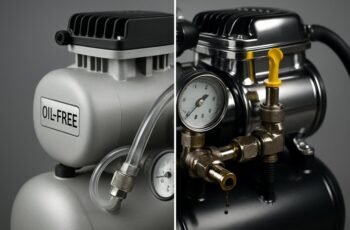
Like two engines pulling toward different horizons, stationary and portable air compressors each promise reliability in its own lane. We’ll weigh endurance, capacity, and mobility to match workload patterns with system design, from tank size and efficiency to setup time and electrical needs. The choice hinges on continuous vs. on-site use, noise, space, and total cost of ownership. We invite you to contemplate where your priorities lie and what trade-offs matter as we explore options further.
Key Takeaways
- Stationary compressors offer continuous, higher CFM at steady pressure for fixed workloads; portable units prioritize mobility and quick deployment with lighter electrical needs.
- Stationary systems use larger tanks and robust cooling to sustain performance, while portable models have smaller reservoirs and sharper pressure fluctuations.
- Choose stationary for reliability, lower refill frequency, and easier maintenance; choose portable for on-site jobs, space efficiency, and quieter operation.
- Endurance and spare parts matter: stationary units emphasize durability and serviceability; portables emphasize compact design and easy transport.
- Budget, space, and noise drive the decision: stationary suits workshops; portable suits job sites with space and noise constraints.
Stationary vs Portable Compressors: Which Fits Your Projects?
Choosing between stationary and portable air compressors hinges on how you plan to use compressed air. We assess project scope, mobility needs, and space constraints to determine fit. Stationary units excel in continuous duty, delivering steady CFM at consistent pressure, while portable units prioritize maneuverability and rapid deployment. Noise levels vary by design, with larger tanks and slower cycling typically producing lower peak noise but extended operation, and compact models generating higher brief spikes. We also consider refilling intervals; stationary systems often have larger reservoirs and higher-efficiency compressors, reducing refill frequency during extended sessions. For multi-tool workshops, stationary offers reliability and reduced downtime, whereas fieldwork benefits from portability and quick setup. In sum, choice hinges on workload duration, environment, and required uptime.
How Stationary Compressors Work: Mechanisms, Motors, and Plumbing
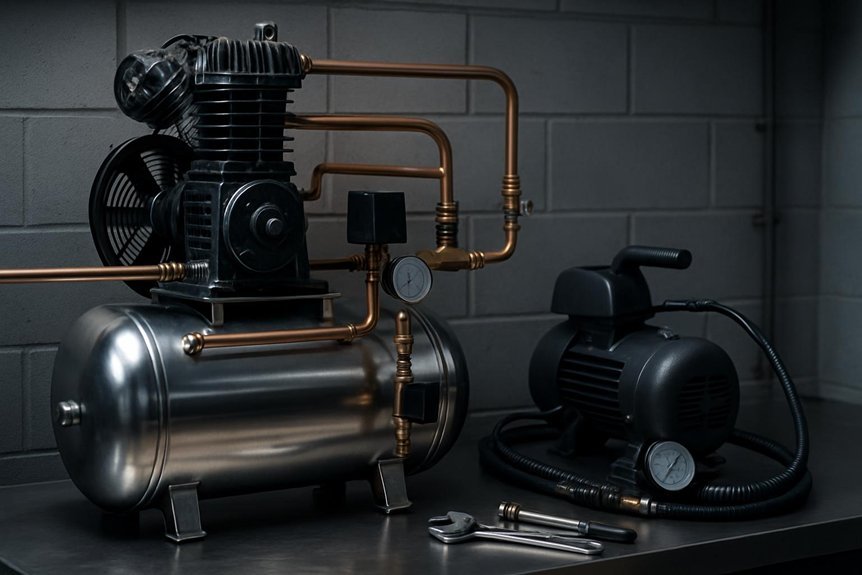
To power stationary compressors, we must look beyond portability and focus on how they generate and sustain air pressure. We analyze the core mechanisms: reciprocating or rotary elements compress intake air, delivering it into a receiver at a controlled pressure. Cylinders, pistons, and valves regulate intake, compression, and discharge cycles, while interstage cooling reduces heat and improves efficiency. Motors provide the torque, with direct-drive or belt-driven configurations affecting vibration, maintenance, and reliability. Plumbing networks, including check valves, regulators, and moisture separators, maintain pressure stability and air quality, minimizing losses. The result is quiet operation when designed with balanced compression, silencing cavities, and smooth-start electronics. Oil free benefits, when applicable, reduce contamination risk, simplify maintenance, and enhance oil-free air purity for certain applications.
How Portable Compressors Work: Mechanisms, Motors, and Plumbing
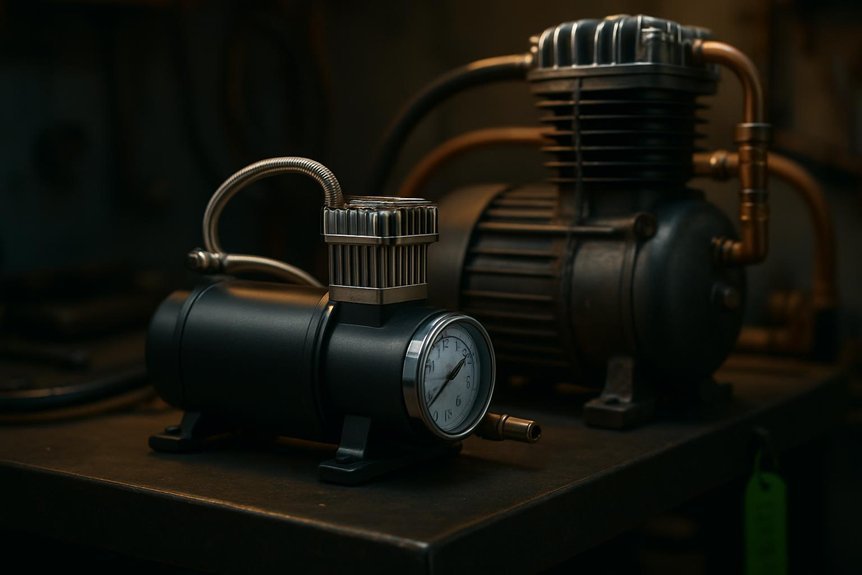
How do portable compressors deliver usable air without sacrificing mobility? We examine compact pressure vessels, inline filters, and integrated regulators that shape air output. In practice, a piston or diaphragm pump draws intake air, compresses it, and stores it in a tank sized for hand-portable use. Motors vary from brushed DCs to brushless configurations, chosen for efficiency, start‑up torque, and heat management. Transmission systems—direct drive or belt-driven—determine mechanical load and vibration profiles, influencing stability during operation. Onboard lubrication, seals, and relief valves protect components and maintain consistent discharge. Plumbing paths route air through regulators, gauges, and optional moisture traps, enabling precise pressure delivery. We assess vibration reduction and noise attenuation implementations as key factors affecting usability in mobile settings.
Pressure and CFM: Real-World Expectations by Type
We’ll examine how pressure consistency, CFM during real use, and type-specific performance diverge in practice. Our focus is on how stationary and portable models meet or miss ideal specs under load, and what that means for sustained tool use. By comparing these factors, we clarify practical expectations for each type.
Pressure Consistency Expectations
Pressure consistency in air compressors hinges on how CFM delivery tracks with regulator setting and load fluctuations. We compare stationary and portable models by how their pressure holds under varying demand and duty cycles, not just peak ratings. Our focus is predictable performance in real work, including short surges and steady runs, while mitigating downstream effects like dust management and noise levels.
1) Regulator response time and hysteresis determine how quickly target pressure is achieved and maintained.
2) Staged compressors versus single-stage impact on droop under high CFM, with duty-cycle awareness.
3) Tank size, venting behavior, and intake filtration influence recovery after bursts and long idle periods.
These factors shape practical reliability, efficiency, and control without unnecessary complexity.
CFM Real-World Differences
Despite nominal CFM ratings, real-world performance hinges on how pressure and flow interact under load. We analyze how stationary and portable units deliver air when tools demand surge, noting that CFM is not a fixed value across duty cycles. The interaction governs tool responsiveness, leak losses, and cycle efficiency, with stationary models often sustaining steadier flow at higher pressures and portable units showing sharper drops under load. Key factors include compressor sizing, pressure switch hysteresis, and motor start-up behavior. We also consider fasteners reliability and noise considerations as operational constraints that shape perceived performance.
| Type | Under Load CFM retained | Pressure stability |
|---|---|---|
| stationary | High | Consistent |
| portable | Moderate | Fluctuating |
| impact on tools | Reduced response time | Latency aware |
Type Performance Variances
When we compare stationary and portable compressors, the real-world performance hinges on how pressure and CFM respond under load for each type. We frame Type Performance Variances by examining how design, duty cycle, and thermal behavior shape regulation curves, delivering precise expectations for shop tasks and persistent, irrelevant topic distractions. Our focus stays technical, not rhetorical, treating each variant as a controlled data set rather than a passion project.
- Stationary units typically sustain higher CFM at steady pressure due to larger tanks and slower cycling, reducing fluctuations under continuous draw.
- Portable units often exhibit greater pressure drop under high demand because compact pumps and smaller tanks heat quickly, triggering pressure cuts.
- Efficiency and duty cycle determine real-world CFM stability more than nominal horsepower alone, aligning outcomes with task-specific requirements.
Use Cases by Task: Shop Projects vs On-Site Jobs
What use cases separate shop projects from on-site jobs when selecting a stationary versus portable air compressor? We approach this by matching task profiles to machine attributes. In-shop projects demand steady outputs, minimal transport effort, and predictable duty cycles, favoring stationary units with larger storage, higher CFM, and robust runtime. On-site jobs require mobility, quick setup, and tolerances for irregular workloads, so portable units with lighter curb weights, simpler electrical requirements, and rapid recoveries excel. Noise tradeoffs matter: shops tolerate higher sound levels for sustained power, while on-site work benefits from quieter approaches or localized silencing. Startup reliability becomes critical when cold starts or remote operation are frequent, guiding choices toward units with efficient pressure switch logic and durable startups. Overall, task continuity, mobility, and environmental constraints drive the selection.
Budget, Space, and Maintenance: What to Check Before You Buy
Budget considerations, space constraints, and maintenance needs shape the buy decision as much as performance specs do. We approach this review analytically, tying budget planning and space optimization to long‑term value, reliability, and downtime risk. Before purchase, we quantify total cost of ownership, including warranty, service access, and parts availability. We compare compressors not just by CFM or PSI, but by how maintenance intervals impact uptime and labor. In compact spaces, footprint and heat dispersion matter; in larger shops, electrical load and noise become deciding factors. Our method emphasizes measurable criteria, repeatable checks, and documented expectations to prevent scope creep.
Budgeted reliability: TCO, footprint, and uptime-driven maintenance first.
1) Budget planning: total cost of ownership, warranty, and service access
2) Space optimization: footprint, heat, and placement considerations
3) Maintenance readiness: parts availability, scheduled servicing, and downtime risk
How to Pick Your Right Compressor: A Simple Decision Framework
So, how do we choose the right compressor without overcomplicating the decision? We apply a simple framework: define load profile, assess duty cycle, and align with budget considerations and maintenance priorities. Start by listing required CFM, pressure, and duty duration, then map these to pump type and tank size. Next, weigh noise, footprint, and energy use against space constraints. Finally, connect upfront cost to long-term maintenance and reliability. The table below visualizes tradeoffs across three axes: portability, capacity, and endurance.
| Portability | Capacity | Endurance |
|---|---|---|
| Compact, light | Moderate to high CFM | High-duty drum-based or rotary |
| Quiet operation | Peak demand alignment | Robust build, easy service |
| Mobile use | Tool compatibility | Spare parts availability |
Frequently Asked Questions
How Loud Are Stationary Vs Portable Compressors in Real Use?
We answer: stationary units are louder in continuous running and louder overall, while portable compressors offer quieter operation at lower duty cycles; noise levels depend on cfm, dBA, and cooling, affecting space requirements and compressors noise levels.
Can Portable Units Run Continuously Without Overheating?
Portable units can run continuously with proper protection; however, they’re limited by sustained duty cycle and heat buildup. With continuous cooling, we can extend operation, but short intervals and thermal monitoring remain essential for reliability.
Do Compressors Require Dedicated Circuits or Outlets?
We can’t skip dedicated outlets: compressors need appropriate circuits, especially larger models. We, the guides, view stationary vs portable responsibilities as balance—proper wiring, breakers, and outlets prevent overloads while optimizing performance and safety for continual use.
What’s the True Energy Cost Difference Between Types?
We can’t claim a single universal energy cost, but stationary units often show lower unit energy use per CFM and better duty cycles, enhancing energy efficiency; portable models tend toward higher relative costs. Here’s our energy efficiency cost comparison.
How Do Maintenance Needs Differ by Location Use?
We compare like a clock and compass: maintenance scheduling varies by location use, with stringent schedules in fixed sites and flexible plans on jobsites. We consider noise considerations, lubrication, and environmental access as critical technical factors.
Conclusion
We’ve weighed the facts and tested the theory: your choice isn’t about bigger or smaller, it’s about fit. If your workload is steady and long—think shop floors, continuous air flow, larger tanks—stationary units prove their merit through reliability and efficiency. If you need speed, portability, and quick setup for varied sites, portable models win on flexibility. By sizing to task duration, pressure needs, and space, you unlock predictable performance and lower total costs. Your best compressor is the one aligned with your workflow.