Like a seasoned navigator spotting the first buoy, we gauge your needs before choosing an air compressor. We’ll map tool demands, PSI targets, and peak bursts to a balanced profile of CFM, pressure head, and tank capacity. We’ll weigh portability against shop space, budget, and setting—Hobby, Garage, or Pro—while confirming electrical, ambient, and startup considerations. If we get this alignment right, you’ll avoid short cycling and overdesign—and there’s more to fine-tune as we proceed.
Key Takeaways
- Assess actual needs: list tools and their CFM at required PSI, plus expected duty cycle and peak bursts.
- Match compressor output: ensure nominal CFM meets sustained tool demands and tank size buffers peak usage.
- Consider setting: hobby, garage, or pro shop; bigger tanks and higher CFM for professional, continuous use.
- Check electrical and space constraints: voltage, circuit protection, ambient conditions, noise, and footprint.
- Plan for reliability: startup surges, recovery rate, maintenance needs, and long-term utilization.
Anchor Your Choice: Define Your Needs First
To determine the right compressor size, we must first define your actual needs: what projects you plan to run, how often, and at what pressure and duty cycle. We approach this as a needs assessment, mapping exact usage scenarios to equipment requirements. We analyze primary tools, their peak and average demands, and the cadence of operation within your workflow. By detailing each scenario, we can quantify airflow, pressure stability, and startup surges, then translate those figures into a targeted compressor profile. This framing prevents overdesign and underutilization, improving efficiency and reliability. We emphasize repeatable evaluation steps, documented assumptions, and verifiable thresholds. Our assessment guides a disciplined selection, aligning capacity with intended use while preserving reserve for variability across usage scenarios.
Read These Specs: CFM, PSI, and Tank Size Explained
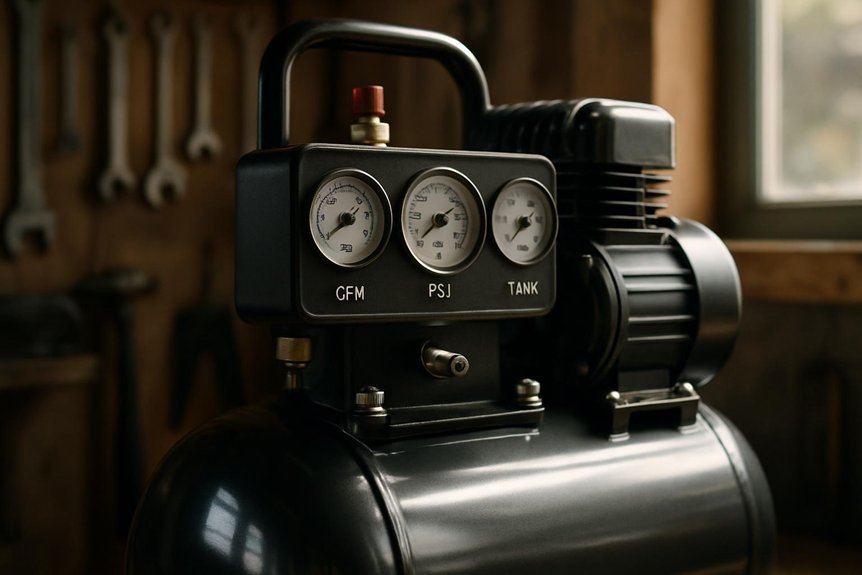
What do CFM, PSI, and tank size really mean for your compressor’s performance? We’llheave it straight: CFM measures volumetric air flow at a given pressure, indicating sustained delivery for tools and finishing processes. PSI indicates usable pressure; it governs how the tool operates and over what distance the flow remains adequate. Tank size reflects stored air capacity, buffering peak demands and minimizing compressor cycling, which affects wear and energy use. To translate specs into performance, we examine how compressors work: a balanced relationship between deliverable CFM, pressure head, and storage, rather than isolated numbers. Safety considerations drive setup, duty cycles, and duty-cycle limits; improper pairing risks overheat or failure. We evaluate specs contextually, ensuring the system meets demand without excessive cycling or risk.
Match Your Tools to the Right Compressor
We analyze tool demands, starting with how each tool’s CFM and duty cycle shape compressor choice. We compare CFM requirements against the compressor’s output to avoid under- or over-sizing equipment. By aligning tool specs with duty cycle and runtime, we set a precise foundation for selecting the right unit.
Match Tool Demands
Matching tool demands to the right compressor starts with identifying each tool’s CFM requirements at the intended operating pressure. We’ll assess peak and sustained demands, then align them with a compressor’s nominal CFM at the target PSI. This guarantees no tool starves for air during critical tasks, whether in a side hustle or renovation projects. We compare duty cycles, tank size, and recovery rates to prevent short cycling. The table below compresses the essential data for quick reference:
| Tool category | Required CFM @ 90 PSI |
|---|---|
| Impact wrench | 4.0 |
| Drill/driver | 3.0 |
| Tool category | Required CFM @ 135 PSI |
| Stapler | 2.2 |
| Sanding pad | 2.5 |
Check CFM Requirements
To ensure you pick a compressor that keeps tools operating smoothly, we start by confirming each tool’s CFM at the target pressure and summing peak versus sustained demands. We then compare those totals to the compressor’s rated CFM at the chosen pressure to avoid under-sizing. Next, we account for real-world variances: line losses, regulator setpoints, and any simultaneous tool usage. This process yields a conservative margin that supports consistent performance. In practice, we prioritize airflow optimization by selecting a unit whose continuous CFM meets or exceeds the aggregated sustained demand. We also assess intake filtration and motor design to minimize pressure drop. By focusing on precise CFM validation, we reduce cycling and improve efficiency, which directly contributes to noise reduction and steadier tool operation.
Consider Duty Cycle
Consider duty cycle when selecting a compressor, because continuous operation isn’t the same as intermittent use. We analyze how runtime affects capacity, duty cycle limits, and recovery time, ensuring the unit meets our tools’ demands without overworking the motor or seals. By mapping expected runtime to compressor duty, we avoid undersizing or overkill. Below, we summarize key runtime considerations and their practical implications.
| Tool/use case | Recommended duty cycle alignment |
|---|---|
| Impact wrench runs | Moderate duty cycle; short bursts, allow cool-down |
| Sanding/grinding | High duty cycle; continuous or near-continuous use |
| Nail guns | Intermittent bursts; moderate duty cycle preferred |
| Blowing/airing out | Low to moderate duty cycle; intermittent operation |
Portable vs. Stationary: Which Fits Your Shop Best
We weigh portable power, stationarity, space, mobility, and budget to determine what fits your shop best. Our goal is to match the compressor type to workflow demands, layout constraints, and future needs without overcommitting on capacity or cost. By outlining tradeoffs in portability, permanence, and cost of ownership, we start with a clear framework for choice.
Portable Power, Stationary Suitability
Portable power should be evaluated for how you work: can you move the compressor with ease, or does your workflow demand a fixed, high-volume setup? We examine portable power versus stationary suitability by analyzing duty cycle, intake options, and drive requirements. For mobile tasks, we prioritize compact tanks, lighter builds, and quick-start features that minimize shifting loads. In contrast, stationary suitability favors larger CFM at full pressure, uninterrupted operation, and robust vibration isolation for long sessions. We assess required air delivery, accessory compatibility, and maintenance access as concrete metrics. Our goal is to map runtime reliability to your patterns: intermittent, tool-assisted bursts favor portability; continuous, factory-grade production favors stationary suitability. By aligning these factors, we clarify which configuration supports consistent performance without excess cost.
Space, Mobility, and Budget
Space, Mobility, and Budget demands weigh the tradeoffs we’ve just mapped for portability and fixed installations. We assess whether a portable unit meets daily use or if a stationary compressor better supports sustained demand. Portable systems offer quick redeployment, lower upfront space use, and simpler wiring, but limited storage capacity and vibration tolerance can hamper precision tasks. Stationary models deliver stable pressure, higher storage reservoirs, and longer runtime, yet require dedicated space, secure mounting, and a more deliberate layout. Budget constraints often dictate selection, balancing initial cost against ongoing energy efficiency, maintenance, and enclosure needs. Consider storage limitations in your shop: will a larger, fixed unit fit and remain accessible, or does a compact, mobile compressor align with workflow and future expansion? Our conclusion anchors on expected duty cycle, tooling mix, and space planning.
Sizing for Your Setting: Hobby, Garage, or Pro
Choosing the right air compressor size hinges on your setting: hobby, garage, or professional shop. We’ll align capacity and deliverability with typical workloads, ensuring efficiency and reliability across environments. In this section, we compare how setting affects CFM, tank size, and runtime, focusing on practical constraints and performance targets.
Choosing the right air compressor size by setting—hobby, garage, or pro shop—for efficient, reliable performance.
1) Hobby gear: prioritize lower CFM bursts, portable tanks, and quiet operation to fit limited spaces.
2) Garage setup: balance duty cycle with tools like impact wrenches and sanders, permitting moderate tank size and quicker refill.
3) Pro shop: emphasize high CFM, robust duty cycle, and larger tanks for continuous use.
This framing helps you choose specs that meet your projects without overstepping noise, space, or budget limits.
Quick Checks Before You Buy: Practical Confirmation Tips
Before making a purchase, we’ll run through practical checks that confirm you’re targeting the right compressor for your setting. We begin with duty cycle and run-time expectations: estimate average usage, peak bursts, and the duration of continuous operation. Next, we verify CFM and SCFM compatibility with tooling, ensuring we don’t overstate capacity. We’ll measure voltage supply, circuit protection, and ambient conditions to prevent performance losses. We assess tank size relative to drain frequency, moisture management, and startup surge impact on breakers. We perform quick checks on compressor duty ratings, lubrication needs, and maintenance accessibility to minimize downtime. Finally, we align noise, footprint, and budget constraints with long‑term utilization, confirming practical confirmation of suitability before purchase. This disciplined approach reduces mismatch and optimizes reliability.
Frequently Asked Questions
How Do I Estimate Peak Compressor Duty Cycle?
We estimate peak duty cycle by matching compressor CFM to peak load plus safety margin, calculating startup surges, and evaluating run-time vs. rest periods; consider tank size, duty cycle limits, moisture removal, and system pressure fluctuations for precise peak duty cycle estimation.
Can I Upgrade a Small Tank Later Easily?
We can upgrade a small tank later, but it isn’t always easy; think of it like resizing a gas tank after a long trip. small tank upgrade hinges on capacity planning and available fittings. We manage it carefully.
Do I Need a Compressor With a Regulator per Tool?
Yes, we do need a regulator per tool for stable pressure. We’ll treat it as a not relevant backup topic and adopt an experimental approach, ensuring precise, analytical control while addressing fluctuations and tool-specific demand nuances.
What Maintenance Schedule Extends Compressor Life?
We debunk maintenance myths by prioritizing a scheduled checklist: we inspect belts, drain the tank weekly, and replace filters on a quarterly cycle; tank material matters for corrosion resistance and safety, extending life and reducing failures.
Is PSI More Important Than CFM for Tools?
Is psi more important than cfm for tools? We say yes, but meaningfully: psi governs pressure to tools, while cfm determines sustained airflow. In practice, cfm significance must meet tool demands, with adequate peak pressure for performance.
Conclusion
We’ve mapped your needs and matched tools to a compressor profile, balancing CFM, PSI, and tank size against duty cycles and startup surges. By confirming electrical readiness, space, and setting—hobby, garage, or pro—we avoid under- or over-design and pesky short cycling. Think of the compressor as a heartbeat for your shop: steady, reliable, and tuned to your workflow. With this disciplined approach, you’ll choose the right size and keep projects flowing smoothly.