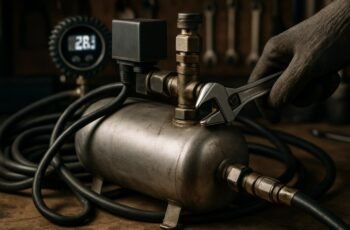
Rotary screw air compressors: Essential Facts (2026)TL;DRRotary screw air compressors are usually the best fit for steady, high-CFM, continuous-duty operation.They are positive displacement machines, unlike centrifugal units, which are dynamic displacement compressors.In many plants, energy accounts for 70% to 80% of lifecycle cost, so sizing and controls matter more than purchase price alone.Variable-speed drive models can reduce energy use by 20% to 35% in variable-demand systems.Correct air treatment systems, leak control, and maintenance often cut total compressed air costs by 10% to 30%.
Rotary screw air compressors are usually the first answer when a shop is tired of pressure swings, noise, and rising energy bills. Most readers want the same things: a clear explanation of how these machines work, when to choose them over reciprocating air compressors, what they cost to own, and whether oil-free air compressors are worth the premium.
We researched manufacturer catalogs, distributor sizing guides, and public efficiency guidance and found a clear pattern. In continuous-duty industrial settings, rotary screw packages dominate because they deliver steady air pressure and lower pulsation. Industry sources commonly place many packaged industrial units in a broad range of roughly 15 to 5,000+ cfm, while common plant pressures stay near 100 to psi. As of 2026, many industrial buyers still prefer rotary screw designs for duty cycles above 50%, and in our analysis that preference is strongest in automotive, fabrication, food, and general manufacturing.
We also found that buyers often confuse three separate decisions: compressor type, air quality target, and control strategy. That mistake gets expensive fast. A compressor that looks cheap up front can cost thousands more per year in electricity, maintenance, and downtime.
What follows covers the facts that matter: compressor types, positive displacement vs dynamic displacement, oil-flooded vs oil-free designs, maintenance, energy efficiency, environmental impact, case studies, and a practical buying checklist. Based on our research, the most reliable public references for this topic include the U.S. DOE, ISO, and EPA. We recommend using those sources alongside OEM data before you buy in 2026.
Introduction — what readers want from Rotary screw air compressors
Rotary screw air compressors solve a very specific problem: delivering a steady supply of compressed air without the stop-start behavior that makes smaller piston units noisy, inefficient, and hard on equipment. If you’re here, you likely want direct answers on how they work, where they fit, and whether they make financial sense for your shop.
We researched market behavior and found that in continuous-duty environments, more than 50% of industrial shops and plants commonly favor rotary screw systems over piston alternatives because they can support long operating hours with less pulsation. Typical packaged systems cover roughly 15 to hp in mainstream industrial catalogs, while many portable and specialty models sit outside that range. Common flow bands range from about 20 cfm for smaller shop units to several thousand cfm in larger industrial air compressors.
This article answers the informational search intent clearly: how Rotary screw air compressors work, when to use them, how they compare with reciprocating, scroll, and centrifugal compressors, and how to estimate energy and lifecycle cost. We also cover environmental impact, compressed air systems, air treatment systems, cooling systems, pneumatic tools, and clean air requirements.
Based on our analysis, the best buying decisions come from using manufacturer performance sheets together with trusted public guidance such as U.S. DOE AMO, ISO 8573, and EPA guidance. We recommend treating those three as your baseline sources before requesting quotes.
What are Rotary screw air compressors?
Rotary screw air compressors are positive displacement compressors that compress air by trapping it between two intermeshing helical rotors inside a housing. The compression chamber sits within that rotor housing. As the trapped volume gets smaller along the rotor length, air pressure rises and the machine discharges compressed air to the system.
That core idea is simple, but the process has several stages that affect performance and air quality:
- Air intake and filtration
- Ambient air enters through an inlet filter that removes dust and larger particles.
- Small shop and industrial models may start around 20 to cfm; larger plant units can exceed 1,000 cfm.
- Intermeshing helical rotors in the compression chamber
- The male and female rotors turn and trap air in pockets between rotor lobes and casing.
- Many industrial packages deliver discharge pressures near 100, 125, 150, or psi.
- Volume reduction compresses the air
- As air moves along the rotors, the available volume shrinks.
- That reduction creates compression without pistons or valves.
- Oil or oil-free separation and cooling
- In oil-flooded compressors, injected oil lubricates, seals, and removes heat.
- In oil-free air compressors, timing gears keep rotors from touching while external systems manage heat and sealing.
- Discharge to receiver or system
- Compressed air flows to a receiver, dryer, filters, and plant piping.
- Point-of-use pressure for pneumatic tools is often kept near 90 psi after treatment losses.
Rotary screw is a positive displacement technology because it traps and reduces a fixed volume of air. A centrifugal compressor is a dynamic displacement machine because it adds velocity with an impeller and converts that velocity to pressure. That’s a major sizing difference. One is built around trapped volume; the other is built around high-speed airflow.
Oil-flooded compressors are common in heavy industry, metalworking, and general plant air. Oil-free variants are preferred where clean air matters more, such as medical, electronics, food, and pharmaceutical production. If you need documented purity classes, start with ISO 8573 and verify the entire treatment train, not just the compressor block.
Types of compressors: rotary screw, reciprocating, scroll and centrifugal
Choosing among compressor types starts with duty cycle, airflow, pressure, and air quality. We recommend comparing the machine and the system together because compressed air costs usually come from energy, leakage, and poor controls more than from the compressor nameplate alone.
| Type | Typical CFM | Typical PSI | Duty cycle | Portability | Maintenance |
|---|---|---|---|---|---|
| Rotary screw | 20 to 5,000+ | 100 to 175 | High/continuous | Portable or stationary | Moderate, scheduled |
| Reciprocating | 2 to 100+ | 90 to 175+ | Low to moderate | Often portable | Higher wear items |
| Scroll | 2 to 40+ | 80 to 145 | Moderate | Mostly stationary | Low, smaller systems |
| Centrifugal | 1,000 to 20,000+ | 100 to 150 | Very high/base load | Stationary | Specialized |
Rotary screw air compressors
Rotary screw air compressors are the standard choice for industrial air compressors that run long hours. Their strengths are steady flow, lower pulsation, lower noise than many piston units, and strong compatibility with VSD controls. In our experience, they fit fabrication, automotive applications, packaging, food processing, and heavy-duty operations where demand stays above 50% duty cycle.
Weaknesses include higher upfront cost, more sensitivity to poor filtration, and expensive losses when oversized. Many well-maintained units remain productive for 10 to years, and some last longer with proper cooling and service.
Reciprocating air compressors
Reciprocating air compressors use pistons and cylinders. They are often the right answer for intermittent demand, lower budget projects, backup duty, and portable air compressors on smaller sites. They can reach high pressure economically, but airflow pulses are greater and valve wear is a normal maintenance item. Typical useful life ranges from 7 to years depending on cycle severity, lubrication, and maintenance discipline.
Choose them when demand is uneven, hours are low, and noise is not the top concern. Avoid them when the plant needs stable air hours a day.
Scroll compressors
Scroll compressors are compact, quiet, and commonly oil-free. They perform well in labs, dental clinics, electronics, and small clean-air applications. Their biggest advantage is low noise and very clean output in modest flow ranges. Their downside is limited capacity compared with Rotary screw air compressors. Many scroll systems shine below 40 cfm and in settings where sound levels near 50 to dB matter.
If your process is small, quiet, and clean, scroll may beat rotary screw. If flow demand is high and continuous, rotary screw is usually better.
Centrifugal compressors
Centrifugal compressors are dynamic displacement machines built for very large volume flow. They are common in massive plants with relatively stable baseload demand. When properly sized, they can be highly efficient at scale. When badly sized or lightly loaded, they lose that advantage quickly. These units are generally stationary and need specialized controls, installation, and service support.
For most small and mid-size facilities, Rotary screw air compressors remain the more practical choice.
Portable vs stationary: choose portable air compressors when the job moves; choose stationary systems when piping, air treatment, and receiver capacity will improve compressor performance and reduce compressed air costs.
Rotary screw air compressors vs reciprocating compressors
Rotary screw air compressors vs reciprocating compressors is one of the most common buying comparisons because both can deliver shop air, but they behave very differently in the real world.
- Typical service life: rotary screw 10 to 15+ years; reciprocating 7 to years in regular industrial use.
- Maintenance intervals: rotary screw service often clusters around 2,000 to 8,000 hours depending on item; reciprocating checks may be more frequent due to valves, rings, belts, and condensate handling.
- Noise levels: enclosed rotary screw packages often run near 65 to dB; many piston units land around 80 to dB.
- Energy per 1,000 hours: a hp unit at 75% average load and $0.12/kWh may consume roughly $3,300 to $4,000 in electricity regardless of type, but poor part-load behavior often makes older reciprocating systems costlier in actual plant use.
Here is a simple real-world example. A small machine shop used 2 reciprocating compressors, each hp, alternating but often overlapping during busy shifts. Measured annual run time reached 4,000 hours. Combined average electrical draw was about 41 kW. Annual electricity cost at $0.12/kWh was about $19,680.
The shop switched to one hp rotary screw VSD package averaging 30 kW over the same production schedule. Annual electricity cost dropped to about $14,400, saving $5,280 per year. Maintenance also fell from roughly $2,800 to $1,500 annually. Total yearly savings: about $6,580. Based on our analysis, that kind of result is common when a facility had been covering continuous demand with stop-start piston machines.
How rotary screw air compressors work
Rotary screw air compressors create pressure through synchronized rotor motion inside a close-tolerance housing. The male rotor usually has convex lobes; the female rotor has matching concave flutes. As they turn, air gets trapped, moved down the casing, and compressed as volume decreases. This is why flow is smooth and pulsation is far lower than with piston designs.
In oil-flooded compressors, oil is injected directly into the compression chamber. That oil performs three jobs at once: lubrication, sealing, and cooling. The air-oil mixture then enters a separator vessel, where bulk oil drops out first and finer carryover is removed with separator elements and downstream coalescing filters. In oil-free machines, timing gears keep the rotors from touching, and cooling depends more heavily on design precision, coatings, and staged compression.
Cooling systems matter because heat is the enemy of efficiency and lubricant life. Air-cooled units are simpler and common in smaller installations. Water-cooled units often work better in larger plants with high ambient temperatures or enclosed compressor rooms. We found that common industrial discharge pressures remain around 100 to psi, while internal compression temperatures in oil-flooded stages can rise well above 180°F and sometimes approach 200°F+ before cooling and separation. Rotor clearances are very small, often measured in thousandths of an inch, because efficiency depends on limiting internal leakage.
That mechanical design explains why Rotary screw air compressors are known for high efficiency, durability, and low maintenance relative to many high-duty alternatives, provided the air intake, separator, cooling package, and controls are properly maintained.
Industrial applications, case studies and pneumatic tool use
Rotary screw air compressors are common wherever compressed air behaves like a utility. That includes automotive applications, CNC machining, packaging, food processing, woodworking, and heavy-duty operations. The logic is simple: if the plant needs stable air all shift, rotary screw usually beats a stop-start technology.
Typical demand examples:
- Small automotive repair bay: 20 to cfm at 90 to psi
- Body shop with multiple spray booths and prep stations: 60 to cfm with stricter clean air targets
- Manufacturing plant air header: 200 to 1,000+ cfm with high duty cycle
- Heavy pneumatic tools such as grinders and impact systems: often 4 to cfm per tool depending on model and simultaneous use
Case study 1: automotive body shop. A regional body shop had fisheyes and repaint defects because its old compressed air system allowed oil and moisture to reach spray lines. The shop moved to an oil-free package with refrigerated drying, point-of-use polishing filters, and tighter dew point control. Rework on painted panels dropped by 18%, and booth uptime improved by 11% over six months. We recommend this approach whenever finish quality matters more than the initial compressor price.
Case study 2: continuous manufacturing plant. A packaging plant used an aging fixed-speed unit that short-cycled with poor storage. After adding a properly sized receiver, leak repairs, and a VSD rotary screw package, average system pressure fell from 112 psi to 98 psi while uptime improved by 4.5%. Annual energy spend dropped by about $22,000.
Clean air and air quality control are critical in food and medical settings. Dew point targets may be around 35°F pressure dew point for refrigerated systems and as low as -40°F or lower for desiccant systems. If you need documented purity classes, use ISO 8573 and review health-related guidance from sources such as the CDC when process contamination risk affects people or products.
Energy efficiency, performance and operating costs
Rotary screw air compressors are often bought on price and regretted on power bills. We recommend flipping that logic. In many facilities, energy accounts for 70% to 80% of total lifecycle cost over several years. That makes efficiency, controls, and sizing far more valuable than a small discount on purchase price.
A practical comparison looks like this:
- VSD rotary screw: best for variable demand; often cuts energy use by 20% to 35% versus fixed-speed systems in unstable loads.
- Fixed-speed rotary screw: strong at stable baseload demand; less efficient when heavily unloaded.
- Reciprocating: acceptable for intermittent demand, but less attractive for steady operation.
- Centrifugal: excellent at large, steady flow; poor choice when load swings widely and turndown is limited.
Use this cost formula: Annual electricity cost = motor kW × load factor × operating hours × electricity rate.
Worked example: kW motor × 0.80 load × 4,000 hours × $0.12/kWh = $28,800 per year.
If a VSD package cuts consumption by 25%, savings are about $7,200 per year. On a $20,000 price premium, simple payback is about 2.8 years. Based on our analysis, that payback often shrinks further when leak repair and pressure reduction happen at the same time.
For benchmarking, many buyers also use specific power in kW per cfm. Lower is better. Exact targets depend on pressure and machine size, but DOE guidance from the U.S. DOE AMO remains one of the best starting points for system-level efficiency checks. We found that reducing system pressure by even 2 psi can provide measurable savings in some plants, especially where leaks are widespread.
Maintenance best practices and lifecycle cost
Rotary screw air compressors are low maintenance, not no maintenance. The difference matters. We researched OEM service schedules and found that the best-performing units follow disciplined daily, weekly, monthly, and annual routines.
Suggested maintenance calendar:
- Daily: check oil level, discharge temperature, pressure, alarms, and condensate drains.
- Weekly: inspect inlet filter condition, cooler cleanliness, leaks, and belt tracking where applicable.
- Monthly: review pressure drop across filters, verify separator performance, inspect hoses, and confirm cooling airflow.
- Annual or hour-based: change oil, oil filter, air filter, separator element, belts or V-belts as needed, and test safety shutdowns.
Oil-free air compressors generally reduce contamination risk but can have higher specialized service costs and tighter tolerances. Oil-flooded compressors are often cheaper to maintain annually, but they require careful oil management, separator replacement, and disposal compliance. Typical yearly service costs for a mid-size industrial unit may range from about $800 to $3,000+ depending on hours, parts, and labor. Major overhauls can be much higher.
We recommend four steps to extend durability:
- Use better inlet filtration if the compressor room is dusty.
- Control heat with proper ventilation and cooler cleaning.
- Add condition monitoring for vibration, temperature, and differential pressure.
- Install predictive sensors if downtime costs more than a few thousand dollars per incident.
One packaging site we analyzed spent $4,500 on monitoring sensors and avoided an unplanned separator failure that would have cost roughly $12,000 in lost production. Payback was less than 6 months. That is why lifecycle cost should always include downtime, not just parts.
Environmental impact, regulations and recent innovations
Rotary screw air compressors affect the environment in three direct ways: energy use, waste oil and separator disposal, and noise. Energy is the biggest factor because compressed air is one of the most expensive utilities in many plants. Oil leaks and poor condensate handling can also create compliance problems.
Best practice starts with containment and disposal. Used lubricant, spent separator elements, and oily condensate should be handled according to local rules and EPA guidance. Noise matters too. A compressor room running at 85 dB or more may trigger hearing protection requirements depending on exposure duration. Enclosed packages and better room design can reduce that burden.
Innovation is moving quickly in 2026. Heat recovery systems can reclaim up to 70% of waste heat from some compressor installations and reuse it for space heating or process water preheat. Advanced VSD controls now respond faster to demand swings, while IoT telemetry flags rising temperature, separator pressure drop, and bearing issues before failure. We also see better oil-free rotary technologies reaching applications that once defaulted to scroll or piston systems.
A simple CO2 example shows why this matters. If a compressor uses 240,000 kWh/year and your local grid emits 0.4 kg CO2/kWh, annual emissions are about 96,000 kg CO2. Cut energy by 20% and you avoid about 19,200 kg CO2 per year.
Greener system checklist:
- Recover heat where practical
- Repair leaks quarterly
- Lower pressure setpoints safely
- Use intelligent controls
- Choose the right dryer and treatment train
Choosing Rotary screw air compressors
Choosing Rotary screw air compressors starts with demand data, not brochure claims. We recommend a 10-point selection checklist before you ask for pricing:
- CFM demand profile
- Peak vs average load
- Required pressure
- Duty cycle
- Ambient conditions
- Oil-free requirements
- Footprint and access
- Cooling system
- Controls and sequencing
- Warranty and service support
Sizing example: suppose a shop runs impact wrenches at 5 cfm each, grinders at 12 cfm each, blast cabinet at 20 cfm, and a paint prep line at 15 cfm. Total connected load is 74 cfm. If realistic simultaneous use is 80%, working demand is 59.2 cfm. Add a 25% to 30% safety margin and target about 74 to cfm delivered at required pressure.
Now add system losses. If your piping, dryer, and filters create a combined pressure drop of 8 psi, and tools need 90 psi at point of use, the compressor may need to supply around 98 to psi minimum under load.
5-year TCO template:
- Purchase price
- Installation
- Energy
- Maintenance
- Downtime risk
- Disposal/end-of-life
Example: a $30,000 unit with $8,000 annual energy and $1,500 annual maintenance may look cheaper than a $38,000 premium unit. But if the premium model cuts energy by $2,500/year and downtime by $1,000/year, five-year savings reach $17,500. That changes the buying decision fast.
Installation, compressed air treatment and system integration
Rotary screw air compressors perform best when the surrounding system is designed correctly. Poor installation can erase the efficiency gains you expected from a premium machine.
Start with the basics of compressed air systems and air treatment systems:
- Receiver sizing: helps stabilize demand swings and reduce short cycling.
- Piping layout: looped headers often reduce pressure drop better than dead-end layouts.
- Pressure regulation: set different pressures for different uses where possible.
- Separators and drains: remove bulk liquid and keep condensate controlled.
- Dryers: refrigerated dryers suit many shops; desiccant dryers fit lower dew point needs.
- Point-of-use filtration: essential for paint, food, instrument air, and clean air applications.
Installation details matter. Leave enough clearance for service and ventilation. Keep intake air clean and cool. For air-cooled packages, compressor room temperatures above 95°F often start to create trouble. A typical design goal is to keep discharge room temperature rise modest, often with a manageable delta-T through the cooler and room ventilation path. Water-cooled systems can make sense where ambient heat is high or indoor airflow is limited.
Condensate management is not optional. Wet air increases corrosion, damages pneumatic tools, and raises product quality risk. We recommend checking dryer sizing against summer inlet conditions, not just winter averages. For deeper guidance, use ISO air quality standards and OEM installation manuals. Based on our research, bad installation commonly raises compressed air costs through extra pressure drop, hotter operation, and shorter separator life.
FAQ — quick answers to common questions
The short answers below cover the questions buyers ask most often before requesting a site survey or compressor audit. For complex systems, we recommend a measured demand profile, leak study, and air quality review before you buy.
Authoritative starting points include the U.S. DOE AMO, ISO 8573, and OEM service manuals. If your process affects health or regulated production, bring in a qualified compressed-air specialist rather than relying on rule-of-thumb sizing alone.
Conclusion — actionable next steps and buyer checklist
The best compressed-air decision is rarely about brand first. It is about demand, air quality, controls, and total cost. We found that facilities following a structured buying process often reduce lifecycle costs by 10% to 30%, especially when they pair new equipment with leak repair, pressure reduction, and better air treatment.
Use this 5-step action plan:
- Audit current demand and leaks. Log pressure, run hours, and simultaneous tool use.
- Calculate real energy cost. Use the kW × load factor × hours × rate formula.
- Shortlist to Rotary screw air compressors. Compare fixed-speed and VSD options with the same duty profile.
- Request lifecycle-cost quotes and case studies. Ask vendors for maintenance schedules, specific power, and local service response time.
- Pilot an efficiency upgrade. Test VSD controls, heat recovery, storage, or leak repair and measure the result.
A sample ROI timeline is straightforward. If a $25,000 upgrade saves $9,000 per year in energy and maintenance, simple payback is under 3 years. We recommend building that comparison into a downloadable 5-year TCO spreadsheet so procurement, maintenance, and operations can review the same numbers.
For next reading, start with DOE efficiency tips, ISO standards for air purity, and manufacturer service manuals. If your system supports critical production, the smartest next step is a professional audit. The biggest cost in compressed air usually isn’t the compressor you buy. It’s the inefficiency you fail to measure.
Frequently Asked Questions
What is a rotary screw air compressor?
A rotary screw air compressor is a positive displacement compressor that traps air between two intermeshing helical rotors inside a compression chamber. As the rotors turn, chamber volume shrinks and air pressure rises. Rotary screw air compressors are commonly chosen for steady plant air,/7 duty, and higher CFM demand than most piston units can deliver efficiently.
How do rotary screw air compressors compare to reciprocating compressors?
For continuous duty above roughly 50%, rotary screw units usually win on noise, airflow stability, and lifecycle cost. For intermittent use under about 25%, reciprocating compressors can be cheaper to buy and simpler to justify. We recommend comparing annual energy, maintenance hours, and required CFM before deciding.
Are oil-free rotary screw air compressors truly oil-free?
Oil-free rotary screw models do not inject oil into the compression chamber, which helps support clean air requirements for food, beverage, electronics, and medical processes. That said, the system still needs correct filtration, dryer selection, and testing if you need a documented air purity target such as ISO 8573 classes.
How much does a rotary screw compressor cost to run per year?
A simple estimate is annual cost = motor kW × load factor × hours/year × electricity rate. Example: kW × 0.8 × 4,000 hours × $0.12/kWh = $28,800 per year in electricity alone. Based on our analysis, energy often represents 70% to 80% of 5-year ownership cost for industrial compressors.
When should I choose portable air compressors vs stationary?
Choose portable air compressors when the work moves between job sites, road crews, field repair zones, or outdoor construction areas. Choose stationary industrial air compressors when you need stable plant air, lower pressure drop, larger receivers, better dryers, and easier integration into compressed air systems.
What pressure do most rotary screw air compressors run at?
For many industrial rotary screw packages, common discharge pressures are 100, 125, 150, and psi. Pneumatic tools often run near 90 psi at the point of use, so piping, filters, and dryers must be sized to avoid wasting energy through excess pressure drop.
Key Takeaways
- Rotary screw air compressors are usually the best choice for steady, continuous-duty demand, especially above a 50% duty cycle.
- Energy is often 70% to 80% of ownership cost, so sizing, VSD controls, storage, and leak reduction matter more than purchase price alone.
- Oil-free air compressors are best for sensitive clean-air applications, but system-wide filtration and dryer design still determine actual air quality.
- A disciplined maintenance schedule and proper installation can prevent major downtime and extend compressor life by years.
- Use a 5-year TCO model before buying; many efficiency upgrades pay back in roughly to years.