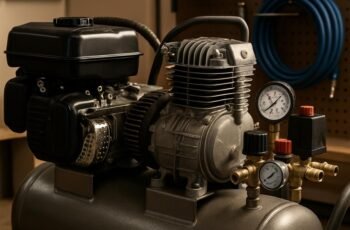
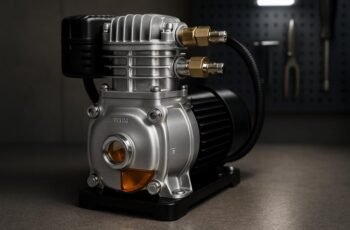
We’ll walk through how to pick a nail gun air compressor by balancing CFM, PSI, and duty cycle with your tool’s needs. We’ll assess tank size, line losses, filtration, and startup surges, then translate those factors into practical, real-world decisions. The goal is a reliable, cost-effective setup that meets your project demands, without overcommitting on unused capacity. There’s more to consider after this, and a clear path awaits.
Key Takeaways
- Match compressor CFM at operating pressure to your nailer’s CFM needs and duty cycle for reliable performance.
- Consider tank size and runtime to minimize interruptions; larger tanks reduce unloads but add weight.
- Evaluate PSI requirements, regulator accuracy, line losses, and filtration to limit pressure drop to the tool.
- Factor hose length, fittings, startup surges, and duty cycle when sizing for real-world use and budget.
- Prioritize tool compatibility across brands, test under load, and plan maintenance for long-term reliability.
Nail Gun Basics: What CFM, PSI, and Duty Cycle Really Mean
Understanding CFM, PSI, and duty cycle is essential to selecting a compatible nail gun and compressor. We present the core concepts, then translate them into practical selection criteria for projects. CFM measures the volume of air required per minute; PSI indicates the pressure the system must sustain during operation; duty cycle reflects how long the compressor can run between rest periods without overheating. We assess these values from the nail gun’s specifications and align them with the compressor’s capabilities. We consider nail gun ergonomics to ensure control and fatigue resistance during extended use, and we account for how compressor filters affect air quality and system longevity. This framework avoids overestimating needs while maintaining precise, repeatable performance.
Matching CFM to Your Nailer: How to Size for Power and Airflow
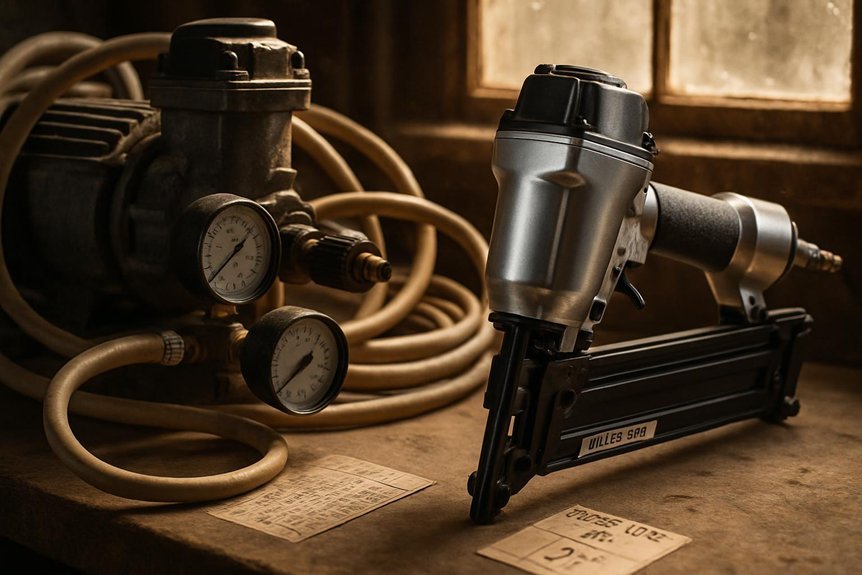
We’ll start by matching the compressor’s CFM range to the nailer’s needs, confirming the worst-case airflow requirement. We then translate that CFM target into a practical setting on your unit, considering hose length and fittings that affect performance. Finally, we’ll outline a clear sizing method to guarantee consistent power and airflow under typical work conditions.
Matching CFM to Nailer
To choose the right CFM for your nailer, start by matching the tool’s required airflow to the compressor’s sustained CFM at the operating pressure. We assess nailer compatibility by confirming that the nailer’s CFM demand aligns with the compressor’s ability to sustain that flow under load. Next, we examine duty cycle and peak draws to ensure the unit can maintain consistent pressure during rapid firing. Airflow regulation becomes our control point: we verify regulator accuracy, line sizing, and filtration to minimize pressure drop from tank to tool. We record observed CFM at the operating pressure and compare it to the nailer’s spec sheet, ensuring a safe margin for startup surges. This methodical check prevents under- or over-specified setups.
Sizing For Power Airflow
We start by translating the nailer’s CFM demand into a practical compressor target. We align CFM with runtime needs, factoring duty cycle, startup spikes, and accessory air usage, to prevent performance drops. Our method removes ambiguity by converting CFM into a usable compressor flow target, then validating with system losses and hose length. We keep expectations grounded, acknowledging that airflow is a function of pressure and volume, not just peak numbers. When sizing, we balance cushion, efficiency, and responsiveness, avoiding overbuilding. We also recognize that unrelated topic and random tangents can distract, so we focus on measurable metrics and repeatable checks.
- Determine peak CFM and add a conservative safety margin
- Factor duty cycle and startup surges into target CFM
- Account for hose length, fittings, and regulator losses
- Verify with a practical test run under load
PSI, Tank Size, and Runtime: How They Affect Performance on the Job
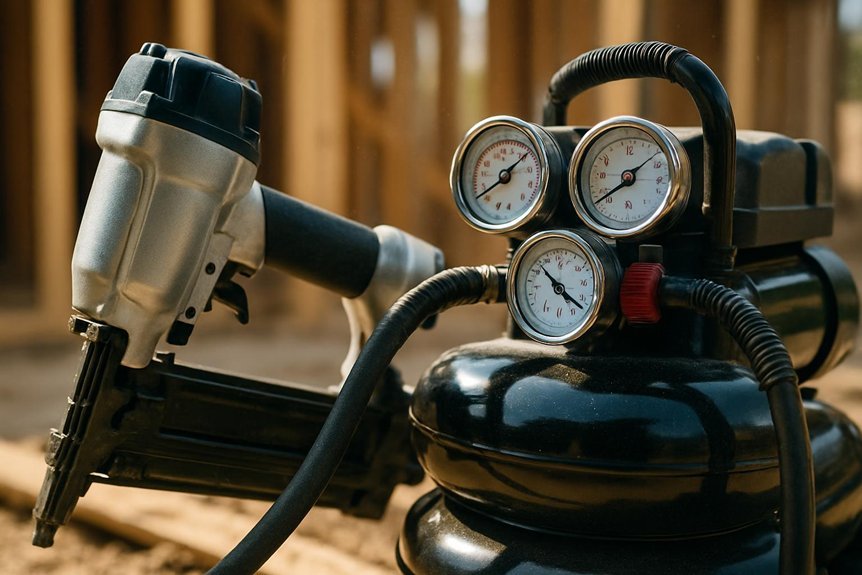
PSI, tank size, and runtime are the core levers that determine a nail gun’s sustained performance on the job. We analyze how pressure (PSI) influences drive force, bit by bit, and how exceeding recommended PSI degrades accuracy and increases wear. Tank size defines available air reserve, dictating cycle length between recharges. Larger tanks reduce unloads and interruptions, improving productivity without lifting more weight than necessary. Runtime, tied to duty cycle, shows how long the compressor can maintain consistent pressure under load before refilling. Understanding these relationships helps us balance efficiency, noise, and duty cycle with workflow. In our approach to nail gun basics, we emphasize matching tool demands to compressor output, avoiding under- or over-specification that harms performance.
Planning for Long Jobs: Understanding Duty Cycle in Real Work Scenarios
We’ll examine Real-World Duty Metrics to map how long a nail gun runs between recharges and rests. Next, we compare Continuous Use Realities with pauses, so you can plan for tooling that meets peak-load demands without overruns. Finally, we’ll share Peak-Load Scheduling Tips to optimize cycles, battery and compressor duty, and maintenance timing for longer jobs.
Real-World Duty Metrics
Real-world duty metrics matter because long jobs expose the limits of a compressor’s duty cycle and airflow stability. We assess how sustained runtime, peak airflow, and duty cycle interact under real loading, not ideal tests. Our goal is to match nail gun demands with predictable performance, avoid pressure drops, and prevent overheating. We quantify how long a unit can sustain typical bursts before cooldown, and how fluctuations affect the tool’s speed and finish quality.
- Duty cycle versus runtime under load, with acceptable temperature rise
- Airflow stability during continuous cycles and brief peaks
- Temperature management, overheating risk, and recovery behavior
- System limits: tank size, regulator range, and inlet filtering considerations
Continuous Use Realities
How long can you push a nailer on a single job without hitting a slowdown? We analyze continuous use in real work by examining duty cycle, the ratio of run time to total cycle time. Our goal is predictable performance, not guesswork. We measure each tool’s compressor match: output CFM, pressure at the nailer, and the nailer’s consumption cadence. When duty cycle approaches limits, runtime declines and cycle times extend, forcing pauses for cooling or air recovery. We recommend aligning continuous use expectations with a generous safety margin, selecting a compressor that sustains steady pressure under load, and sizing hose loss and fittings accordingly. Documented duty cycle figures guide our planning, preventing air-starved starts and ensuring consistent drive depth and nailing rhythm throughout long jobs.
Peak-Load Scheduling Tips
Peak-load scheduling hinges on understanding peak duty cycles during long jobs and planning air supply accordingly. We map actual usage to compressor output, nailer demands, and reservoir reserves, then align usage windows with compressor capabilities. This disciplined approach minimizes pressure dips and unplanned shutoffs, improving consistency and finish quality. We also tie operation timing to maintenance budgeting, ensuring service needs are foreseen and funded. By modeling duty cycles, we identify when capping intake or staggering cycles preserves performance. We acknowledge that tool mix, hose length, and regulator settings affect flow, so we document assumptions and results. Continuous monitoring of runtime versus available air helps refine estimates for future jobs and budgeting. Clear data drives reliable decisions and smoother workflow.
- Duty-cycle mapping
- Reservoir and regulator tuning
- Staggered operation planning
- Maintenance budgeting alignment
Reducing Noise on Site: Practical Noise Targets and Quiet-Mode Tips
What practical noise targets should we aim for on a busy jobsite, and how can quiet-mode features help us stay there without slowing work? We define noise targets as measured at the operator’s ear and the nearest site boundary, typically 75–85 dB(A) for continuous operation, with short peaks below 90 dB(A). We implement a staged approach: baseline measurements, equipment selection, and procedural controls. Quiet mode tips include derated duty cycles, automatic low-RPM operation when not cutting, and muffling strategies that don’t impede performance. We monitor with calibrated sound meters and log results to verify compliance between task phases. We prioritize equipment with inherent low- noise designs and effective exhaust management, then adjust workflow to maintain productivity while meeting noise targets. Documentation ensures repeatable, defensible site practices.
Pick the Right Compressor Type for Your Nailer Style
Choosing the right compressor type hinges on your nailer’s style and duty cycle; mismatches waste energy and extend cycle times. We select a compressor that matches the nailer’s workflow, ensuring consistent operation and minimizing downtime. Our focus is tool compatibility and sustained performance, not oversized kit. For finish nails, lightweight, low-PSI models with high airflow can reduce cycling while preserving drive power. For framing or heavy-duty studs, opt for higher CFM at the required duty cycle to maintain penetration without stalling. Consider issue-specific duty ratios and startup surge tolerance to protect fasteners and motors. Align compressor type with nailer demands to maximize cost efficiency and reliability over the project life.
- Match CFM and duty cycle to your nailer’s feed rate
- Assess startup surge and tank pressure requirements
- Prioritize consistent airflow over peak PSI
- Evaluate total cost of ownership for ongoing use
Portability vs. Capacity: Finding the Right Balance for Your Projects
Balancing portability and capacity isn’t about choosing one over the other; it’s about matching your project’s workflow to the compressor’s performance envelope. We evaluate duty cycle, tool demand, and peak start-up load to determine where compromises are acceptable. Portability reduces setup friction and transport time, but smaller tanks raise refill frequency, affecting continuous firing. Conversely, larger capacity extends run-time yet increases weight and footprint, challenging job-site maneuverability. Our approach is to quantify desired CFM at operating pressure, then map it to a model whose runtime and recovery intervals align with task cadence. We also consider storage practicality, favoring compact storage solutions for tight spaces without sacrificing essential performance. Budget constraints guide component selection, steering us toward efficient compressors that deliver consistent pressure with minimal ancillary gear.
Estimate Your Project Needs: Use-Case Scenarios for Budgeting
To estimate project needs accurately, we translate tool usage into a concrete budget by mapping use-case scenarios to required CFM at operating pressure and expected run-time. We systematically classify tasks, then align compressor specs with budget planning and tool compatibility, ensuring practical headroom. Our approach minimizes overkill while preventing workflow stalls, giving predictable cost and performance.
To estimate project needs, translate tool use into a budget by mapping tasks to CFM, run-time, and headroom for reliable cost and performance.
- Define task profiles (nailing frequency, joint count, duration) to project CFM and duty cycles
- Convert profiles into a running hour estimate, then translate into compressor size and runtime
- Compare tool compatibility across brands and models to avoid mismatches
- Establish a budgeting margin for accessories, maintenance, and future scalability
Maintenance and Budgeting for Reliability: Essential Upkeep and Costs
Could reliability be safeguarded through disciplined upkeep and thoughtful budgeting? In this section, we outline a rigorous maintenance budgeting approach that supports consistent performance. We begin with a baseline inspection schedule: daily checks for leaks, pressure stability, and gauge accuracy; weekly lubrication of moving parts; and monthly filter and anode inspections. Documented records enable traceable reliability focus, revealing trends and deviation from expected life cycles. Budget allocations should cover consumables, replacement seals, incoming air filtration, and periodic compressor service by qualified technicians. Implement a preventive maintenance calendar aligned with manufacturer guidelines, and adjust for runtime and duty cycle. Prioritize reliability over impulsive upgrades; invest in spare parts stock and a clear escalation protocol to minimize downtime and extend service life.
Frequently Asked Questions
How Do I Choose a Compressor for Nail Gun Air Leakage?
We choose a properly sized compressor to minimize control pressure fluctuations, prioritize leak prevention, and verify fittings. We evaluate compressor sizing against nail gun CFM demands, test for leaks, and adjust regulator settings to maintain consistent airflow.
What Maintenance Prevents Regulator Failures and Leaks?
We prevent regulator failures and leaks with strict maintenance routines: inspect seals, purge moisture daily, replace worn diaphragms, and calibrate pressure relief. Regular lubrication and filter changes boost regulator reliability and extend service life for consistent performance.
Can You Convert a Compressor for Continuous Dry Air Use?
Yes, we can convert a compressor for continuous dry air use. We’ll implement continuous filtration and airflow optimization, documenting steps methodically, calibrating flow, and testing under load while we monitor moisture, pressure consistency, and system stability.
Is a Larger Tank Worth It for Occasional Projects?
A larger tank is worth it for occasional use; it smooths pressure and reduces cycling, but for small tank setups with infrequent projects, gains are modest and portability may trump capacity. We recommend balance between flow, pressure, and duty.
How Does Temperature Affect CFM and PSI Performance?
Temperature effects cause CFM and PSI to drop as ambient temps rise, while pressure fluctuations intensify with cooling; we verify this by testing. We, readers, conclude accurate performance hinges on thermal management and stable load conditions.
Conclusion
We’ve built a framework that pairs exact specs with practical realities, balancing promise and performance. On one hand, CFM, PSI, and duty cycle promise power; on the other, tank size, line losses, and noise remind us to plan. We weigh precision against practicality, efficiency against cost. By testing real loads, we bridge theory and site, ensuring reliability. In this juxtaposition of ideal specs and real-world constraints, we choose tools that truly fit our projects.