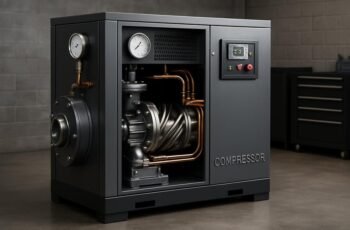
We’re always told that oil-free machines are flawless, but the truth is more nuanced and important for your workflow. We’ll guide you through core trade-offs, maintenance needs, and how to match specs to duty cycles so you can make a sound choice. If you want to avoid contamination, manage costs, and keep production steady, there are critical considerations we’ll outline before you decide. Let’s explore what truly fits your tasks.
Key Takeaways
- Compare oil-free vs lubricated designs: oil-free reduces contamination risk and maintenance, while lubricated offers smoother operation for heavy-duty, continuous use.
- Assess air quality needs and duty cycle to decide suitability for oil-free units in clean room or paint/composites applications.
- Understand CFM, PSI, and duty cycle to size the compressor for peak and continuous demands with appropriate headroom.
- Consider maintenance and total cost: oil-free often lowers maintenance complexity but may have higher purchase cost; factor downtime and reliability.
- Check reliability, filters, seals, and service network to ensure timely maintenance and long-term performance of oil-free compressors.
Oil-Free vs Lubricated: Core Differences and Implications
Oil-free and lubricated air compressors differ primarily in how they manage friction and wear inside the pump. We outline the core differences to help you compare performance, maintenance, and reliability. In oil-free units, seals and materials are selected to minimize contact wear, reducing contamination risk and eliminating oil carryover, which supports cleaner air and simpler maintenance. Lubricated designs rely on oil films to cushion moving parts, improving longevity under heavy duty use and offering smoother operation at high duty cycles. Consider oil-free benefits such as reduced filtration needs and lower operational costs over time, counterbalanced by potential limits in extreme duty scenarios. Weigh lubricants tradeoffs, including periodic oil changes and possible oil carryover, against the convenience of oil-free operation.
How to Decide If You Need an Oil-Free Compressor
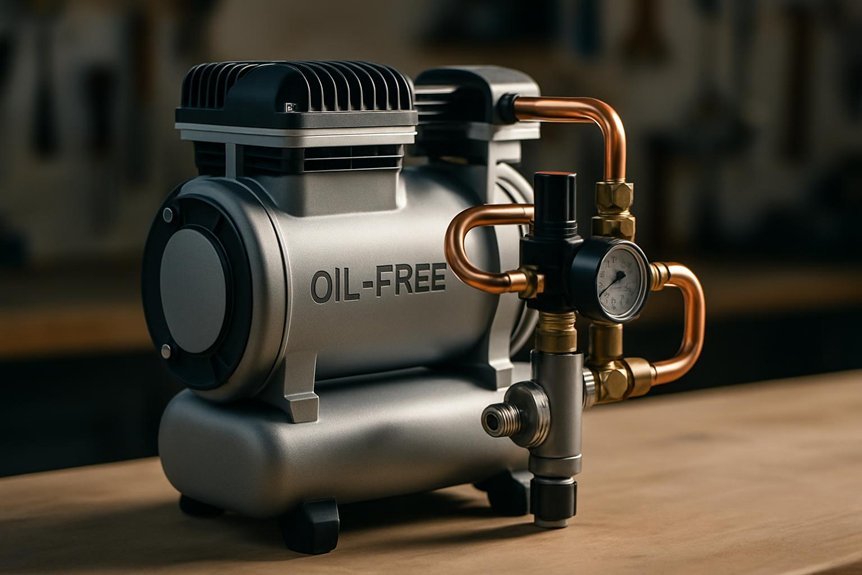
Determining whether an oil-free compressor is right for you hinges on your priorities for air quality, maintenance, and cost. We assess practicality by weighing contamination tolerance, uptime goals, and budget impact. If you prioritize cleaner air in sensitive applications, an oil-free unit reduces cross-contamination risks, while we acknowledge occasional misconceptions tied to oil free myths. When maintenance is a factor, the absence of oil changes routine expectations, clarifying both tasks and intervals—yet we must confront maintenance myths that overstate simplicity. Cost considerations balance initial price against long-term expenses. To visualize the choice, consider the table below:
| Criterion | Benefit of Oil-Free | Potential Limitation |
|---|---|---|
| Air Quality | Lower contamination risk | Limited filtration scope |
| Maintenance | Simpler routines | More frequent parts checks |
| Cost | Predictable spend | Higher upfront |
How to Size an Oil-Free Compressor for Your Tasks
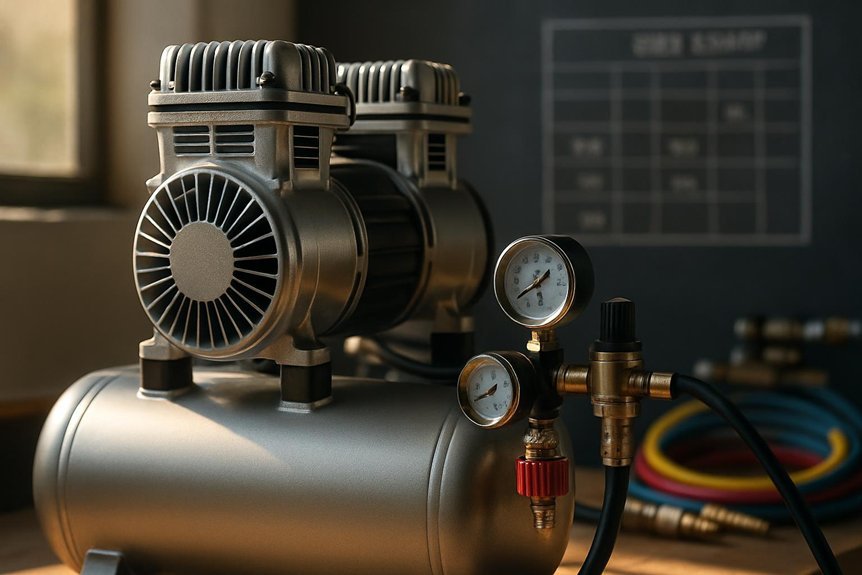
How do you determine the right size for an oil-free compressor when your tasks vary in pressure and flow? We guide readers by aligning usage profiles with compressor capacity, avoiding overkill while ensuring reliability. Begin with task-specificDuty expectations, then assess peak and continuous demands to prevent shortfalls. We examine duty cycles, common pressures, and typical intake requirements, translating them into a practical sizing framework. We acknowledge that unused topic ideas or unrelated focus should not derail the selection process; instead, we isolate needs to the actual tasks. Our approach emphasizes scalable options and appropriate headroom, preventing excessive wear and undersupply. By focusing on variability in demand, readers learn to balance portability, efficiency, and performance without overestimating requirements. This method supports informed, objective choices tailored to real-world use.
Key Specs for Oil-Free Models: CFM, PSI, and Duty Cycle
We’ll start with the basics of CFM and PSI to match your tool needs and airflow demands. We’ll explain how duty cycle affects continuous use and what it means for reliability. This sets the stage for choosing a model that balances performance, runtime, and longevity.
CFM and PSI Basics
What do CFM, PSI, and duty cycle mean for an oil-free air compressor, and why do they matter? We, as buyers, translate these specs into real performance. CFM indicates the volume of air delivered at a given pressure, guiding tool compatibility. PSI reveals usable pressure for completing tasks. Duty cycle shows how long the unit can run between rests, affecting reliability in longer jobs.
- CFM vs. PSI balance: match tool demands with compressor capacity
- Duty cycle implications: define runtime limits and rest periods
- Practical selection: prioritize two word discussion idea 1, two word discussion idea 2 for realistic use
Understanding these basics helps us select an oil-free model that meets two word discussion idea 1 and two word discussion idea 2 in everyday work.
Duty Cycle Demands Explained
Duty cycles determine how long an oil-free compressor can run before it must rest, and understanding them helps prevent overheating and premature wear. We explain how duty cycle ratings translate to practical use, so you match run time to task. For continuous operations, choose models with higher duty ratings and plan short rests to maintain performance. Short cycles save energy but increase heat buildup, which can accelerate lubrication myths if you push beyond design limits. We also address turbine cleanliness, noting that clean intake and filter maintenance preserve consistent output and reduce contaminants entering the compression chamber. Informed choices about duty cycles help you avoid under‑ or over‑sizing, ensuring reliable performance without unnecessary component stress or unexpected downtime.
Piston vs Screw: Choosing the Right Oil-Free Design
When choosing an oil-free compressor, the decision between a piston drive and a screw drive hinges on your demand profile and duty cycle. We’ll compare reliability, maintenance, and cost to help you decide between piston vs screw options, specifically for oil free vs lubricated designs. In practice, piston units excel at lower, intermittent demands, while screw configurations suit steady, higher-output needs.
- Consider load consistency: intermittent use favors piston for simplicity; continuous use benefits from screw efficiency.
- Evaluate maintenance: piston has fewer moving parts but more frequent service intervals; screw offers longer intervals with higher initial cost.
- Assess lifetime cost: oil-free screws may reduce downtime, while lubricated variants sometimes lower upfront price.
Our goal is a precise match to your application, avoiding unnecessary complexity.
Noise, Vibration, and Footprint: Practical Sizing Tips
Noise, vibration, and footprint often determine how comfortably an oil-free compressor fits into a workspace, so start sizing with realistic, measured expectations. We approach sizing by aligning duty cycles, intended running hours, and peak demand to the unit’s rated capacity, avoiding overspecification. Prioritize realistic noise targets based on the environment; select models offering noise reduction features or enclosure options, and assess inlet mufflers where applicable. Evaluate vibration propagation by considering mounting options, vibration isolation mounts, and base rigidity. Footprint matters for room layout and service access, so measure floor space, clearance, and exhaust routing. We recommend a conservative margin for future tool additions. By balancing capacity, acoustics, and foundation, we achieve stable performance with minimal disruption to routine operations.
Air Quality: Filtration, Dryness, and Stable Output
We guarantees air quality in oil-free compressors remains consistent through filtration, dryness, and stable output? We examine three core controls that preserve performance and protect downstream equipment.
- air filtration effectiveness: select housings with appropriate filtration stages and hygienic seals to prevent bypass.
- moisture control: implement desiccant or refrigerated dryers sized to load without creating excessive pressure drop.
- output stability: monitor pressure, flow, and temperature to maintain consistent delivery and minimize moisture carryover.
Together, these elements prevent particulates and vapor from entering tools, preserving efficiency and longevity. By prioritizing filtration, dryness, and stable output, we ensure reliable operation while avoiding unnecessary energy use and costly downtime.
Reliability and Maintenance: What Oil-Free Turbines Require
Reliability and maintenance are paramount for oil-free turbines, and understanding their requirements helps prevent downtime. We approach this topic with clear steps and practical checks so you can plan confidently. Oil-free turbines rely on precise tolerances, clean intake, and timely service to sustain performance. Key activities include reliability testing to validate performance under load and maintenance scheduling to align inspections with operating hours. Regular filter and seal inspections prevent contamination, while bearing and impeller checks detect wear early. Adherence to manufacturer intervals minimizes unexpected failures and keeps output steady.
| Step | Focus | Outcome |
|---|---|---|
| 1 | Reliability testing | Validates endurance and stability |
| 2 | Maintenance scheduling | Reduces surprises and downtime |
| 3 | Component inspection | Detects wear early |
Total Cost of Ownership: Budget, Warranties, and Value
Total cost of ownership (TCO) for oil-free air compressors hinges on more than a sticker price or purchase date. We assess budget, warranties, and value to avoid surprises and ensure long-term performance. While oil-free vs oil lubricant choices affect upfront costs, maintenance costs and reliability shape true TCO over time. We guide you to weigh initial investment against expected service life, energy use, and required parts.
- Budget planning: upfront price, running costs, and predictable replacements
- Warranties: coverage duration, exclusions, and service network
- Value: downtime impact, energy efficiency, and resale potential
Frequently Asked Questions
Do Oil-Free Compressors Require More Frequent Service Than Lubricated Ones?
Yes, oil-free typically requires more frequent oil-free maintenance and checks, but lubricated reliability often means longer service intervals. We’ll guide you toward proper schedules, balancing oil-free maintenance needs with overall compressor performance for your use.
Can Oil-Free Models Handle Continuous 24/7 Operation Reliably?
Yes, oil-free models can handle continuous operation, but only with proper selection and maintenance. We emphasize reliability testing, using duty cycles and cooling principles to ensure sustained performance and reduce wear during continuous operation.
Are Oil-Free Compressors Suitable for High-Humidity Environments?
Yes, oil-free compressors handle high humidity reasonably well, but humidity impact can raise corrosion risk and condensation; we mitigate it with proper condensate management and sealing. Noise considerations also matter; choose models with low running sound feet.
How Do Ambient Temperature and Altitude Affect Oil-Free Performance?
Ambient temperature and altitude dramatically influence oil-free performance. We’ll explain ambient temperature effects, altitude effects, cooling efficiency, and material wear, noting heat rises and compressed air quality; we adjust designs to minimize wear and maximize cooling efficiency.
Do Oil-Free Turbines Consume More Electricity Than Lubricated Types?
We say yes, oil-free turbines typically consume slightly more electricity than lubricated types due to higher friction and cooling needs, reducing oil-free efficiency and increasing lubricationless energy use, though advances narrow the gap with proper design and operation.
Conclusion
We’ve laid out the logic, layers, and leverage to guide your gear choice. With careful consideration, coherent compromises, and committed common-sense checks, we can cut confusion and calibrate confidence. By weighing wear-resistant, water-worry-free options and well-mated warranties, your workflow will smoothly surge. So stay selective, scrutinize specs, and solidify savings. Steering steady,_sensible decisions secure safer, cleaner air, reduced risk, and reliable results—our shared roadmap to robust, ready-for-duty operation.