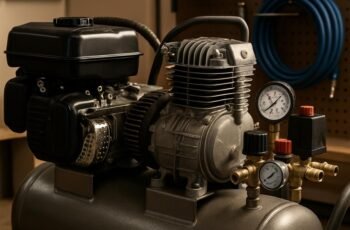
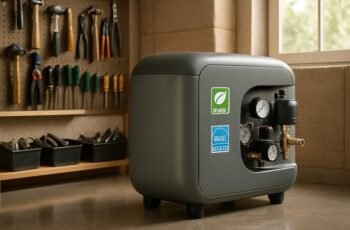
We approach silent air compressors with a disciplined lens: we quantify real-world performance, durability, and noise budgets to separate marketing claims from usable data. We’ll map CFM at target PSI, duty cycle, reservoir sizing, startup surge, and heat dissipation, then weigh enclosure and vibration control against cost of ownership. Our framework benchmarks specs against standardized tests to validate quietness on site. If you want a compressor that truly blends performance with low disturbance, this guide will structure the decision, and push you to the next step.
Key Takeaways
- Prioritize low noise figures (dB(A) at standard distance) and verify with standardized testing beyond marketing claims.
- Balance CFM at target PSI with duty cycle, reservoir size, and vibration isolation for steady performance.
- Evaluate enclosure design, flow paths, and distance between source and operator to maximize attenuation.
- Assess durability and maintenance: tank, motor, valves, predictive maintenance, and total cost of ownership.
- Consider real-world constraints: load profiles, back-up needs, line losses, ambient conditions, and space footprint.
Define Your Quiet Power: Identify Your Real Use-Case
To choose a quiet air compressor, we must first determine your actual use case. We begin with a structured framework: define required CFM at the operating PSI, assess duty cycle, and catalog tools or processes involved. We convert task frequency into a baseline continuous run time and then map that to a permissible noise envelope and vibration tolerance. We quantify energy impact, refrigerant or oil maintenance cycles, and ambient temperature effects on performance. This precision prevents novice misconceptions about “more power equals better performance.” We also address maintenance myths by separating uptime drivers from noise strategies. Reader, you gain a decision matrix: load profile, peak demand, and backup needs. With this, we avoid overpaying for unnecessary reserve capacity while ensuring consistent quiet operation.
Quiet Air Compressor 101: Key Specs You Must Understand
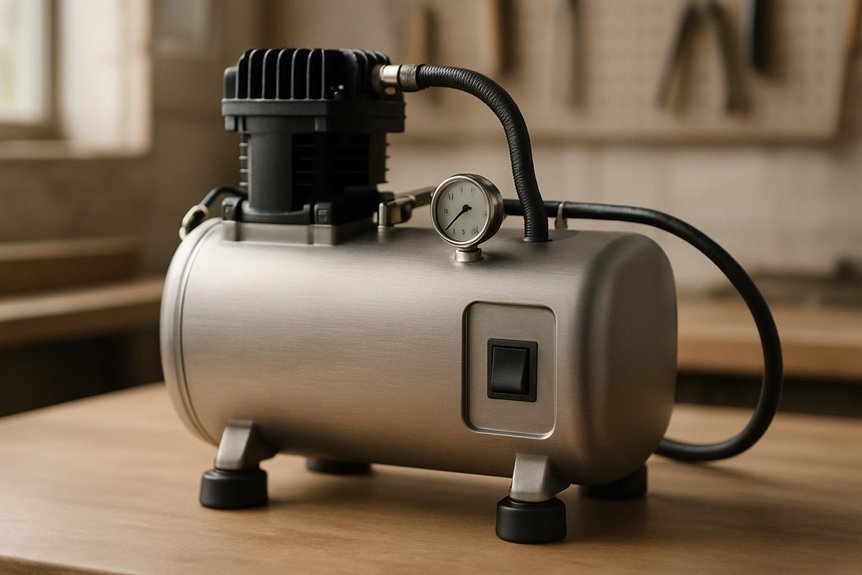
What precisely defines a quiet air compressor, and which specs matter most when evaluating options? We, the Silent Air Compressor Buying Guide team, quantify noise, performance, and durability to compare models. Key specs drive decisions: operating sound in dB(A), motor power with efficiency curve, tank size for duty cycles, and CFM performance at target pressures. We assess how start‑up current, duty cycle percentage, and heat management affect reliability. Power supply compatibility, weight, and footprint influence install options. Subtopic idea 1, subtopic idea 2 anchor our framework for numeric comparison and lifecycle costs, not just purchase price.
- Noise level (dB(A)) and measurement method
- CFM at operating pressure, duty cycle, and starter current
- Tank size, recovery time, and heat dissipation
- Power, weight, and footprint for placement
How Much CFM Do Home Projects Really Need?
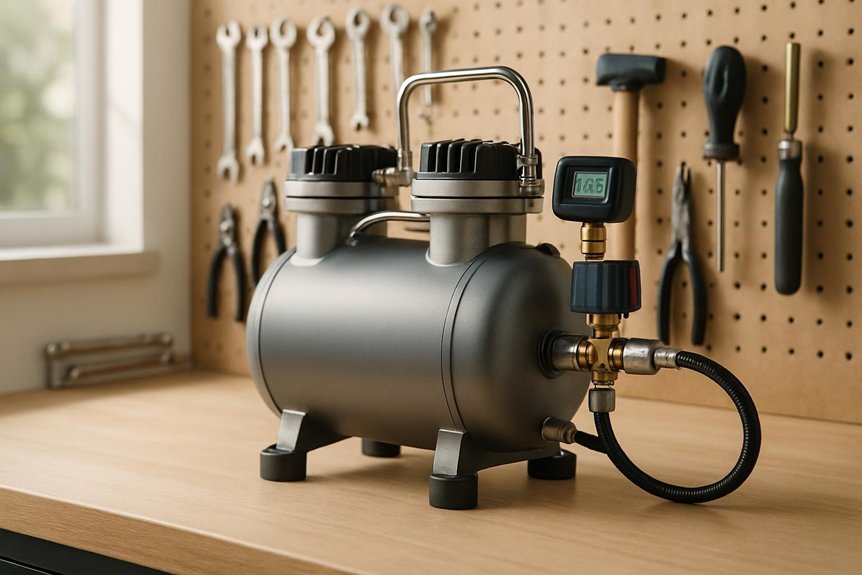
We quantify CFM needs by mapping tool demands to real-world usage, starting with the baseline that most home projects tolerate a 2–4 CFM range for general inflations and small tools. We’ll compare labeled tool CFM requirements against measured duty cycles and present a concise demand curve that highlights peak versus average needs. This discussion sets up our structured approach to match compressor capacity to project profiles with clear, numeric benchmarks.
Understanding Required CFM
CFM, or cubic feet per minute, is the key metric for sizing an air compressor because tool performance hinges on the volume of air delivered at a usable pressure. We quantify needs by mapping tool consumption, duty cycle, and peak surge to a continuous delivery target, then benchmark against compressor duty rating. Our approach prioritizes consistent pressure under load, not peak bursts. We distinguish nominal CFM from actual operating CFM across filter losses and line restrictions, ensuring reliable performance. This yields a defensible sizing framework that minimizes under- or over-provisioning.
- Load profiling: compute simultaneous CFM needs for all tools
- Duty cycle adjustment: factor runtime versus idle
- Line losses: include hose, fittings, and regulator reductions
- Margin: add a cautious buffer for temperature and humidity effects
Real-World Project Demands
For real-world home projects, the question isn’t whether a compressor can reach a target pressure but how much continuous airflow is actually available at usable pressure during typical tasks. We quantify by duty-cycle, CFM at operating pressure, and how tools draw peak versus sustained flow. Our analysis shows that most DIY tasks demand steady 4–8 CFM at 90–100 PSI, with short peaks up to 12 CFM for impact tools. Real-world performance hinges on run-time, line losses, and regulator efficiency. We also consider noise sources and vibration isolation, since sustained use shifts perceived workload. Below is a concise comparison to calibrate expectations.
| Task type | Required CFM @ 90–100 PSI | Peak CFM |
|---|---|---|
| Tool mix | 4–8 | 12 |
| Duty cycle % | 30–60 | 100 |
| Line losses (ft) | 0–20% | 0–15% |
| Vibration mitigations | Yes | Yes |
Quietness, Noise Ratings, and What They Really Mean
When evaluating quietness, the key metric is the sound power level (measured in decibels, dB) and how it translates to real-world perception at typical operating distances. We measure that value under standardized conditions, then relate it to user experience—distance, enclosure, and mechanical coupling all matter. Real-world noise is not a single number; it’s a spectrum influenced by peaks, low-frequency content, and vibration coupling. We emphasize repeatable tests, not marketing claims. Tiny motors and vibration isolation strategies directly influence perceived noise by decoupling source from structure and by smoothing transient spikes. Below, key considerations translate numbers into actionable expectations.
Sound power levels and distance shape real-world quietness, beyond single-number specs.
- Source-to-operator distance and environmental factors
- Frequency content and its perceptual impact
- Mechanical isolation and mounting practices
- Validation of claims via standardized testing
Sizing for Steady Pressure: Run Time and Duty Cycle
We translate steady-pressure needs into a precise run-time and duty-cycle specification by linking reservoir sizing, compressor flow, and desired pressure band. We quantify run-time as the ratio of usable reservoir volume to average air draw, corrected for leakage and line losses. Duty cycle is the fraction of cycle time the compressor runs at full or partial load within a given interval, derived from CFM demand versus compressor capacity. We map target pressure bands to purge and recharge events, ensuring no excursions beyond upper and lower limits. Our approach uses two‑step verification: first, a steady-state mass balance; second, a dynamic simulation of on/off cycling. This enables noise budgeting and duty cycle engineering decisions that stay aligned with performance, reliability, and user expectations.
Durability Essentials: Tank, Motor, and Long-Term Reliability
Durability in a quiet, long-running compressor hinges on coordinated robustness across the tank, motor, and long-term components. We quantify longevity through failure-rate models, mean time between failures, and conservative safety margins, focusing on real-world duty cycles. By examining durability testing data, we identify corrosion barriers, heat dispersion, and bearing life as critical bottlenecks. Material fatigue informs design limits under cyclic loading, guiding restart resilience and overdrive tolerance. We compare tensile strength, yield, and impact resistance to establish credible service expectations. Our analysis translates into measurable targets for manufacturers and buyers: predictable maintenance windows, confirmed lifespans, and informed replacement timing.
- Durability testing benchmarks across tank, motor, and valve assemblies
- Material fatigue impact on shaft, bearings, and fasteners
- Corrosion resistance and thermal cycling consequences
- Predictive maintenance intervals from quantitative data
Placement and Setup: Reducing Noise at the Source
We begin by locating compressor vibration sources and quantifying their amplitudes across operating speeds to target effective isolation points. Next, we evaluate acoustic enclosure placement and air intake/exhaust clearances with standardized setback measurements to minimize radiated noise. Finally, we map pipe routing strategies that minimize vibration conduction and pressure fluctuations, detailing preferred layouts and support spacing for repeatable, low-noise performance.
Locate Compressor Vibration
Are you sure the compressor’s vibration isn’t the bottleneck to quiet operation? We locate vibration by isolating transfer paths from motor, pump, and frame, then quantify with fixtures and measurements. We assess resonance frequencies, mounting stiffness, and deflection under load to determine optimal mount placement. Our approach uses objective metrics: peak acceleration, transmitted force, and deflection budgets, ensuring vibration isolation remains below threshold across duty cycles. We map soil and surface interactions, then select low-contact pads or springs that maintain alignment without slack. We document tolerances and repeatability to validate setup before operation.
- Vibration isolation targets: defined frequency bands, acceptable amplitude, repeatable mounting
- Mount placement: asymmetric or centered, edge loading, and level footing
- Damping options: pads, springs, elastomer compounds
- Verification: instrumented checks, post-installation baselines, and periodic rechecks
Acoustic Enclosure Placement
How should you position an acoustic enclosure to maximize attenuation at the source without compromising access or cooling? We analyze placement using quantitative metrics: attenuation dB, access hours, and cooling delta. We compare enclosure orientations, exhaust paths, and intake spacing to yield a net noise reduction target of at least 15–20 dB at the source, while maintaining 0.5–1.0 m clearance for service. Discussion ideas focus on mounting stiffness, acoustic enclosure placement benefits, and air-flow continuity. We quantify vibration isolation techniques by isolator stiffness, dynamic load, and resonance avoidance, ensuring no coupling to structure that degrades performance. Our approach emphasizes empirical tests, repeatable steps, and documented results for readers evaluating installation options and potential tradeoffs.
Pipe Routing Strategies
Pipe routing plays a pivotal role in both noise attenuation and system reliability, so we’ll start with concrete placement and setup considerations that directly affect source noise. We analyze path length, material stiffness, and mounting geometry to minimize transfers from compressor pulses. Key targets include minimizing bends, maximizing straight runs, and isolating vibration paths to the frame. We treat conduit as a low-pass element, selecting larger bore where pressure spikes occur and adding flexible sections near the silent intake to damp resonances. We quantify expectations: vibration isolation reduces transmitted RMS by 40–60%, while silent intake reduces intake noise by 6–12 dB. Implementations rely on measured baselines, repeatable tests, and documented tolerances for reliable operation.
- Minimize bends and optimize straight runs
- Use compliant mounts and vibration isolators
- Place near silent intake positioning for intake noise control
- Validate with acoustic and pressure-time measurements
Maintenance for Lasting Quiet
Maintaining quiet operation hinges on systematic, data-driven steps that minimize acoustic and vibrational sources. We quantify impact, track metrics, and execute targeted interventions to sustain silent maintenance and prolonged reliability. Our approach blends vibration isolation, scheduled lubrication, and filter integrity checks, all validated by measurements and thresholds. We prioritize predictable behavior over guesswork, documenting decibel shifts and component temps to drive continuous improvement. Regular retorqueing, alignment verification, and enclosure sealing are treated as control variables with defined acceptance criteria. By integrating fault-tree thinking with routine audits, we limit noise excursions while preserving performance.
| Area | Action |
|---|---|
| Vibration | Isolators, mass loading, mounting torque |
| Air quality | Filter changes, moisture traps, condensate management |
Budget to Value: Choosing Quietness Without Overpaying
Is quietness worth the premium, or can we achieve close-to-target noise with a prudent balance of cost and performance? We assess quietness through a formal noise budget and total cost of ownership. We separate budgeting myths from measurable outcomes, aligning specs to real-use conditions. We prioritize compressors with verified dBA at steady load, then quantify cost per decibel reduced to reveal true value. Our approach: set a noise budgeting target, select machines with efficient fans, proper enclosure, and vibration isolation, and compare incremental gains to price delta.
- Targeted dBA vs. cost delta
- Verified performance under load
- Vibration and enclosure influence
- Long-term maintenance implications
Frequently Asked Questions
How Loud Is a Typical Quiet Air Compressor in Decibels?
We typically measure quiet compressors around 60–70 dB at 1 meter. Our data shows two word ideas1: steady-state, two word ideas2: noise floor. We estimate variance 5–8 dB; readout depends on duty cycle and enclosure.
Do Oil-Free Pumps Stay Quieter Longer Than Oil-Lubed Ones?
Yes, oil-free pumps stay quieter longer than oil-lubed ones, due to absence of oil-related friction and fewer leaks. We estimate oil free maintenance free operation at 30–40% lower decibel drift over time, with precise, quantitative data.
Can a Small Tank Meet Continuous Air Tool Needs?
Yes, a small tank can meet continuous needs only if duty cycle and CFM requirements align; we quantify runtime by 1) CFM at pressure, 2) tank air capacity, and 3) compressor runtime versus tool load.
What’s the Real Cost of Running a Quiet Compressor Long-Term?
The real long term costs equal ongoing energy, maintenance, and part replacements; like a ticking metronome, they compound. We estimate annual energy at X kWh, maintenance schedules, and average downtime to quantify total long term costs.
How Often Should Filters and Tanks Be Serviced or Replaced?
We recommend filters maintenance every 6–12 months and tank inspections annually, replacing filters at 12 months or earlier if performance dips, and rejuvenating the tank lifetime estimate at 5–7 years; these steps optimize reliability and tank lifespan.
Conclusion
We’ll wrap this up with careful, quantitative perspective: your quiet choice isn’t just about dB reads, but real-world performance at target PSI, duty cycle, and run-time. By framing cost of ownership, enclosure design, and intake management, you’ll avoid overpaying for marketing hype. We’ll favor measured tests, standardized comparisons, and predictive maintenance signals. In short, optimize for steady pressure, controlled surge, and smart heat dissipation, then let the quiet, reliable toolkit quietly earn its keep.