It’s estimated that a typical workshop wastes up to 20% of compressed air through cycling losses and leaks. We’ll break down how tank size governs responsiveness, surge damping, and duty cycle, then map it to real-world usage. We’ll outline steps to determine CFM, PSI, and demand patterns, compare small versus large tanks, and show practical implications for startup cycling and heat. If you’re planning a scalable system, you’ll want concrete criteria before choosing a tank.
Key Takeaways
- Tank size affects how quickly pressure drops and how often the compressor runs, balancing duty cycle and delivery stability.
- Small tanks suit intermittent, light tasks; large tanks provide steadier air, reduced cycling, and better peak support.
- Use target PSI, cut-in/cut-out pressures, and CFM demand to calculate usable volume and required storage.
- Larger tanks dampen surges and moisture buildup but require more space and initial cost.
- Modular, scalable tanks and shared controls simplify upgrades and capacity planning with minimal downtime.
Determine Your Requirements: CFM, Pressure, and Duty Cycle
To size an air compressor accurately, we start by identifying three core requirements: CFM, desired pressure (PSI), and duty cycle. We, as readers, need a precise method to translate those metrics into tank sizing. First, determine your CFM peak need, then map it to a compressor that sustains that flow without droop. Next, set the target PSI based on tool requirements, and ensure the system can reach and hold that pressure with minimal cycling. Finally, define the duty cycle, deciding how long the compressor runs in a given period to prevent overheating. In practice, this yields clear benchmarks for tank volume and compressor speed. For practical planning, consider discussion ideas and unrelated topics only as reference points, not design constraints.
Small Tanks vs. Large Tanks: When Each Works Best
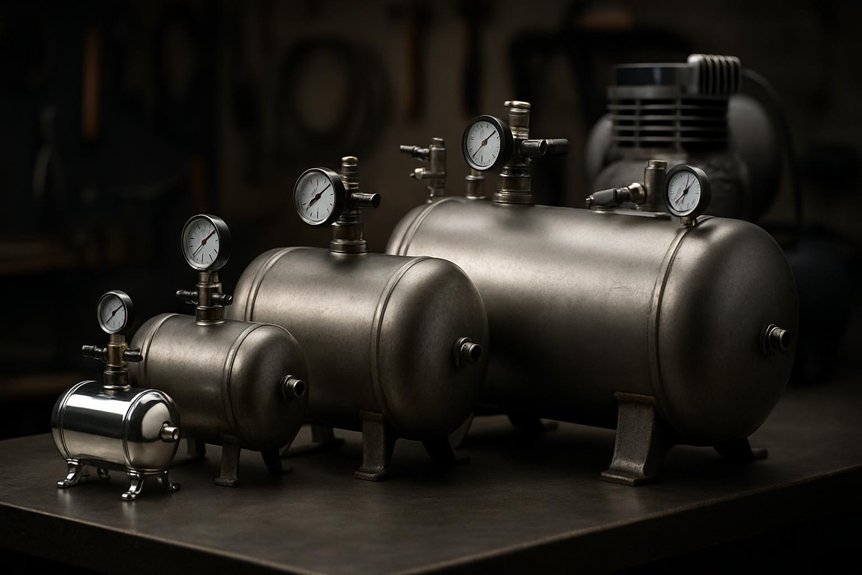
So, when should you choose small tanks versus large tanks, and what makes each option preferable in practice? We address this by deployment scenario and load patterns. Small tanks deliver quicker response for intermittent, light-duty tasks with lower initial cost and space, while minimizing air storage means less pressure drop impact between cycles. Large tanks provide sustained delivery through higher total stored volume, reducing duty-cycle fluctuations on continuous or high-demand work, at the expense of higher footprint and cost. For short bursts, small tanks enable fast cycling and simpler maintenance. For continuous usage or high-demand tools, large tanks stabilize pressure more effectively and extend compressor life. Choose based on duty cycle, average CFM, and available space, ensuring system balance.
How to Calculate the Ideal Tank Size Step by Step
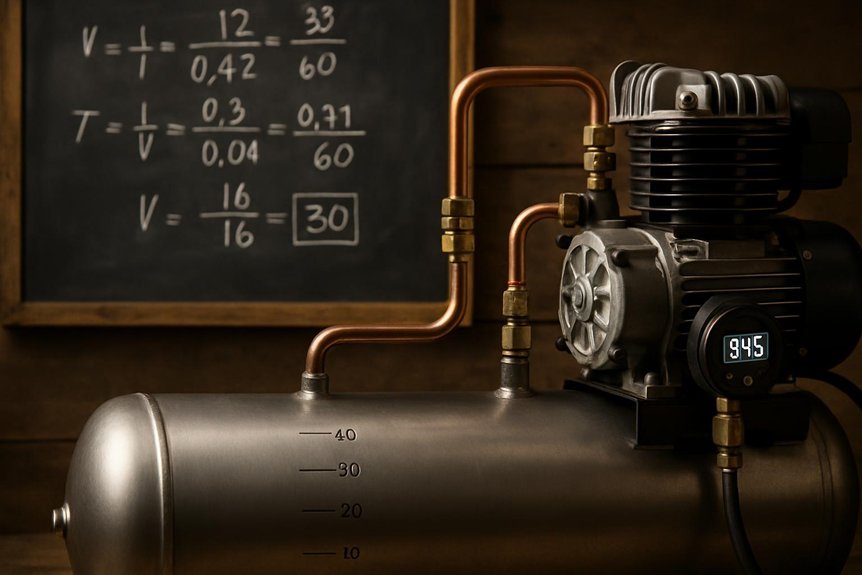
We’ll start by determining the required CFM for our tools and expected runtime. Next, we’ll consider the PSI range to ensure adequate headroom and recovery, then calculate the tank volume needed to meet those flow and pressure goals. This step-by-step approach keeps the sizing precise and aligned with system demands.
Determine Required CFM
Determining the required CFM is the key to sizing your air compressor tank accurately. We begin by listing the maximum CFM demands of each tool or process, then sum them with a safety margin. Next, we convert continuous CFM needs to a pulsed profile, acknowledging that peak surges occur during start-up. We select a compressor with a rated CFM equal to or slightly above the combined demand, ensuring adequate recovery time for compression and no excessive cycling. We quantify duty cycle, storage volume, and compressor lag, and we document acceptable operating ranges. We avoid discouraged topics and irrelevant considerations, focusing on measurable inputs. Finally, we validate results against real-world usage, adjusting for standby pressure and leakage. The goal is a predictable, stable supply that minimizes empty runs and pressure fluctuations.
Consider PSI Range
How big should the tank be for a given pressure range? We analyze PSI bands to determine usable air storage before cycling. We define a target cutoff: cut-in pressure, where the pump starts, and cut-out pressure, where it stops. The difference (pressure swing) drives cycle frequency and tank usefulness. For a mini compressor or portable setup, aim for a modest air-muffler of storage that reduces starts, while not overemphasizing idle weight. In a stationary system, larger tanks smooth demand peaks and minimize compressor runs. Convert CFM and duty cycle into a required air storage volume by multiplying the expected draw by the allowable cycle time and adjusting for pressure drop. Align tank size with system type, ensuring reliable, efficient operation across operating PSI ranges.
Calculate Tank Volume
To size a tank precisely, start from your target cut-in and cut-out pressures and the expected air draw. We then calculate volume using V = (P1 × MA) / (P2 − P1), where MA is air delivery per cycle. We translate your pressures into usable tank capacity, choosing between mini tanks for small duty and large tanks for sustained draw. The following table visualizes the relationship:
| Target P (PSI) | Cut-in PSI | Tank Volume (gal) |
|---|---|---|
| 90/120 | 90 | 4–6 |
| 100/130 | 100 | 9–15 |
| 110/140 | 110 | 20–30 |
This method yields a precise, repeatable size and highlights why mini tanks differ from large tanks in duty and efficiency.
Practical Implications: Startup Cycling, Heat, and Air Stability
We’ll examine how startup cycling, heat buildup, and air stability interact with tank size and system design. We’ll discuss how short cycling wastes energy, increases wear, and affects pressure consistency, while heat and ambient conditions influence compressor efficiency and moisture management. Our goal is to outline practical considerations that guide selection and operation to maintain steady airflow and reliable performance.
Startup Cycling Impact
Startup cycling can have immediate effects on a compressor system’s heat and air stability. We describe how brief on/off cycles raise refrigerant-like heat transients and stress components, yet still preserve detectable air stability during steady-state runs. Our focus is on cycle frequency, not load duration, since frequent starts increase motor currents and pressure fluctuations, potentially altering compressor clearances and piping response. We examine how tank size influences surge behavior: larger tanks dampen pressure spikes, reducing frequent cycling, while small tanks permit quicker pressure rebounds but intensify startup events. We quantify acceptable cycling ranges relative to motor cooling and unloader efficiency, linking them to air stability metrics such as pressure ripple and recover time. In practice, choosing an appropriate tank size mitigates startup cycling effects and maintains stable output.
Heat and Air Stability
How does startup cycling influence both heat load and air stability in a compressed-air system? We, as designers, examine startup cycles as the dominant trigger for transient heat addition and pressure drift. Frequent cycling raises heat load through rapid compression, increasing heat retention in the tank and surrounding components, which elevates moisture saturation and reduces efficiency. Each idle period allows partial cooling, but repeated starts produce oscillating air charge levels that transiently shift system pressure and flow. Stable operation depends on cohesive control of thermostat or pressure switch, proper insulation, and tank sizing to dampen these transients. By aligning air charge targets with demand patterns, we minimize peak heat and maintain consistent pressure delivery.
Use-Case Profiles: Hobby, DIY, and Professional
What use-case profile best fits your needs—hobby, DIY, or professional—directly influences the ideal air compressor tank size. We categorize profiles to align capacity with task frequency and runtime, ensuring predictable performance and reduced cycling. For hobby, smaller tanks minimize space and cost while tolerating longer downtime between cycles; DIY requires a balanced tank to handle moderate tools and occasional sprint use; professional use demands larger tanks for continuous duty and reduced pressure drops. Our framework emphasizes duty cycles, recovery rates, and system leakage. Table conveys the relationship between profile, tank size, and expected behavior.
| Profile | Recommended Tank Size (gal) |
|---|---|
| Hobby | 6–20 |
| DIY | 20–60 |
| Professional | 60+ |
Upgrades and Future Planning for a Scalable System
As our use-case framework clarifies how tank size should scale with workload, planning for upgrades and future growth is the next step: we design with modularity and predictable performance in mind. Our approach emphasizes upsize scalability through staged capacity, avoiding overcommitment while preserving response margins. We implement modular expansion using standardized ports, interchangeable tanks, and shared controls to minimize downtime. Future plans include evaluating duty cycles, peak demand windows, and where bursts occur, so we can add compressors or reserve capacity without reengineering the core system. Documentation covers upgrade paths, cost-to-benefit analyses, and compatibility matrices. We validate by simulating load projections and verifying pressure stability under diverse scenarios, ensuring that expansions remain seamless, scalable, and aligned with operational targets.
Frequently Asked Questions
How Do Noise Levels Vary With Tank Size?
Noise levels generally drop with larger tanks due to extended cycling and smoother air delivery. We analyze noise reduction through tank sizing, accounting for compressor duty cycle and orifice losses, guiding our recommendations for quieter operation and effective dampening.
What Maintenance Schedule Is Tank-Specific?
We recommend maintenance intervals based on tank usage and duty cycle, inspecting daily and performing full checks quarterly to protect tank durability. We document pressure tests annually, monitor corrosion, and replace gaskets or safety valves as part of routine maintenance.
Do Tanks Affect Compressor Warranty?
We’re asking: do tanks affect compressor warranty? Yes—tank warranty terms can impact coverage; using non‑compliant or damaged tanks may void it. We factor noise considerations, safety standards, and calibration when evaluating warranty implications for tank use.
Can a Split-Tank System Improve Performance?
Answering yes: a split-tank system can boost performance by reducing pulsations and improving airflow. We see split tank efficiency rise with balanced delivery, while dual tank readiness supports steady duty cycles; we, too, optimize pressure regulation and reliability.
How to Choose Tanks for Renewable Power Setups?
We choose tanks for renewable power setups by balancing storage, discharge rate, and inverter compatibility; prioritize passive cooling and humidity control, ensuring stability during cloudy periods while maintaining safe relay and thermal margins for continuous operation.
Conclusion
We’ve mapped the terrain, and with it, a clear image of our air system’s heartbeat: a tank that stores, buffers, and breathes with our tasks. When we size right, pressure steadies like a calm depth, and startup surges fade into a whisper. We’ll balance CFM, PSI, and duty with measured steps, planning future growth. In practice, it’s a precise, scalable dance—practical, predictable, and ready for whatever we lift off the bench tomorrow.