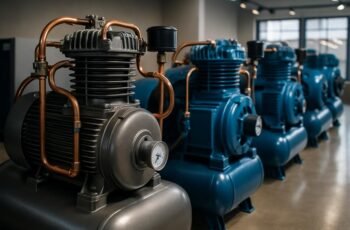
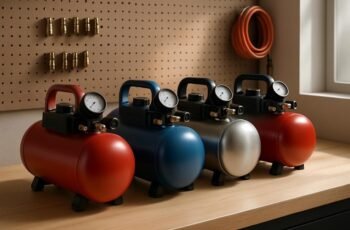
Like a well-tuned machine, we can break down when a high‑pressure air compressor makes sense and how to size it precisely. We’ll quantify your psi, CFM, and duty needs, compare fixed versus portable options, and weigh oil-lubed against oil-free choices, all against cost of ownership and maintenance. We’ll also map tank size to job cadence, noise, and heat, leaving you with a clear path that invites you to push further while you stay grounded in data.
Key Takeaways
- Quantify needs: match psi, CFM, and duty cycle to tool demand, usage pattern, and peak loads to avoid over- or under-specification.
- Tank size vs portability: balance refill cadence, workload bursts, heat, and mobility for real-world duty cycles.
- Choose compressor type wisely: weigh fixed vs portable, oil-lubed vs oil-free for reliability, maintenance, and air quality.
- Prioritize maintenance and TCO: robust filtration, cooling, alerts, and spare-parts lead times to minimize downtime and lifecycle cost.
- Plan modular upgrades: select a base brand with clear upgrade paths and modularity for scalable pressure, flow, and control enhancements.
Do You Really Need a High-Pressure Compressor for Your Project?
Do you really need a high-pressure compressor for your project? We approach this with a data-driven mindset, weighing function against cost, risk, and reliability. First, we quantify pressure requirements: what tools demand, duty cycle, and peak loads dictate. Next, we compare air delivery options, noting that higher pressure often reduces volume efficiency and increases energy use. We assess equipment longevity, maintenance intervals, and safety features, since sustained high-pressure operation introduces escalating failure modes. We also map downstream workflows to determine if standard compressors can be boosted with regulators or boosters rather than full high-pressure units. In this analysis, high pressure considerations and practical uncertainties frame our recommendation, ensuring we avoid over-specification while delivering dependable performance aligned with real-world needs.
Understanding PSI, CFM, and Duty Cycle in Plain English
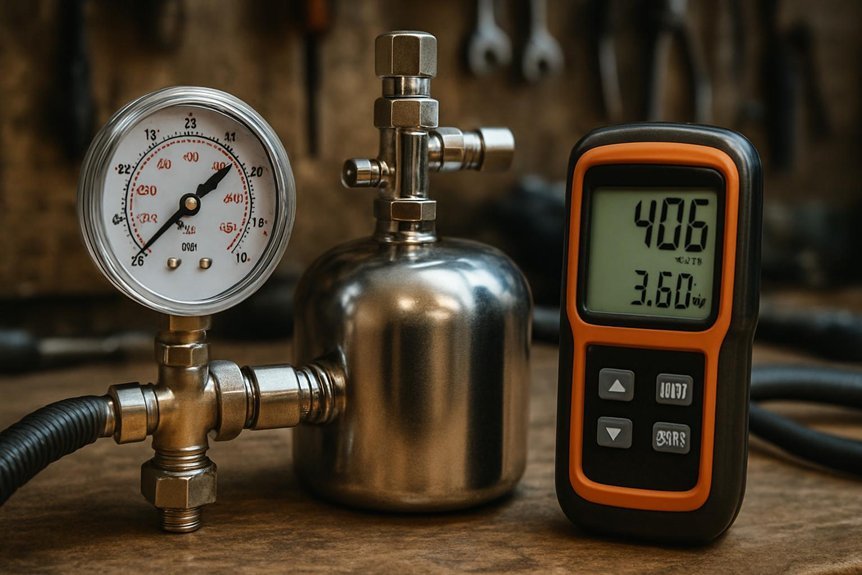
As we move from weighing high-pressure vs. standard setups to how performance actually plays out, we’ll define key terms in practical, numbers-driven terms. understanding psi, cfm, and duty cycle, plain english.
- PSI explains pressure delivered to tools; higher psi isn’t always better if flow drops.
- CFM measures how much air volume moves per minute; matches tool demand, not just compressor size.
- Duty cycle is the percent time a unit can run before cooling pauses; higher duty means steadier output.
- Matching metrics requires reading specs as a system, not in isolation.
We’ll translate specs into real-world expectations, quantify tradeoffs, and help you pick targets that align with your tasks and runtime.
Tank Size and Portability: Matching Capacity to Your Jobs
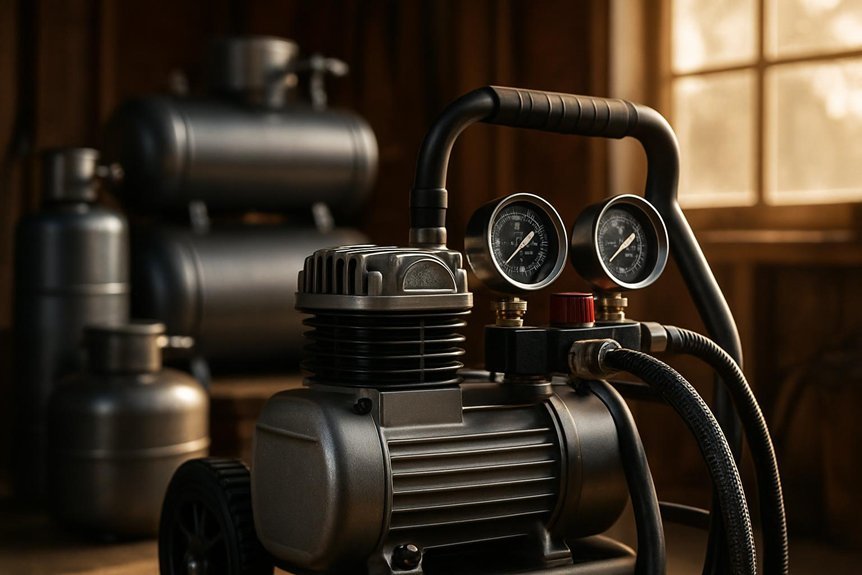
Tank size and portability aren’t afterthoughts; they’re the heartbeat of a reliable workflow. We analyze how tank capacity intersects with your job timeline, refill cadence, and tool demands to minimize downtime. Larger tanks reduce cycle starts, but add weight, space, and heat load; smaller tanks boost mobility but increase refill frequency. We quantify trade-offs by mapping CFM bursts to expected duty cycles and typical usage hours per week. We also account for budget constraints, balancing upfront cost against longer-term efficiency gains and maintenance. Noise considerations factor in too: larger tanks can smooth pressure but may escalate compressor runtime and sound levels. Our method is to match tank volume to peak simultaneous tool demand, then validate with real-world testing and phased upgrades.
Which High-Pressure Compressor Type Should You Buy? Fixed, Portable, Oil-Lubed, or Oil-Free
We’ll compare fixed versus portable setups, weighing consistent duty cycles, space needs, and grunt factors to match your workflow. We’ll also assess oil-lubed versus oil-free options with reliability, maintenance, and air-quality implications in mind. Our approach uses data-driven criteria to guide application suitability and help you select the most appropriate type.
Fixed vs Portable
Choosing between fixed and portable high-pressure compressors hinges on how you plan to use it: power needs, space, and portability constraints drive cost, performance, and maintenance implications. We compare reliability, total cost of ownership, and suitability for our typical workbenches and fields. Key considerations include vibration, footprint, and service access, which influence unexpected noise and noise mitigation strategies.
- Assess installation footprint and vibration transfer to determine mounting needs.
- Evaluate runtime requirements to balance cycling, cooling, and fuel or electricity costs.
- Compare maintenance intervals, parts availability, and expected downtime.
- Weigh portability benefits against potential performance trade-offs and storage constraints.
Conclusion: fixed units excel in steady workloads; portable units win for mobility. Choose based on duty cycle, space, and logistical demands.
Oil-Lubed vs Oil-Free
When deciding between oil-lubed and oil-free high-pressure compressors, we start by comparing the core trade-offs that affect reliability, maintenance, and total cost of ownership. We evaluate wear, filtration needs, servicing intervals, noise, and lifecycle costs to determine suitability for fixed or portable use. Oil-lubed units generally offer smoother operation and longer service intervals but demand oil management and potential contamination controls, while oil-free models reduce maintenance steps yet may incur higher costs per CFM and shorter component life.
| Factor | Impact |
|---|---|
| Reliability | Oil lubed typically longer life; oil free may use simpler seals |
| Maintenance | Oil free lowers ongoing oil checks; oil lubed needs oil changes |
Application Suitability Guide
We need to determine which high-pressure compressor best fits your needs: fixed, portable, oil-lubed, or oil-free? We approach this by evaluating use-case, reliability, and lifecycle costs. Our framework weighs practicality against performance data, ensuring options align with care maintenance needs and energy efficiency. Below are key suitability factors:
1) Application scope: fixed units suit continuous duty; portable models fit changing sites.
2) Duty cycle and heat management: oil-lubed machines excel under heavy use; oil-free reduce filtration needs.
3) Contamination tolerance: oil-free minimize oil carryover; fixed oil-lubed require filtration care.
4) Total cost of ownership: energy efficiency and maintenance intervals drive long-term value.
We’ll compare specs, verify duty cycles, and quantify energy use to guide you to the optimal choice.
Features That Prevent Downtime and Extend Life (Filters, Coolant, Oils, Maintenance Alerts)
High-pressure air compressors rely on robust filtration, reliable cooling, proper lubrication, and proactive maintenance alerts to minimize downtime and extend component life. We examine filters, coolant, oils, and alerts as a system: each element reduces wear, flags issues early, and supports consistent performance. Our approach is data-informed: monitor differential pressures, lubrication schedules, and coolant temperatures to quantify impact on uptime and life extension. Prioritize inline filtration to protect valves and seals; select oils with oxidation resistance for extended intervals; ensure coolant loops maintain stable temperatures under load; implement maintenance alerts tied to usage hours and sensor data.
| Factor | Practical impact |
|---|---|
| Filters | Traps contaminants, cuts wear |
| Maintenance alerts | Schedules proactive service |
Buying Checklist: Reliability, Warranty, and Total Cost of Ownership
How do we choose a high-pressure air compressor that lasts and costs less over time? We approach reliability, warranty, and total cost with a data-driven lens, aligning specs to real-world use. We perform a reliability comparison across models, weighing failure rates, mean time between failures, and service intervals. We then assess warranty terms, coverage depth, and response speed, translating policy into expected uptime. Finally, we calculate total cost of ownership, including purchase price, energy use, maintenance, and potential downtime. Our checklist includes:
1) Verified reliability data and supplier support
2) Clear warranty terms and transferability
3) Transparent maintenance costs and intervals
4) Documented energy efficiency and downtime impact
This method yields objective, actionable insights for durable, cost-conscious choices.
Brand and Upgrade Planning: Choosing Wisely Now and Later
We’ll build on our reliability and TCO framework to map out brand choices and upgrade timing, using a data-driven lens to decide what to buy today and what to plan for later. We approach brand evolution with a structured criteria set: performance stability, component availability, service network, and total lifecycle cost. We compare manufacturers by documented failure rates, maintenance intervals, and spare-part lead times, then translate findings into clear upgrade paths. Our method emphasizes modularity where possible, enabling phased enhancements without major overhauls. For readers, this means selecting a base-brand with strong upgrade paths, documented upgrade options, and predictable resale value. We’ll document decision points, thresholds, and timing, so choices today support scalable reliability and smoother transitions to future pressure, flow, and control advancements.
Frequently Asked Questions
How Long Does a High-Pressure Compressor Typically Last?
A high-pressure compressor typically lasts 8–12 years with proper maintenance. We analyze wear, oil, seals, and duty cycles; old tech may introduce new issues, yet rigorous servicing often extends life. We compare data across models for reliability.
What Maintenance Tasks Are Essential for Reliability?
We see that neglecting essential checks reduces reliability maintenance success by up to 40%. We perform regular oil, filter, and V-belt inspections, monitor temps, and verify safety certifications to sustain reliability maintenance and safety certifications. We’re meticulous, data-driven, proactive.
Can You Retrofit Sensors to an Existing Unit?
We can retrofit sensors, but compatibility issues must be evaluated first; we analyze port types, power needs, and firmware, then test readings. We document results, adjust wiring, and confirm accuracy before deployment.
How Do Noise and Vibration Affect Performance?
Noise and vibration can dramatically reduce efficiency, sometimes by 15–20%. We, accordingly, analyze noise regulation and vibration isolation, measure decibels and amplitude, and adjust mounts and routing to improve performance and reliability.
What Safety Certifications Should I Look For?
Safety certifications we trust include OSHA, CE, UL, and ASME; Compliance standards demand documented test data, leak checks, and maintenance logs. We analyze figures, compare metrics, and guide you toward options that meet regulatory and performance benchmarks.
Conclusion
We’ve mapped the variables, quantified the tradeoffs, and aligned your needs with a coherent system. Before you commit, weigh PSI, CFM, duty cycle, tank size, and mobility against maintenance costs and service networks. The choice isn’t just what you need today, but how you’ll grow tomorrow. Stay disciplined: compare options, validate with real data, and anticipate upgrades. If you pause now, the right compressor will reveal itself—and your projects will run like clockwork.