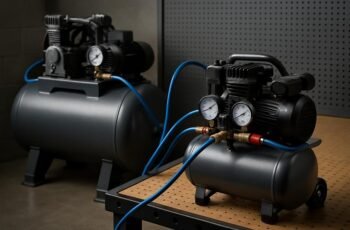
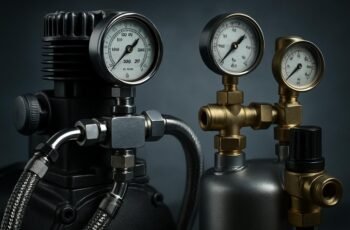
We understand you might think portable units are enough for most tasks, but stationary compressors offer steadier performance for extended runs and larger workloads. In this discussion, we’ll compare duty cycles, tank size, noise, and maintenance to help you weigh mobility against uptime and space needs. We’ll present practical use cases, costs, and a decision framework that clarifies when each form factor makes sense, leaving you with concrete criteria to act on.
Key Takeaways
- Portable vs stationary: portable units are lightweight with quick setup for on-site tasks, while stationary models offer higher duty, larger tanks, and fixed power delivery.
- Key metrics: CFM, PSI, and runtimes determine tool speed, pressure stability, and endurance, guiding the suitability for each use case.
- Use-case fit: tiny, intermittent tools favor portability; high-duty, continuous work favors stationary setups with centralized power.
- Cost and maintenance: portables usually lower upfront cost but higher long-term operating costs; stationaries cost more upfront but offer efficiency and longer service life.
- Quick decision framework: assess duty cycle, noise, portability needs, pressure/flow requirements, and lifecycle reliability to choose wisely.
Define Your Needs: Portable vs Stationary Compressors
To determine whether you need a portable or stationary air compressor, start by analyzing your work environment and the tasks at hand. We compare needs to constraints: mobility, uptime, and space. Portable units emphasize lightweight construction, simple setup, and quick repositioning, supporting short-duration operations and on-site tasks. Stationary models prioritize higher continuous duty, larger tanks, and robust framing for fixed locations. We weigh practicality against cost and maintenance cycles, determining if frequent transport or constant availability matters most. We assess workflow consistency, tool demands, and ventilation, ensuring electrical compatibility and noise considerations align with site rules. If you require flexibility, prioritize portability, but monitor portable durability under expected loads. For long-running, high-volume use, prioritize space optimization and fixed-system efficiency within a stationary configuration.
Key Performance Basics: CFM, PSI, and Runtimes Explained
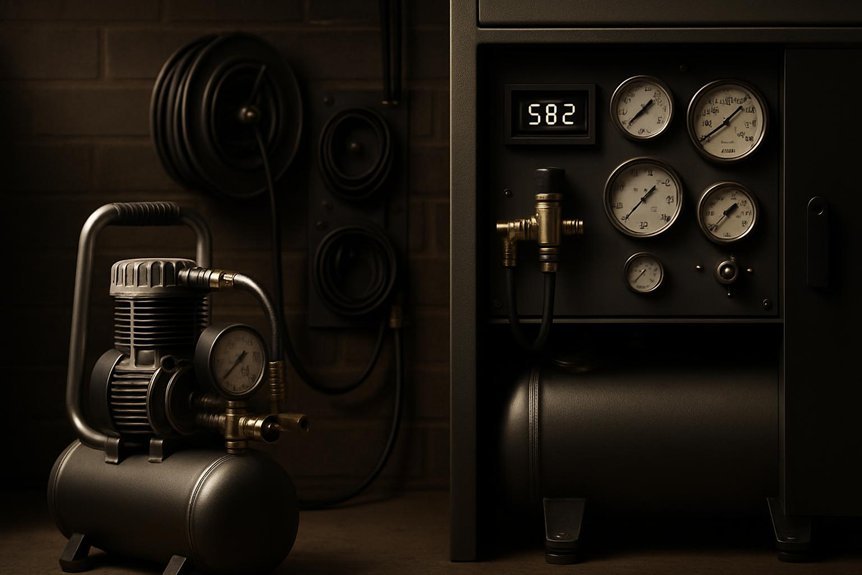
We’ve laid out how portable and stationary setups meet different work demands, and that groundwork leads us to the core performance metrics: CFM, PSI, and runtimes. CFM considerations quantify delivered air volume at a given runtime, informing tool compatibility and duty cycles. PSI dynamics describe pressure behavior under load, revealing how demand spikes affect starter strain, regulator response, and accessory performance. We analyze CFM as a function of rpm, motor size, and compressor design, noting that higher CFM with stable pressure yields faster tool operation but increases power draw and heat generation. Runtimes reflect tank capacity and duty cycle, dictating refill frequency. Together, these factors determine efficiency, cooling needs, and maintenance intervals, guiding selective choices between portable and stationary configurations for predictable workflow consistency.
Use Cases: When Portable or Stationary Makes Sense for Projects
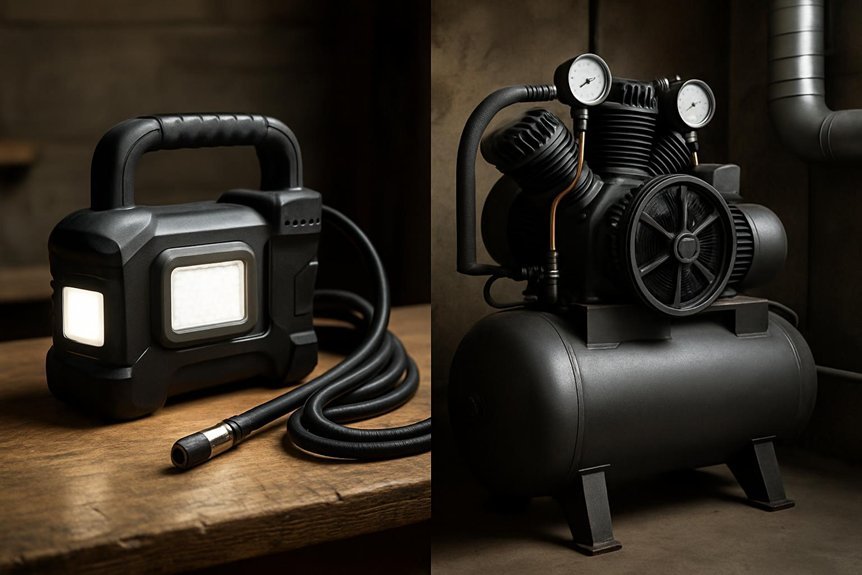
So, when should you choose a portable unit over a stationary setup—and what project signals the right fit? We approach this by matching tool demands to mobility, startup time, and access constraints. For tiny air tools requiring short bursts or intermittent use, portability minimizes setup loss and bridge-work delays, making a compact unit ideal. Stationary systems excel when continuous runtime, higher duty cycles, or centralized power delivery are needed, such as framing, decking, or drywall finishing where sustained airflow is critical. Noise considerations matter: if nearby occupants or shared spaces constrain operation, select models with lower dBA or mounted silencers, or schedule runs to reduce impact. In sum, assess tool variety, run-time consistency, and site access to decide where portability or stationarity yields the clearest efficiency edge.
Cost, Space, and Maintenance: What to Expect in Real-World Scenarios
Could the real-world trade-offs of cost, space, and maintenance tip the scales between portable and stationary compressors? We examine total ownership costs, not just sticker prices. Cost trends show portable units often have lower upfront outlays but higher long-term operating costs due to smaller tanks, more frequent refills, and higher energy per CFM. Stationary models typically incur higher initial investment yet deliver better efficiency, durability, and lower per-usage energy in continuous duty. Space considerations matter: portable units save floor area but require storage and handling, while stationary systems demand dedicated footprints and mounting. Maintenance routines influence reliability: portable units benefit from simpler components but more frequent service intervals; stationary systems rely on robust engineering, longer service cycles, and easier access for professional diagnostics. Overall, lifecycle cost clarity guides choosing the appropriate form factor.
Quick Decision Framework: A Practical Checklist to Finalize Your Pick
Do you want a quick, practical way to decide between portable and stationary compressors? We’ve built a concise checklist that translates specs into decisions, focusing on durability tradeoffs and noise considerations. Use this framework to align performance with usage patterns and long-term costs.
1) Assess duty cycle and expected run time to gauge material fatigue and maintenance intervals.
2) Compare inlet noise, enclosure design, and mounting to determine real-world sound profiles.
3) Map portability needs against required pressure, flow, and vibration control for stability.
4) Weigh upfront cost versus lifecycle reliability, service access, and replacement risk.
This framework streamlines choices, enabling data-driven selections while avoiding overengineering.
Frequently Asked Questions
How Do Noise Levels Affect Long-Term Workshop Use?
We find that noise levels considerably affect long-term workshop use, increasing fatigue and reducing focus, while vibration factors contribute to structural wear and tool alignment drift, and we measure noise impact to optimize scheduling, isolation, and acoustic treatments.
Can a Portable Compressor Handle Continuous Run Hours?
Yes, a portable compressor can run continuously within its run time limits, though sustained use risks overheating. We balance portable durability with duty cycle, monitoring temps and loads to optimize efficiency and reliability for extended projects.
What Maintenance Schedule Boosts Reliability the Most?
We schedule maintenance cadence strictly, because it boosts reliability most. Regular inspections, filter changes, oil levels, and leak checks are our reliability boosters, minimizing downtime and wear while maintaining performance across varying duty cycles.
Do Warranties Vary Between Portable and Stationary Models?
Warranties do vary: portable warranties tend to be shorter and more limited, while stationary models offer broader industrial coverage. We’ll compare terms, coverage durations, and exclusions to determine which aligns with your risk and usage profiles.
How Do Warranty Terms Apply to DIY Vs Professional Use?
We determine warranty terms by usage, not model type; DIY vs professional affects warranty scope and user eligibility. We analyze defect coverage, daily operating limits, and required professional installation, ensuring precise, transparent criteria for each use category.
Conclusion
We’ve weighed portable versus stationary compressors with clarity and precision, and our conclusion is practical: choose based on mobility needs, duty, and space constraints, then match CFM/PSI to your tools and runtimes. Portable excels where quick setup and relocation matter; stationary shines where uptime and efficiency dominate. Think of your choice as a bridge between flexibility and durability—built to carry your workflow across the job site, not just toward it. Your best fit is the one that minimizes compromises.