You probably don’t know how small changes in duty cycle or air-end efficiency can swing total costs by tens of percent over a compressor’s life. We’ll dissect how demand profiling, staged capacity, and maintenance intervals shape reliability and ROI. Our goal is a disciplined framework that weighs kW per CFM, part-load behavior, noise, and control strategies against space and tariffs. Stay with us as we map a practical path to a scalable, cost-conscious selection.
Key Takeaways
- Understand rotary screw basics: how air-ends trap and compress air, oil management, and noise/ enclosure impact on performance.
- Match sizing to demand: analyze duty cycles, load profiles, and peak events to determine appropriate capacity and staging.
- Evaluate efficiency and noise: compare specific power (kW/CFM), full/part-load performance, and measured sound power at typical points.
- Consider maintenance and TCO: plan routine oil/filter changes, component reliability, MTBF, downtime costs, and lifecycle economics.
- Assess fit and flexibility: review rotor topology, bearing/end clearance, serviceability, and controllability for process variability.
How Rotary Screw Compressors Work: Core Concepts
Rotary screw compressors operate by trapping air between two meshing rotors and reducing volume as the rotors turn. We analyze how this trapping yields continuous compression, with a smooth discharge profile that minimizes pulsations. The interaction of air, oil, and rotors determines efficiency: oil seals gaps, lubricates surfaces, and aids heat transfer, while the swept volume governs intake and exhaust timing. We examine how oil separation, where lubricant is removed from the compressed air before delivery, reduces contamination and downstream maintenance. Sound dampening becomes essential to control vibration transmission and noise, influencing mounting, enclosure design, and organizational compliance. We emphasize steady-state performance metrics—volumetric efficiency, pressure ratio, and thermal stability—because predictable behavior guides system integration and maintenance planning.
Size Your Compressor: Demand Profiles and Duty Cycles

Sizing a compressor starts with understanding the demand profile and duty cycle, because these factors determine the required capacity, headroom, and control strategy. We analyze load patterns across shifts, processes, and peak events to establish a representative size profile. Size profiling combines historical usage, variability, and runtime to map compressor runtime against demand, guiding selection of base load versus modular capacity. Duty cycle interpretations help us quantify how often the unit runs at specified loads, informing control methods and storage needs. We translate profiles into a target compressor size, compressor bank layout, and staged ramping logic. Our approach emphasizes minimal oversizing, avoiding unnecessary energy use while sustaining reliability and supply. This disciplined assessment reduces cycling, improves stability, and aligns equipment with actual production needs.
Efficiency and Noise: Choosing Quieter, More Efficient Models
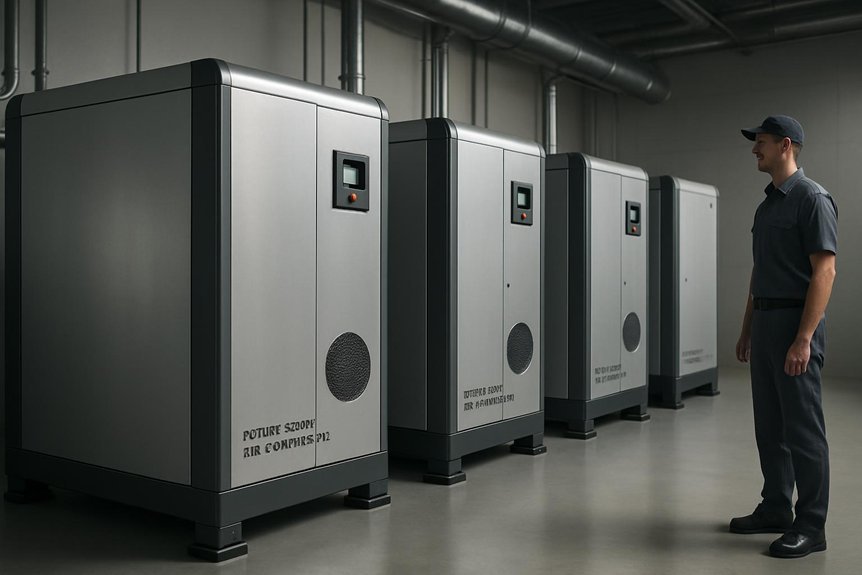
What benefits do quieter, more efficient models deliver in practice, and how should we evaluate those gains? We examine performance metrics, focusing on energy efficiency and noise reduction as primary success criteria. We compare specific power (kW per CFM) to quantify electrical input relative to output, then assess full-load vs. part-load efficiency to gauge everyday running costs. We also measure sound power levels and acoustic profiles at typical operating points, translating them into workplace impact and regulatory compliance implications. Selecting quieter units often reduces ductwork and enclosure requirements, improving serviceability and heat rejection management. We prioritize models with advanced control strategies, variable-speed drives, and high-efficiency compressors to minimize energy losses during part-load. Overall, the goal is a net decrease in energy consumption and audible emission without sacrificing reliability.
Rotary Screw Air-End Types and Configurations
From the efficiency-focused discussion above, we now examine the Rotary Screw air-end types and configurations that underpin both performance and reliability. We, as practitioners, analyze how meshing precision, rotor geometry, and seal integrity influence volumetric efficiency and heat generation. Common air-end topologies include single-entry/dual-rotation designs and advanced screw profiles that minimize slip and pulsations. Configurations vary by bearing arrangement, end clearance, and lubrication method, each affecting startup torque, belt load, and efficiency curves. We compare proposal concepts like modular housings, integrated cooling, and pre-load adjustments to assess interchangeability and serviceability. Design variations impact noise, leak paths, and maintenance intervals, guiding selection toward consistency with load profiles and duty cycles. Our critique targets predictable performance, scalable output, and matched compressor-system integration.
Maintenance, Reliability, and Total Cost of Ownership (TCO)
We’ll start by outlining the maintenance costs that typically recur across rotary screw systems and how they map to TCO. Then we’ll summarize reliability metrics—mean time between failures, scheduled vs. unscheduled downtime—and their impact on long-term operating costs. This framework lets us compare options with a clear view of reliability performance and total ownership expense.
Maintenance Costs Breakdown
Maintenance costs for a rotary screw air compressor hinge on three core components: routine service intervals, component reliability, and the cumulative TCO. We quantify maintenance budgeting by separating preventive tasks from corrective actions, aligning intervals with manufacturer specs, wear rates, and operating conditions. Regular oil changes, filter replacements, and gas-path inspections drive predictable expense curves, while unplanned downtime inflates costs beyond baseline projections. Component wear directly influences midlife service scope, replacement timing, and spare-part strategy, underscoring the importance of accurate wear modeling in budgeting exercises. We present a method to map costs across asset life, differentiating upfront capex from ongoing O&M. Our aim is transparency: linking maintenance decisions to observable cost drivers and supporting data-driven choices that minimize total lifecycle expenditure.
Reliability Metrics Overview
Reliability metrics tie directly to our maintenance and cost framework by translating observed performance into actionable indicators. We focus on reliability benchmarks to quantify consistency, predict failures, and optimize service intervals. By classifying failure modes, we translate symptoms into targeted interventions, reducing downtime and TCO. Our approach blends preventive checks with data-driven alerts, enabling timely part replenishment and root-cause analysis. We measure mean time between failures (MTBF), failure severity, and repair turnaround to frame risk and cost implications. This structured view supports informed buy decisions and ongoing equipment stewardship.
| Metric | Description |
|---|---|
| MTBF | Average uptime between failures |
| Failure mode | Nature of primary faults |
Compare Models for Your Shop or Plant: A Practical Decision Matrix
We compare models using a concise decision matrix that weighs Model Efficiency, Operational Cost Insights, and Suitability for Applications. This framework helps us quantify performance across efficiency, running costs, and fit to specific shop or plant needs. By aligning these factors, we establish clear criteria for selecting a rotary screw air compressor that meets both technical requirements and budgetary constraints.
Model Efficiency Matrix
How do we quickly identify the best match for your shop or plant when evaluating model efficiency? We construct a model efficiency matrix that maps compressor variants to measurable performance attributes. We compare rated flow, pressure range, and duty cycle alongside energy consumption under representative loads. We weight efficiency by operating point relevance, then normalize results to enable apples-to-apples decisions across brands. We emphasize steady-state and partial-load behavior, noting how control strategies (VSD, unloading schedules) influence real-world energy use. We also track thermal management and accessory parasitics that erode nominal efficiency. By synthesizing unit-specific energy consumption against required output, we reveal gaps between advertised spec sheets and practical performance. This matrix guides purchase choices toward consistent, sustainable operating costs.
Operational Cost Insights
Operational cost is where the rubber meets the road: a practical decision matrix translates model efficiency into real-world spending and downtime implications. We quantify life-cycle costs by contrasting capital, maintenance, and energy expenses across models, then normalize for usage hours and load profiles. Operational costs hinge on compressor efficiency, part-load performance, and the frequency of service events, all of which influence uptime and labor requirements. We factor energy pricing into annualized totals, applying actual or projected tariff structures to estimate cost variation between units. Our comparison emphasizes consistent data: rated efficiency, full-load and part-load COP, maintenance intervals, and component replacement costs. By aligning these metrics with shop demand, we reveal total ownership implications, enabling informed, data-driven equipment choices that minimize operating risk and maximize return on investment.
Suitability For Applications
Which models best fit your shop’s workload and reliability requirements, and how do they align with your process, space, and energy constraints? In this section, we evaluate suitability for applications with a practical decision matrix. We compare models by duty cycle, pressure range, and controllability, translating specifications into real-world outcomes. Our discussion ideas center on matching compressor performance to peak and off-peak demand, storage strategy, and maintenance impact on uptime. We assess how plant layout, noise limits, and utility tariffs influence selection, prioritizing reliability and scalable capacity. We also map application types—continuous production, intermittent tooling, and critical air feeds—to suitable configurations. Final recommendations emphasize alignment with process tolerances, energy efficiency opportunities, and total-cost-of-ownership implications, highlighting suitability applications that minimize risk while maximizing productivity.
Frequently Asked Questions
What Are Common Failure Modes for Rotary Screw Compressors?
We observe common failure modes: bearing wear and seal leaks, which we mitigate by monitoring vibration, temperature, and lubrication. We’ll diagnose, quantify wear rates, and implement preventive maintenance, ensuring seals remain intact and bearings operate within spec.
How Do Ambient Conditions Affect Compressor Performance?
Ambient conditions directly affect performance: higher ambient temps reduce ambient efficiency and hinder heat dissipation, forcing the compressor to work harder. We’ve tested this, and our data shows performance drops unless intake cooling and proper airflow are optimized.
Are There Retrofit Options for Legacy Systems?
We can retrofit legacy systems, evaluating retrofit economics and legacy integration to minimize downtime and extend life. We’ll compare costs, efficiency gains, and compatibility, and propose scalable options that fit current infrastructure while preserving performance and reliability.
What Warranties Cover Different Compressor Components?
We offer warranty coverage that varies by component, with defined component scopes; seals, bearings, and castings often receive different terms. We’ll explain exclusions, duration, and transferability, so you understand exactly what’s covered and for how long.
How Do You Assess a Unit’s True Operational Cost Over Time?
We estimate true operational cost by tracking energy use and maintenance over time, identifying spikes; a 20% efficiency gap often hides hidden costs. We pursue cost optimization while mitigating reliability risk through disciplined monitoring and data-driven decisions.
Conclusion
From here, we’ve mapped the critical levers—end design, filtration, lubrication, and control—that drive uptime and cost. By profiling demand, matching duty cycles, and sizing against staged capacity, you minimize oversize penalties and energy waste. Prioritize low kW per CFM, robust MTBF, and accessible maintenance. Compare models with a structured decision matrix, considering space, noise, tariffs, and storage. In short, pick for reliability and total cost, not just upfront price, and your ROI will follow. You’ll reap steady pressure, not surprises.