We balance the promise of high output with the reality of system complexity. As we guide you through choosing a reciprocating air compressor, we’ll weigh stage design, pressure needs, and duty cycles against noise, maintenance, and total ownership. Our approach is precise and data-driven, not hype-driven. We’ll outline how to match PSI and CFM to your tasks, compare oil-free versus oil-lubed options, and flag common pitfalls that impact uptime. Let’s start with how to quantify your actual shop demands.
Key Takeaways
- Assess shop needs and real-world use to match duty cycles, noise, reliability, and maintenance practicality with compressor specifications.
- Understand single-stage vs two-stage designs, stage counts, cooling/filtration, and how pressure handling and startup surges affect longevity.
- Size for PSI, CFM, tank volume, and duty cycle; balance demand, energy use, noise, and tank recovery dynamics.
- Evaluate total ownership: upfront cost, maintenance intervals, parts availability, warranties, and serviceability.
- Verify performance claims with real data: CFM at pressure, full-shift demos, noise in occupied spaces, and reliability over time.
Identify Your Shop Needs: DIY, Garage, or Industrial
When choosing a reciprocating air compressor, start by clearly defining your shop’s demands: DIY tasks, a home garage, or a heavier industrial workload. We assess duty cycles, runtime, and load variance to map capacity against anticipated tool use. We perform a concept comparison of CFM at operating pressure, startup surges, and storage options to prevent under- or over-sizing. We quantify noise considerations by measuring decibel levels at typical distances and evaluating enclosure effects, ensuring the unit fits within acceptable thresholds for our workspace. We prioritize reliability metrics, maintenance intervals, and component quality to reduce downtime. Our approach remains precise and data-driven, aligning compressor specs with actual usage, so selections optimize performance without excessive cost or complexity. This framing guides informed, practical decisions.
Reciprocating Air Compressor Types: Single‑Stage vs Two‑Stage
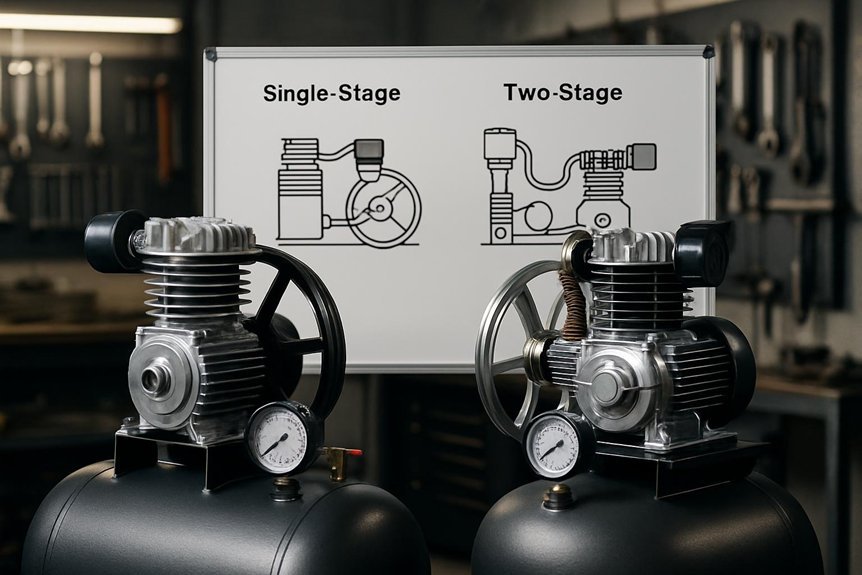
We compare single-stage and two-stage designs by examining stage count differences and how they influence output pressure and efficiency. We’ll highlight pressure handling variants, noting how two-stage units typically deliver higher pressures with better volumetric performance at runtime. This sets up a precise discussion of selection criteria for your shop’s demands.
Stage Count Differences
Stage count differences define a fundamental performance split between single-stage and two-stage reciprocating air compressors. We, as guides, compare compression paths: single-stage uses one piston and one compression event per cycle, while two-stage splits the process into two cylinders, first boosting pressure then refining it. This separation reduces discharge temperatures and improves volumetric efficiency at higher pressures, enabling better reliability under sustained duty. Stage count also influences efficiency, cooling needs, and maintenance access; fewer moving parts in single-stage can simplify design, whereas two-stage designs trade simplicity for output stability and reduced moisture carryover. When evaluating options, we consider duty cycle, desired pressure, and downstream usage. Two word discussion ideas emerge: optimization strategy. Overall, the stage count parameter directly shapes performance envelope and system life.
Pressure Handling Variants
Single‑stage and two‑stage reciprocating compressors handle pressure differently, and that distinction drives their suitability for specific duty points. We’ll outline how each variant manages flow, efficiency, and duty cycles, so you can match a model to your process. Key differences affect startup behavior, outlet pressure stability, and achievable pressure ratios. We emphasize system implications like inlet filtration and protection against startup surges, which influence long‑term reliability.
- Single‑stage units aim for modest pressure with simpler maintenance, but may exhibit higher discharge temperatures at load peaks.
- Two‑stage designs split compression across two cylinders, improving efficiency and pressure handling for higher duty points.
- Intercoolers and aftercoolers reduce temperature, aiding lubrication and longevity.
- Proper filtration and surge mitigation prevent premature wear and reduce operational risk.
Size It Right: PSI, CFM, Tank, and Duty Cycle
We start by clarifying how PSI and CFM relate to your runtime needs, so you can match delivery pressure with actual airflow. We’ll weigh tank size against duty cycle and usage patterns, ensuring recoveries align with peak demand. Finally, we’ll connect these factors to practical selection criteria that minimize downtime and maximize efficiency.
PSI Versus CFM Basics
Do you know how PSI and CFM relate to the real performance of a reciprocating air compressor? We measure PSI as pressure capability and CFM as delivered flow at a given pressure. Together, they define usable air for tools, cycles, and duty. Higher PSI increases potential pressure but may reduce CFM if the unit isn’t sized for both. We seek a balance where CFM meets tool demand without excessive tank cycling. Precision in matching PSI-CFM avoids energy waste and noise, aiding energy efficiency and noise reduction.
1) PSI sets the upper limit of tool performance, while CFM governs sustained output.
2) At constant demand, higher CFM with moderate PSI reduces cycling.
3) Oversized PSI for low CFM wastes energy and increases noise.
4) Always verify CFM at your target PSI for accurate sizing.
Tank Size Considerations
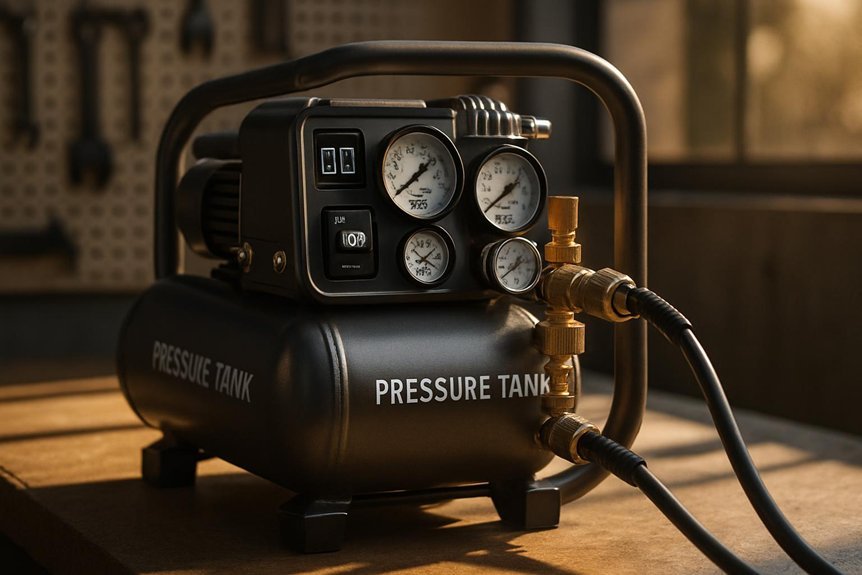
How big a tank do we actually need to smooth out demand without wasting space or energy? We size tanks to balance surge handling with system efficiency. In practice, tank size affects startup current, runtime pauses, and moisture control. We recommend tying tank capacity to CFM demand and valve sizing, ensuring the receiver stores enough air to cover peak draw without excessive dead volume. Proper tank selection minimizes cycling frequency and pressure fluctuations, while avoiding oversized vessels that raise cost and footprint. Consider duty cycle expectations and piping losses when selecting a nominal volume. Valve sizing interacts with tank volume to maintain stable pressure during demand changes.
| Characteristic | Guidance |
|---|---|
| Tank size metric | gallons (L) |
| Key factor | CFM demand, valve sizing |
Duty Cycle Implications
Duty cycle directly influences how long a reciprocating air compressor can run between starts and stops, and it ties closely to tank size, PSI setpoints, and overall CFM demand. We analyze how duty cycle informs sizing, reliability, and thermal management across operating conditions, including high altitude performance and power to weight considerations. Short cycling reduces efficiency, increases wear, and alters startup current demands, so we align CFM demand with controlled pressure and adequate tank reserve.
- Match operating CFM to duty cycle limits to prevent premature cycling.
- Use larger tanks where high duty cycles occur to smooth delivery and reduce starts.
- Account for altitude effects on cooling, cooling duty, and power to weight implications.
- Evaluate startup surge and thermal rise to optimize PSI setpoints.
Oil-Free vs Oil-Lubed: Which Suits Your Use?
Are oil-free and oil-lubed compressors fundamentally different in how they perform and endure under load, or do the differences hinge mainly on maintenance and application? We approach this by clarifying operating principles and failure modes. Oil-free units rely on surface coatings and tolerances to seal and lubricate; wear is more direct and noise characteristics shift with component interaction. Oil-lubed designs use continuous lubrication to reduce friction, extend life, and dampen wear-induced fluctuations. Performance under load centers on heat management, piston-ring behavior, and valve timing, with oil-lubed machines typically delivering steadier pressure stability. Noise level tradeoffs occur: oil-free often exhibit higher peak noise due to reduced damping, while lubricated systems may show smoother operation. Selection hinges on application, maintenance capacity, and cleanliness requirements.
Costs, Maintenance, and Total Ownership
Costs, maintenance, and total ownership hinge on upfront price, ongoing operating expenses, and reliability risk. We assess total cost by factoring purchase price, energy use, parts, and service intervals, then weight warranty considerations against expected uptime. Our approach centers on objective metrics: cost comparison across models, anticipated downtime, and replacement cycle costs, not just sticker price.
1) Upfront price versus long-term operating cost
2) Routine service schedules and component lifespans
3) Spare parts availability and lead times
4) Warranty terms and reliability risk exposure
We emphasize that better initial pricing isn’t always best when maintenance frequency or part scarcity raises total ownership risk. Clear data on servicing, energy efficiency, and warranty coverage guides prudent selection.
How to Compare Models and Avoid Pitfalls
When comparing models, we align specs with real-world use and maintenance practicality to avoid value traps. We start by mapping displacement efficiency to your load profile: higher throughput matters only if the system maintains steady pressure with minimal cycling. Next, we evaluate accessories and serviceability—accessible filters, easy oil changes, and clear warranty terms reduce hidden costs over time. We compare motor HP, RPM, and bore stroke to predict startup surge, air temperature rise, and heat management needs. Noise reduction features matter in occupied spaces, but we balance them against efficiency penalties and cooling requirements. Finally, beware marketing claims: verify CFM at your pressure, confirm demo data over a full shift, and prioritize proven reliability over flashy specs.
Frequently Asked Questions
How Loud Is the Compressor During Typical Operation?
We answer: typical operation ranges around 60–85 dB, depending on design, enclosure, and duty cycle norms; we note loudness comparisons vary with mounting and ventilation, so we assess our compressor’s noise profile against standard duty cycle norms.
Which Warranties Cover Compressor Components and Parts?
We’ll keep it simple: warranty scope covers major components, with full component coverage for critical parts and optional extensions. We’ll analyze limits, exclusions, and claim steps, noting how coverage varies by model and authorized service.
Can I Upgrade From Oil-Lubed to Oil-Free Later?
Yes, we can upgrade, but oil-lubed to oil-free conversion feasibility depends on the model; we must assess head, seals, and crankcase. Maintenance challenges include oil management, venting, and filter integrity during and after conversion.
What’s the Best Air Filtration for Sensitive Tools?
We’ll use high-grade air filtration to protect sensitive tools, removing oil mist, particulates, and moisture before use. Our precise filtration strategy minimizes rust and contamination, so sensitive tools stay accurate, reliable, and ready for exacting work.
How Do I Recycle or Dispose of Old Compressors?
We recycle old compressors through certified electronics recyclers and metal recyclers, and we follow proper disposal methods for oils, seals, and refrigerants. We’ll guide you to recycling options and disposal methods that minimize environmental impact and compliance risks.
Conclusion
We’ve walked through the key decision points—the shop context, stage design, pressure and flow needs, lubrication, and lifecycle costs—so you can match a compressor to real work. We’ve compared models, checked maintenance footprints, and weighed reliability against price. Will you trust performance claims or verify with real-world data before committing? By prioritizing duty cycles, tank sizing, and accessibility, you’ll minimize downtime and total costs while maximizing productivity. Your best choice starts with a clear specification and disciplined evaluation.