We’re taking a close look at seven stationary air compressors that keep your shop moving—balancing tank size, CFM, power needs, noise, and maintenance. From VEVOR’s big 2-stage units to compact pancake models and rugged rotary screws, there’s a mix for everyone. Each option has its trade-offs, and choosing the right setup can transform how you tackle jobs. Wonder which one fits your workflow best and why, as we break down the key details.
Key Takeaways
- Consider 2-stage and rotary-screw stationary units for higher CFM, pressure, and continuous-duty reliability in demanding shop workflows.
- Match tank size and CFM at target pressure to minimize cycling and maximize runtime between fills.
- Check electrical requirements (3-phase vs single-phase with inverter) to ensure proper circuit sizing and compatibility.
- Factor oil-free or low-maintenance pumps for quieter operation and easier upkeep in busy work environments.
- Review noise levels, build durability, and included accessories (hoses, tanks, dryers) for long-term value and versatility.
VEVOR 80 Gallon 2-Stage Air Compressor (3-Phase)


If you’re running a commercial shop or a heavy-duty workshop, the VEVOR 80 Gallon 2-Stage Air Compressor (3-Phase) stands out for its power and reliability. We appreciate its 80-gallon tank and dual-stage design, delivering 15.5 SCFM at 90 PSI with a 6.5 HP oil-free motor. For three-phase setups, it’s built for continuous use, while single-phase users can add an inverter separately. The oil-free, low-noise operation (86 dB) keeps work moving. Built from 4 mm steel, it’s robust and leak-scrutinized, ideal for nail guns, spray guns, and impact wrenches on industrial or construction projects. It provides stable, consistent air supply.
Best For: commercial shops and heavy-duty workshops needing a high-capacity, reliable 3-phase air compressor for continuous use.
Pros:
- 80-gallon tank provides extended operation and stable air supply
- Dual-stage design delivers 15.5 SCFM at 90 PSI for efficient performance
- Oil-free operation with relatively low noise (86 dB) and robust steel construction
Cons:
- Requires 3-phase power; single-phase users must buy an inverter separately
- 6.5 HP motor may be overkill for small or light-duty projects
- 86 dB noise level may be noticeable in quiet environments
Craftsman 6-Gallon Pancake Air Compressor, 150 Psi

The Craftsman 6-Gallon Pancake Air Compressor stands out for its compact, portable design paired with a solid 150 PSI max and 2.6 CFM at 90 PSI, making it a sensible pick when we need reliable air power on the go. We value its 6-gallon tank, 1.0 HP, and 120V operation that deliver steady performance without overloading circuits. Its oil-free pump reduces maintenance, while dual quick couplers let us run two tools simultaneously. At 30.8 pounds with a carry handle, it’s easy to move between garage, job site, or truck. A 1-year warranty backs reliable U.S.-based support.
Best For: Home workshop users who need a portable, low-maintenance air compressor for tasks like tire inflation, light painting, and basic pneumatic tools.
Pros:
- Oil-free pump reduces maintenance and simplifies upkeep
- 2.6 CFM at 90 PSI and 150 PSI max provide solid performance for small-to-medium tasks
- Dual quick couplers enable running two tools simultaneously and easy setup
Cons:
- 6-gallon tank may run out of air if multiple tools are used at once for prolonged periods
- 1.0 HP motor limits performance on heavy-duty or high-demand applications
- Heavier for a pancake style unit (approximately 30.8 lb) and may be less convenient to lift frequently
JASTIND Industrial Air Blow Gun with Nozzles

For those tackling industrial or home cleanups where high-pressure blow-off is essential, the JASTIND Industrial Air Blow Gun with Nozzles stands out with its all-metal construction and adjustable airflow nozzle. We highlight its brass adjustable air flow nozzle, two steel extensions, and anti-break silver chromed zinc body. Built for durability, it uses copper alloy valve screws, nozzle, and quick coupling with improved sealing components. The gun delivers powerful, high-volume air through a tapered nozzle and lets you fine-tune output. Extensions reach tight spaces safely, and a metal hanging hook keeps it ready for next task, factory or workshop.
Best For: individuals and shops needing durable, high-pressure air blow-off for industrial or residential cleanup tasks, particularly where tight spaces require extensions and adjustable airflow.
Pros:
- All-metal construction with durable copper alloy components and zinc alloy body for long-lasting use.
- Adjustable airflow nozzle and two steel extensions facilitate precise, high-volume blow-off and reach into confined areas.
- Includes convenient metal hanging hook and protective accessories for versatility and storage.
Cons:
- Heavier design relative to plastic-bodied models, which may affect prolonged use comfort.
- Requires a compressed air source; performance depends on available supply and regulation.
- Higher upfront cost compared to basic plastic air blow guns.
7.5kW 230V Rotary Screw Air Compressor 39 CFM

A standout choice for shop floors needing reliable, constant air is the 7.5 kW 230V Rotary Screw Air Compressor delivering 39 CFM, engineered with inverter-controlled variable frequency operation to keep pressure steady and energy use low. We designed this unit to run on 208–230V, 60Hz, single phase, with a 3600 rpm motor and 39 CFM output at up to 120 psi. It uses a soft start for quieter operation and real-time speed adjustment for efficiency. Remember, it cannot convert single-phase to three-phase; install with a storage tank and optional refrigerated dryer for clean gas. Indoor storage recommended.
Best For: Shop floors needing a reliable, constant air supply with energy-efficient, inverter-controlled operation for 208–230V single-phase setups.
Pros:
- Inverter-controlled variable frequency operation for steady pressure and energy savings
- Soft start and real-time motor speed adjustments reduce noise and wear
- Suitable for 39 CFM at up to 120 psi with straightforward installation and indoor storage
Cons:
- Cannot convert single-phase to three-phase; requires appropriate electrical setup
- Requires storage tank and optional refrigerated dryer for best air quality
- Outdoor exposure requires shelter; installation indoors preferred
EMAX E350 80 Gal. 2-Stage Industrial Compressor
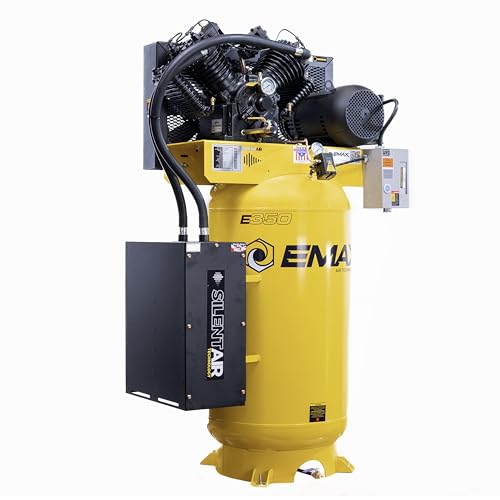
Looking for nonstop power with quiet operation? We present the EMAX E350 80 Gal. 2-Stage Industrial Compressor. With 7.5HP, 1-Phase, 2-Stage design, it delivers 31 CFM into an 80 gallon tank, powering demanding tools without frequent refills. Silent Air Technology cuts noise by up to 50%, keeping conversations normal and workplaces calmer. Advanced lubrication delivers precise oil where needed, extending pump life and reducing maintenance. Four-stage filtration keeps air clean, while the low-profile setup and belt-driven system offer easy speed adjustments and pulley changes for customized performance. It’s a reliable, adaptable solution for industrious workshops.
Best For: businesses or workshops needing high-capacity, quiet, belt-driven air compression for demanding tools with long runtime and customizable performance.
Pros:
- Quiet operation with Silent Air Technology reducing noise up to 50%
- Large 80-gallon tank provides extended runtime between refills
- 2-stage, belt-driven design offers adjustable pump speeds and customizable performance
Cons:
- 1-phase power may limit certain industrial setups requiring three-phase power
- Larger footprint may require substantial floor space for installation
- Higher upfront cost relative to smaller or single-stage compressors
Ingersoll Rand 3HP 60‑gal Single‑Stage Compressor

The Ingersoll Rand 3HP 60‑gal Single‑Stage Compressor stands out for continuous-duty reliability, making it our top pick for shops that run air tools all day without breaks. It delivers 10.3 CFM at 90 psi and operates at 230V single phase with a 60‑gal vertical ASME receiver. Built on cast iron, it uses All Season Select synthetic lubricant for up to 2,000 hours between changes. With 100% continuous duty, a max 135 psi, auto start/stop, and a fully pre-wired setup, it’s ready to go—easy maintenance, safe guarding, and durable performance included.
Best For: Shop professionals who run continuous air-tool usage and need a durable, high-capacity 60‑gal single‑stage compressor with 100% continuous duty.
Pros:
- 100% continuous duty cycle ideal for all‑day operation
- 10.3 CFM at 90 psi with a 60‑gal vertical ASME receiver for ample storage
- All-season synthetic lubricant and cast-iron build enhance longevity and reliability
Cons:
- 230V single‑phase Power requirement may limit availability in smaller setups
- Large footprint due to 60‑gal tank; may require dedicated space
- Single‑stage design could be less efficient for ultra-fine or high-demand applications compared to multi‑stage models
DEWALT Pancake Air Compressor, 6 Gallon, 165 PSI (DWFP55126)

If you need a compact, ready-to-go pancake style compressor, this DEWALT 6-gallon model pumps out 165 PSI with an oil-free pump for maintenance-free operation and quick recovery between nails and spray sessions. We appreciate the heavy-duty pancake design, high-flow regulator, two hose outlets, and cord wrap for tidy storage. With a 6 gallon tank and 0.9 horsepower, it delivers 2.6 SCFM at 90 PSI and handles long tool runtimes, plus quick recharges. It remains relatively quiet for a shop unit, weighs about 30 pounds, and includes a 5-meter hose. This corded option suits pneumatic tools, nail guns, and spray work.
Best For: Those seeking a compact, maintenance-free 6-gallon pancake compressor for nail guns, pneumatic tools, and spray work in small to medium shop spaces.
Pros:
- Oil-free pump for low-maintenance operation
- 6-gallon tank with quick recovery and 165 PSI for extended tool runtime
- Two outlet connections and cord wrap for easy storage and versatility
Cons:
- Noise levels can vary in perception; listed around 78.5 dBA (some sources show 75.5 dB)
- Heavier for a portable unit (about 30 pounds) and may require a sturdy setup
- 1-year limited warranty may be shorter than some competitors
Factors to Consider When Choosing Stationary Air Compressors
We’ll walk you through the key factors—tank size, power requirements, air flow, noise, and build durability—that shape how a stationary compressor fits your workflow. We’ll help you match tank capacity to your tool needs, confirm electrical requirements, and ensure the airflow meets your most demanding tasks without overkill. Let’s discuss how these elements influence reliability, noise levels, and long-term durability so you choose with confidence.
Tank Size Considerations
Choosing the right tank size is essential for steady, uninterrupted air flow, especially when you’re running high-demand tools. We’ll look at how tank capacity shapes runtime between cycles, with larger tanks like 60–80 gallons offering more reserve before the compressor kicks in. A bigger tank also helps reduce motor starts, which can lower wear and energy spikes during operation. For heavy loads or multiple tools, an 80-gallon tank is often preferred to maintain consistent pressure. The tank capacity should match the compressor’s CFM at your target pressure to prevent rapid cycling and underfill. Remember, a stationary, large tank needs adequate space and stable mounting to safely handle weight and vibration during operation.
Power Requirements Clarity
What power setup best suits your stationary compressor? We know many models require three-phase power, with some explicitly needing 208–230V at 60Hz and even offering inverter options for single-phase use. Some units warn against converting single-phase to three-phase with a converter, so we plan accordingly. Motor power is stated in horsepower and links directly to flow (CFM) and pressure (psi), shaping electrical draw and wiring needs. Some compressors list maximum current or service duty (100% continuous or specific amps), guiding our circuit breaker sizing and safety checks. Tank size and whether the design is single- or two-stage influence startup surge and sustained load, affecting the chosen power supply setup. We’ll align our selection with these clear, practical power requirements.
Air Flow Capacity
How much air do you actually need from a stationary compressor? We measure air flow capacity in cubic feet per minute (CFM) at a given pressure, like 90 PSI, to show how many tools can run at once. Higher CFM ratings let you sustain multiple tools and cut pressure drops during heavy use. Two-stage or rotary screw designs typically deliver higher, steadier CFM at higher pressures than single-stage units. When evaluating capacity, match the CFM to your load so the compressor meets peak air demands without excessive cycling. Compare the CFM at your target operating pressure (e.g., 90 PSI) rather than just pump horsepower or tank size. This alignment protects performance and efficiency across demanding tasks.
Noise Aspects
Noise levels matter, but they aren’t the whole story: you should look at how a unit’s design and operating setup affect real-world sound. We start by noting that noise is usually listed in decibels, typically between 70 and 86 dB, and that design and capacity drive that range. Oil-free designs may cut maintenance, but their noise isn’t guaranteed to be lower, since sound output is a separate spec to check. Larger units, like 80-gallon tanks, can run with lower noise per CFM because of steady pressure and slower cycling. Rotary screw designs and inverter drives reduce peak noise with softer starts and steadier speeds. When comparing, weigh the listed dB alongside tank size, duty cycle, and enclosure effects on perceived loudness.
Build And Durability
Durability isn’t an afterthought when you’re choosing a stationary compressor; it’s built into the core design. We look for thick steel plates—about 4 mm—for both tank and frame to resist wear in tough environments. Cast iron or heavy-duty metal construction and reinforced housings matter, because these units run continuously and handle higher pressures. Dual-stage or screw designs with sealed components reduce gas leaks and improve long-term sealing reliability under heavy use. Enclosures or fully enclosed belt guards protect moving parts, boosting safety and reliability where space is tight and demands are high. Built-in features like oil-free or synthetic lubricant systems give long service intervals, supporting maintenance efficiency while keeping performance steady across thousands of hours.
Oil vs Oil-Free
Oil-free and oil-lubricated stationary compressors each have distinct advantages, so we weigh maintenance needs, output quality, and longevity to match your use case. Oil-free models require less maintenance since they don’t need oil changes and have fewer lubricant-related part replacements, and they run cooler with reduced oil contamination risk. They produce cleaner output—ideal for painting and food-grade applications—because no oil separators or filters are needed in the air stream. However, initial noise can be higher, and moving parts may wear faster without oil lubrication. Oil-lubricated compressors generally offer longer component life for heavy use due to proven lubrication in moving parts, though they demand regular oil changes and related maintenance. Ultimately, choose based on load, air quality needs, and downtime tolerance.
Maintenance Demands
When we pick a stationary compressor, the maintenance demands matter as much as the initial price. Two-stage designs and larger tanks, like an 80 gal model, extend runtimes and reduce cycling, which lowers maintenance frequency and keeps output steady. Oil-free models cut ongoing lubrication chores but demand regular seal and valve inspections to stay leak-free during continuous use. A rotary screw with inverter control smooths pressure and can save energy, yet it still requires periodic oil checks and belt/drive inspections. Routine tasks include changing filters, performing oil changes where applicable, and checking gauges, drains, and moisture separators to prevent rust and contamination. Annually, schedule filter replacements, oil level checks, belt tensioning, and motor/thermal protection inspections for reliability.
Frequently Asked Questions
How Do I Pick Between 2-Stage and Single-Stage Compressors?
We pick based on use: 2-stage lasts longer and runs cooler for heavy, continuous work, while single-stage handles lighter, intermittent tasks. If you prioritize efficiency and durability, choose 2-stage; otherwise, go with single-stage for simplicity.
What Maintenance Keeps a 80-Gallon Unit Reliable?
We keep an 80-gallon unit reliable by changing oil as recommended, inspecting belts and hoses, draining condensate daily, replacing filters on schedule, checking safety valves, and keeping vibration pads firm—so it runs smoothly and longer for you.
Can These Systems Run Air Tools Continuously Without Overheating?
We can run air tools continuously without overheating if we select a high-capacity, duty-cycle-friendly compressor and monitor temps, airflow, and duty cycles; meanwhile, we’ll use proper cooling, scheduled pauses, and rated tools to stay safe and efficient.
What Dry Air Delivery Rate Is Needed for My Tools?
We need to know each tool’s CFM at operating pressure, then sum those requirements; start with the highest CFM tool and add the rest, factorting startup surges, duty cycle, and line losses to size your dry air delivery rate.
How Important Is Phase Compatibility for 3-Phase Setups?
Phase compatibility is essential; mismatches trip breakers, reduce efficiency, and stress motors. We’ll ensure balanced phases, proper grounding, and protective controls. We’re steering this ship together, aligning components so 3-phase systems run smoothly and reliably. Trust our plan.
Conclusion
We’ve walked through sturdy tanks, steady CFM, and smarter keep-running design, and we’re convinced these machines aren’t just tools—they’re the quiet heartbeat behind our projects. When we pair capacity with efficiency, noise with reliability, we unleash a rhythm that powers finish-worthy results. So let’s choose with intention, matching needs to specs, and let these compressors be the metronome for consistent, flawless work—marrying capability to craft, every single session.