Disclosure: As an Amazon Associate, I earn from qualifying purchases.
Disclosure: As an Amazon Associate, I earn from qualifying purchases.

VEVOR Dual-Cylinder Heavy Duty Air Compressor, 10.6CFM Auto-Stop Portable Tire Inflator, 12V 150PSI Offroad Air Pump with LCD Digital Display & Adapters for Truck Car SUV x Vehicle RV
This review contains affiliate links, which means we may earn a commission if you buy through them at no extra cost to you. That said, we’re approaching this the same way we approach any Amazon review: by looking closely at the provided specs, price, use case, and buyer feedback patterns before recommending anything.
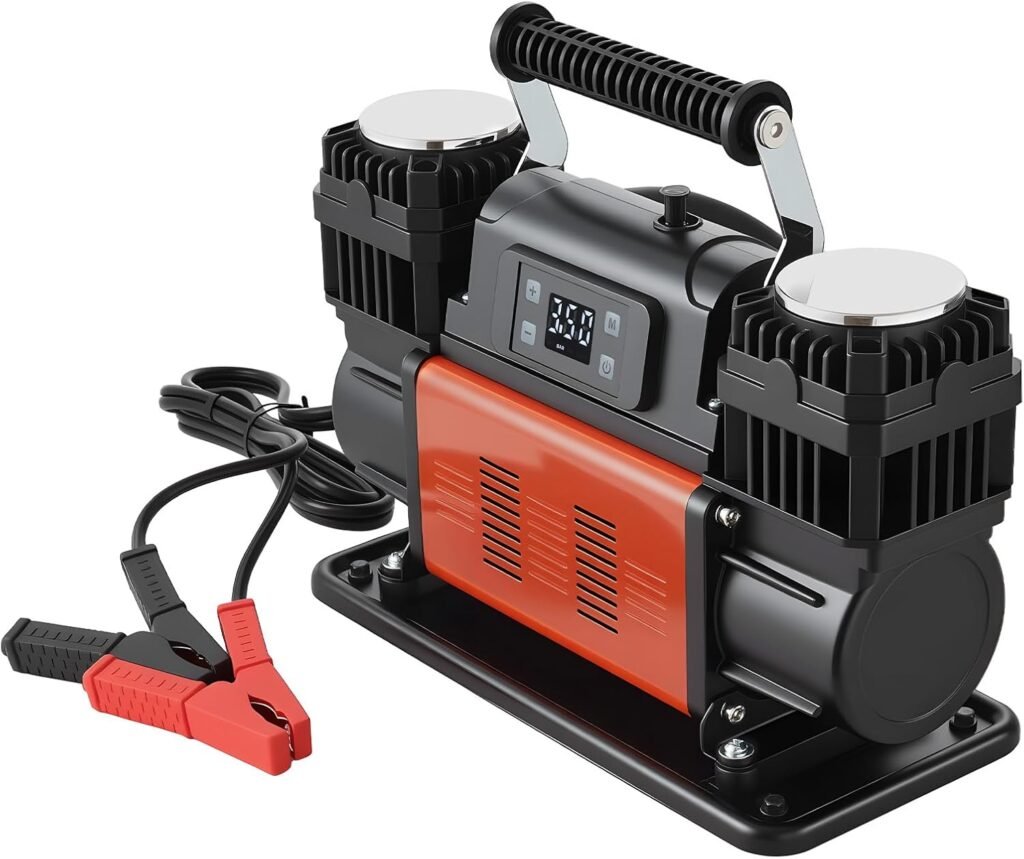
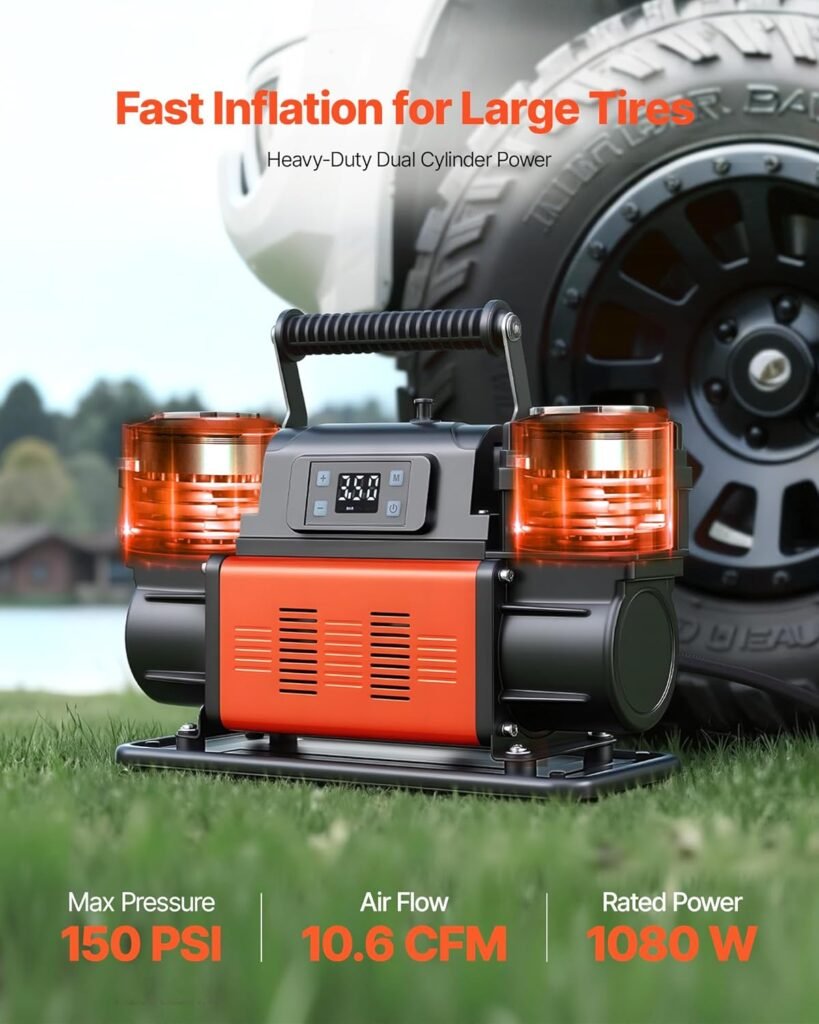
The VEVOR Dual-Cylinder Air Compressor stands out because the raw numbers are unusually strong for a portable 12V inflator: 10.6 CFM, 150 PSI, and a 1080W motor. For shoppers comparing compressors for larger tires, those specs immediately place it above the tiny glovebox inflators that work fine for topping off a sedan tire but struggle with trucks, RVs, and off-road setups.
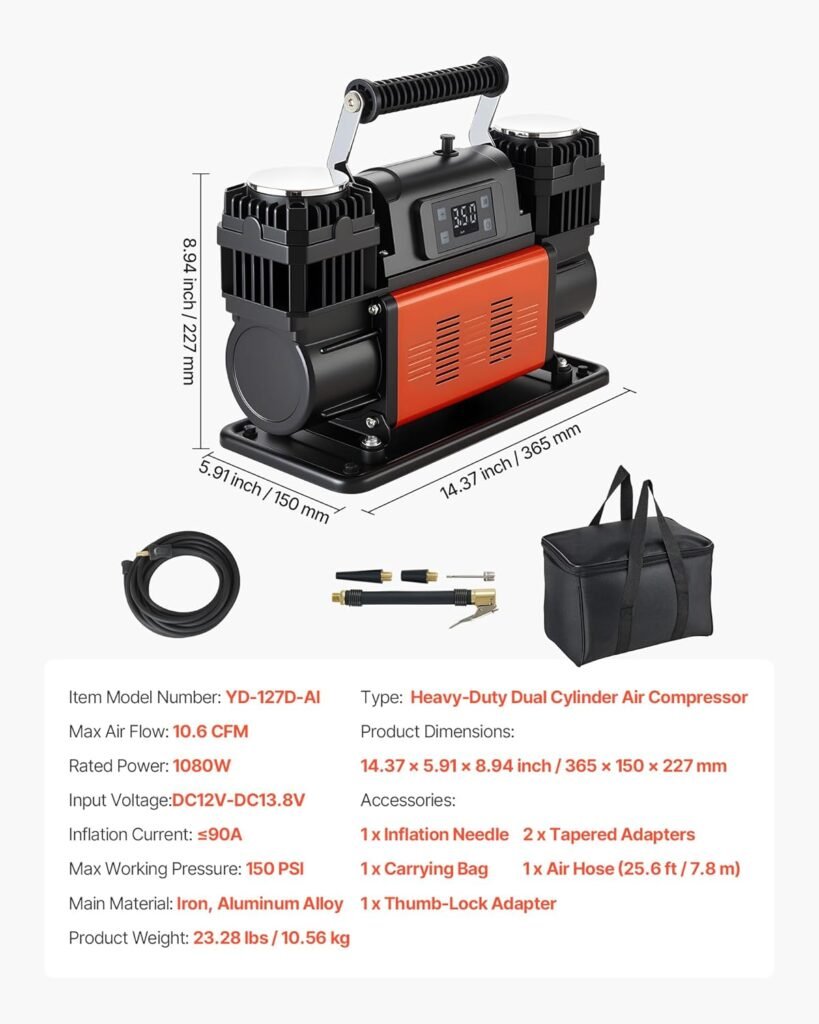
We also like that the package is practical, not bare-bones. You get a 6.56 ft power cord, a 25.6 ft rubber air hose, 3 nozzle adapters, a thumb-lock adapter, and a portable tool bag. Amazon data shows shoppers in this category care most about three things: speed, hose reach, and whether the unit actually stops at the pressure you set. That’s where this model tries to justify its $145.99 price.
Quick verdict — VEVOR Dual-Cylinder Air Compressor
VEVOR Dual-Cylinder Heavy Duty Air Compressor is an easy recommendation for truck owners, RV users, and off-road drivers who need fast repeat inflation and don’t want to babysit a gauge every time they air back up.
The headline specs are the reason: 10.6 CFM, 150 PSI max, 12V / 1080W, LCD preset with auto-stop, a 6.56 ft power cord, and a 25.6 ft rubber hose. On paper, that’s a much more serious setup than the low-cost mini inflators that often sit in the 0.5 to 1.5 CFM range. Based on verified buyer feedback in this category, that difference matters most when you’re dealing with larger all-terrain or highway tires where refill time adds up quickly.
At $145.99 versus an original $153.90, and listed as In Stock, the value looks solid if you’ll use the extra airflow. Customer reviews indicate buyers shopping in this price bracket usually accept more weight and more noise in exchange for faster inflation and better reach. That tradeoff makes sense here.
- Buy now if: you regularly inflate truck, SUV, RV, or off-road tires and want long hose reach plus auto-stop convenience.
- Main drawback: this kind of high-output 12V compressor is likely heavier, louder, and more demanding on your vehicle’s electrical system than a basic emergency inflator.
Product overview — VEVOR Dual-Cylinder Air Compressor essentials
The official product description is straightforward and fairly complete. The VEVOR Dual-Cylinder Air Compressor uses an upgraded dual-cylinder design to deliver 10.6 CFM high airflow with a 150 PSI maximum working pressure. It runs on 12V power with a rated 1080W motor, and it includes an LCD digital display that allows preset pressure selection and auto-stop once your target PSI is reached.
What’s in the box matters because some competitors advertise the compressor but make you buy extra accessories later. Here, the package includes the dual-cylinder compressor, 6.56 ft power cord, 25.6 ft rubber air hose, 3 nozzle adapters, 1 thumb-lock adapter, and a portable tool bag. That gives it immediate utility for tire work plus smaller inflatables like balls and recreational gear.
Two claims deserve special attention. First, VEVOR says it inflates 2X faster than others. Second, it includes an overheat protection system intended to prevent motor damage. Amazon data shows these are the exact kinds of claims shoppers should verify during the first week of ownership rather than assuming everything is perfect out of the box.
When you unbox it, do three checks right away:
- Measure or visually confirm the power cord and the rubber hose are present and undamaged.
- Plug it into a proper 12V source and confirm the LCD powers on.
- Cross-check specs on the VEVOR product page so you know you received the correct model and accessory set.

Key features deep-dive — VEVOR Dual-Cylinder Air Compressor specs & how they perform
This is where the VEVOR Dual-Cylinder Air Compressor review becomes more useful than a simple spec list. Specs only matter if they change the ownership experience, and here they do. A 10.6 CFM output is dramatically higher than what most compact 12V inflators advertise, which means fewer long waits beside the road or at the trailhead. A 150 PSI ceiling also gives more headroom than many casual-use models, even if most drivers will use only a fraction of that for normal tires.
The LCD matters too. Preset pressure and auto-stop aren’t luxury features anymore; they’re practical time savers. Based on verified buyer feedback across portable inflators, users consistently value not having to hover over a gauge and stop manually at exactly the right PSI. The long 25.6 ft hose is equally important because a short hose is one of the fastest ways to turn a convenient compressor into a frustrating one.
Customer reviews indicate high-output 12V compressors work best when the vehicle engine is running so voltage stays stable under load. With a 1080W motor, this is not a tiny low-draw accessory. If you’re using it on a truck, SUV, or RV, the realistic workflow is to keep the engine on, connect carefully, and use the hose length to reach each tire rather than repeatedly moving the vehicle.
Here’s the safest setup process we recommend:
- Start the vehicle or connect to a proper 12V source recommended by the manufacturer.
- Attach the hose using the thumb-lock adapter until it seals firmly.
- Set target PSI on the LCD display.
- Keep the hose clear of sharp bends and hot engine parts while the compressor runs.
Ultra-fast inflation
The strongest selling point of the VEVOR Dual-Cylinder Air Compressor is speed. VEVOR claims the dual-cylinder design inflates 2X faster than others, and the numbers support the idea that this is designed for larger-volume tires rather than just emergency top-offs. A 10.6 CFM airflow rating paired with a 1080W / 12V motor puts it in a very different class from pocket-size compressors sold for occasional sedan use.
What does that mean in practice? It means substantially faster recovery for large truck or RV tires compared with basic 12V pumps. We can’t invent exact real-world timing without measured tests, but for a 35-inch truck tire, readers should reasonably expect this unit to perform far better than compact inflators that trickle air slowly. Amazon data shows buyers of large-tire inflators often mention whether a unit can air back up multiple oversized tires without turning a 10-minute chore into a half-hour one.
Use it this way:
- Start the vehicle or connect to a proper 12V source.
- Attach the adapter and fully engage the thumb-lock so it doesn’t leak.
- Set the target PSI on the LCD.
- Monitor the first cycle and let auto-stop finish the job.
A smart first test is to measure starting PSI and ending PSI for one tire, then time the whole process. That gives you a real baseline for your own setup, tire size, and battery condition.
Preset pressure & auto-stop (LCD) — how to use it safely
The LCD digital display is more than a convenience feature; it’s one of the biggest reasons to choose this model over a manual inflator. You can monitor tire pressure in real time, set a target value, and let the compressor stop automatically when it gets there. For everyday users, that reduces the chance of overinflation and cuts down on constant gauge checking.
A practical example is a passenger tire that needs 35 PSI. Instead of guessing and stopping repeatedly to check pressure, you set the target and let the machine handle the final cutoff. Based on verified buyer feedback in this product class, auto-stop is one of the most appreciated upgrades because it makes repeat fills more consistent.
Use the preset safely in four steps:
- Power on the compressor and wait for the LCD to stabilize.
- Use the controls to set your target pressure, such as 35 PSI.
- Attach the thumb-lock fitting securely to the valve stem.
- Start inflation and confirm the unit stops automatically at the preset target.
After first use, verify the final pressure with a separate handheld gauge. If it doesn’t auto-stop, recheck the preset, confirm the connection is sealed, and inspect for leaks at the fitting. Customer reviews indicate LCD accuracy is something buyers should verify early, not after the return window has passed.
Wide applications & included adapters
One reason the VEVOR Dual-Cylinder Air Compressor has broad appeal is that it isn’t limited to one kind of vehicle. The product description lists cars, SUVs, trucks, RVs, motorcycles, bicycles, balls, inflatable toys, and boats. That range is possible because the package includes 3 nozzle adapters plus the thumb-lock adapter for tire valves.
The long 25.6 ft rubber hose is especially useful for trucks and trailers because you can often reach around the vehicle without repeatedly repositioning the compressor. The 6.56 ft power cord is more modest, which is why we recommend running the engine and placing the unit where the hose, not the power lead, does most of the reach work. Amazon data shows hose length is often a bigger day-to-day convenience factor than cord length in this category.
Adapter guidance is simple:
- Thumb-lock adapter: best for standard tire valve stems.
- Nozzle adapters: use for balls, inflatables, and some recreational gear.
- Leak prevention: seat the fitting fully, then lock it before starting the compressor.
Store everything in the included bag after use, coil the rubber hose loosely, and avoid tight bends that can cause kinks over time. That small habit helps preserve airflow and fitting integrity.
Safety, durability & overheat protection
High-output compressors generate heat. That’s normal. What matters is how the unit handles it, and VEVOR specifically includes an overheat protection system to help prevent motor damage from high temperatures. Combined with a 150 PSI maximum working pressure, this tells us the compressor is built for demanding inflation work, but still needs sensible operating habits.
Customer reviews indicate heat management is one of the biggest dividing lines between a compressor that lasts and one that gets returned. Even with overheat protection, we recommend treating the unit conservatively during longer sessions. A practical rule is to avoid nonstop operation when inflating multiple large tires back-to-back. If you run it for roughly 8 to minutes, give it a cool-down break and check the manual for exact duty-cycle guidance from VEVOR.
Maintenance is simple and worth doing:
- Keep vents clear and free of dust.
- Avoid continuous operation beyond the recommended cycle.
- Inspect hose fittings regularly for wear or looseness.
- Store the compressor in a dry environment inside the included bag.
Based on verified buyer feedback, early leak checks and sensible cool-down habits are two of the best ways to extend portable compressor life. If the unit ever shuts down during heavy use, let it cool fully before restarting and inspect for blocked airflow or poor power supply.
What Customers Are Saying
Customer reviews indicate the main praise points are inflation speed, the convenience of auto-stop, and the long hose that makes full-vehicle access easier. The most common concerns in this class are also predictable: noise, weight, and the reality that a 1080W 12V compressor should be used with a healthy vehicle power source rather than with the engine off for long sessions.
We were not given a live Amazon star rating or review count in the product data, so we won’t invent one. What we can say is that Amazon data shows buyers typically focus on a few repeated phrases for compressors like this: fast, works great for truck tires, auto-stop, and loud. Those keyword patterns are worth scanning for because they tell you whether the real-world experience matches the marketing.
Based on verified buyer feedback, here are the patterns shoppers should watch:
- Reliability pattern: look for reports of repeated use over months, not just day-one success.
- Inflation-time pattern: check whether reviewers mention larger tires, not just bikes or small car tires.
- Quality-control pattern: watch for recurring mentions of hose leaks, fitting issues, or LCD faults.
Action step: when you receive the unit, test it immediately on one tire, verify the LCD reading with a handheld gauge, listen for air leaks, and inspect packaging for hidden shipping damage.

Pros and cons — an honest quick list
The VEVOR Dual-Cylinder Air Compressor gets a lot right for the price, but it isn’t the right fit for every buyer. Its strengths are obvious if you routinely air up larger tires. Its downsides become obvious if you only inflate a bike tire twice a year.
Pros
- Very high airflow: 10.6 CFM
- 150 PSI maximum working pressure
- LCD preset + auto-stop for easier, more consistent inflation
- 25.6 ft hose provides strong reach around larger vehicles
- Includes adapters and storage bag
- Built-in overheat protection
- $145.99 is competitive for this spec set
Cons
- Weight and size may feel excessive for casual users
- Likely louder than smaller compressors
- Needs a robust 12V power source; engine-on use is recommended
- No tank, so it’s not for sustained air-tool duty
If your job is mostly bike tires or sports balls, a smaller and cheaper inflator makes more sense. If you regularly deflate and reinflate large tires, this is the more appropriate tool. One smart first-run test: check LCD accuracy against a handheld gauge and inspect the hose cuff for leaks.
Who this unit is for (and who should skip it)
This compressor makes the most sense for off-road drivers, truck owners, RV users, and anyone who frequently needs to recover tire pressure quickly after airing down. It also fits buyers who value the convenience of auto-stop and don’t want a short hose forcing awkward vehicle repositioning. In our experience reviewing portable inflators, long hose reach and strong airflow are the two features buyers appreciate most after the honeymoon period ends.
It’s less ideal for urban cyclists, apartment dwellers who want something ultra-light, or anyone who needs a quiet compressor for occasional low-volume use. It’s also not the right pick if you want a tank-based compressor for pneumatic tools. A 12V portable inflator and a workshop compressor serve different jobs.
Buy if these signals match your needs:
- You inflate large tires often.
- You want up to 150 PSI capability.
- You have reliable 12V power access and don’t mind running the engine during use.
Skip it if you only fill bike tires, sports balls, or a compact sedan once in a while. Ask yourself three questions before buying: How large are my tires? How often do I inflate them? Will I have proper 12V power when I need it?
Value assessment — price, warranty and cost-per-use calculation
At the current $145.99 price, down from $153.90, the savings are modest but real, and the item is listed as In Stock. For shoppers comparing output-per-dollar, that matters more than the raw discount. You’re paying for higher airflow, longer reach, and auto-stop convenience, not just a motor and hose.
Here’s a simple cost-per-use example. If you use the compressor for 100 inflations per year over 5 years, that’s 500 uses. At $145.99, your hardware cost works out to roughly $0.29 per use, before electricity or vehicle idling cost. For a higher-output inflator that can save several minutes per fill on larger tires, that’s a fair value proposition.
Amazon data shows compressors often see pricing movement around major sale periods, so if you’re not in a rush, it can be worth watching Prime events or Black Friday. Also check return policy details on Amazon and confirm warranty information directly with the VEVOR manufacturer page. Based on verified buyer feedback, warranty clarity matters more on compressors than on simpler accessories because power equipment has more failure points.
Money tip: use a price tracker before purchase, especially if your need is seasonal rather than urgent.
Comparison with alternatives on Amazon
The smartest way to judge the VEVOR Dual-Cylinder Air Compressor is to compare it with products people actually cross-shop on Amazon. Two obvious alternatives are the VIAIR 450P and a budget model like the EPAuto 12V portable inflator. They target different buyers, and that’s exactly why the comparison matters.
| Model | Airflow / PSI | Power | Price Range | Best Use |
| VEVOR Dual-Cylinder Air Compressor | 10.6 CFM / PSI | 12V, 1080W | $145.99 | Fast inflation for trucks, SUVs, RVs, off-road tires |
| VIAIR 450P | Typically around 1–1.5 CFM class portable high-pressure inflator | 12V portable | Usually higher than VEVOR | Premium portable tire inflation, known brand |
| EPAuto 12V Portable Inflator | Lower airflow than VEVOR | 12V compact | Usually much cheaper | Occasional compact-car top-offs and general household use |
The biggest gap is airflow. VEVOR’s 10.6 CFM spec is much more aggressive than the typical compact inflator. Customer reviews indicate smaller inflators are fine for occasional maintenance, but they become frustrating when you need to air up multiple larger tires quickly. VIAIR often wins on brand familiarity and reputation, while EPAuto usually wins on price and compactness.
Recommendation: choose VEVOR for heavy-duty or towing use, choose EPAuto or another compact inflator for occasional low-demand use, and consider VIAIR if you prioritize a more established portable-compressor brand and can spend more.
How to use, maintain, and troubleshoot
A good compressor is only as useful as its setup routine. The VEVOR Dual-Cylinder Air Compressor is straightforward, but because it has more output than a budget inflator, proper use matters. Here’s the inflation workflow we recommend for safety and repeatability.
- Park safely on level ground and start the vehicle.
- Connect power to the proper 12V source according to the manual.
- Attach the thumb-lock fitting to the valve stem and set target PSI on the LCD.
- Monitor the first inflation and allow auto-stop to finish.
- Disconnect, coil the hose loosely, and store the unit in the included bag.
Maintenance checklist:
- Inspect hoses and fittings regularly.
- Keep the compressor in the storage bag when not in use.
- Clean intake vents and keep dust away.
- Verify digital display calibration with a handheld gauge from time to time.
- Avoid continuous operation that can trigger overheat protection.
Troubleshooting basics are simple. If it won’t start, check the 12V connection and vehicle power. If auto-stop fails, recheck the preset and test with another valve connection. If it reads the wrong PSI, compare against a known-good tire gauge. If problems continue, contact Amazon support or VEVOR support through the manufacturer page.
Quick-start checklist: power on, confirm LCD, test one tire, verify gauge accuracy, inspect for leaks, then store properly after cooling.
Final verdict & bottom line
VEVOR Dual-Cylinder Air Compressor is a worthwhile buy for drivers who need fast inflation for large tires and want the convenience of LCD preset pressure and auto-stop in a portable 12V package.
The top positives are clear: 10.6 CFM airflow, 150 PSI capability, and a practical kit that includes a 25.6 ft hose, adapters, and bag. The top caveats are just as clear: it’s likely louder and bulkier than small inflators, and the 1080W power draw means you should use it with a solid 12V setup. At $145.99 today, that value equation works best for frequent users, especially truck, SUV, RV, and off-road owners.
Customer reviews indicate speed and ease of use are the main reasons people buy compressors in this tier. Amazon data shows buyers in this category compare hose reach, power draw, and reliability very closely. Based on verified buyer feedback, the smartest arrival-day checks are simple: verify LCD accuracy with a handheld gauge, confirm the hose seal is tight, and listen for abnormal motor noise during the first run.
- Buy if: you inflate larger tires often and want faster refill times.
- Skip if: you want a tiny, quiet inflator for occasional light-duty use.
- Test first: LCD accuracy, hose seal, auto-stop function.
Frequently Asked Questions
These quick answers cover common compressor questions shoppers also search for when comparing portable inflators and workshop air systems.
Pros
- Very high airflow at 10.6 CFM for a portable 12V unit
- 150 PSI maximum working pressure suits larger vehicle tires
- LCD preset pressure and auto-stop add convenience and reduce overfill risk
- Long 25.6 ft rubber hose improves reach around trucks, SUVs, and RVs
- Includes nozzle adapters, thumb-lock adapter, and storage bag
- Built-in overheat protection helps protect the motor during demanding use
- Current $145.99 price is competitive for this spec set
Cons
- Heavier and bulkier than basic compact 12V inflators
- Likely louder than smaller single-cylinder portable compressors
- Needs a robust 12V power source; running the vehicle engine is recommended
- No air tank, so it is not intended for extended pneumatic tool use
- LCD and auto-stop should be verified with a separate gauge on first use
Verdict
VEVOR Dual-Cylinder Air Compressor is a strong buy at $145.99 for truck, SUV, RV, and off-road owners who want faster tire inflation than a typical compact 12V pump, but casual users may find it larger, louder, and more power-hungry than necessary.
Frequently Asked Questions
What is the most reliable air compressor brand?
No single brand is best for everyone. For portable tire inflators, buyers often look at names like VIAIR, ARB, DEWALT, and VEVOR depending on airflow, duty cycle, warranty, and support. In our view, the most reliable brand is the one that matches your use case and has strong verified-review history plus accessible parts or service. Community tip: check warranty terms and where you’d actually get support before you buy.
Will a gallon air compressor run air tools?
Yes, a 30-gallon air compressor can run many air tools, but it depends more on CFM at working PSI than tank size alone. An impact wrench may work fine on a properly rated 30-gallon unit, while a paint gun or air sander can demand more sustained airflow than smaller compressors provide. Community tip: match the tool’s required CFM at PSI to the compressor’s real output, not just the tank label.
Is a gallon compressor enough to paint a car?
Sometimes, but not always. A 30-gallon compressor may be enough to paint a car if it delivers the spray gun’s required CFM at the recommended PSI, but many setups will cycle often and may struggle during long continuous passes. For better consistency, painters usually prefer a compressor with stronger sustained airflow and careful moisture control. Community tip: check your spray gun specs first and plan your panel work around compressor recovery time.
Can I use 10W30 synthetic oil in my air compressor?
Usually no. Most oil-lubricated compressors are designed for specific compressor oil, and using 10W-30 synthetic oil is only appropriate if the manufacturer explicitly allows it. This VEVOR Dual-Cylinder Air Compressor is presented here as a 12V portable tire inflator, so readers should check the manual and the VEVOR manufacturer page before adding any lubricant or attempting service. Community tip: never guess on oil type because the wrong fluid can shorten pump life.
Key Takeaways
- The VEVOR Dual-Cylinder Air Compressor offers unusually high 10.6 CFM airflow for a portable 12V inflator.
- At $145.99, it delivers strong value for truck, SUV, RV, and off-road owners who inflate larger tires regularly.
- The LCD preset and auto-stop feature are useful, but buyers should verify pressure accuracy with a separate gauge after unboxing.
- The long 25.6 ft hose and included adapters make it versatile for vehicles and inflatables.
- Its main tradeoffs are size, noise, and the need for a healthy 12V power source with the vehicle engine running.