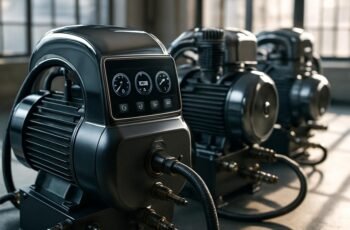
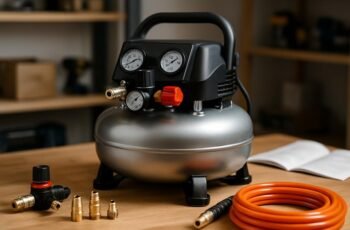
What you may not know is that a compressor’s efficiency often changes with load swings and duty cycle, not just its label. We work with total cost of ownership—upfront price, electricity, peak demand, and service intervals—to judge if energy-efficient models truly pay back. We’ll balance practical trade-offs, feature relevance, and site constraints, then map out how to quantify savings before you decide. The path isn’t purely technical; it hinges on your shop’s pattern and incentives, and that matters more than you think.
Key Takeaways
- Energy-efficient air compressors reduce operating costs by cutting electricity use, lowering peak demand, and extending maintenance intervals, improving total cost of ownership.
- Upfront cost should be weighed against long-term savings, including energy, parts, downtime, and potential incentives for net present value.
- Efficiency features (VFDs, proper sizing, tight seals, and soft-start controls) deliver more CFM per kW and reduce heat and noise.
- Reliability and scheduling matter: longer maintenance intervals save money but raise risk of unexpected failures; balance readiness and downtime risk.
- A structured decision framework should weigh energy gains against risk exposure, ensuring performance gains don’t compromise reliability or scheduling certainty.
Do Energy-Efficient Compressors Pay Off in Your Shop?
Do energy-efficient compressors pay off in a shop? We evaluate total cost of ownership by balancing upfront price against operating costs. Efficient models typically reduce electrical load, leverage advanced motor controls, and minimize compressor run time through better modulation, which lowers energy storage losses and heat dissipation. In practice, we quantify annual energy savings, maintenance intervals, and replacement cycles to estimate payback periods. We also assess ancillary benefits, such as reduced heat in work zones and less demand on cooling systems. Noise reduction often accompanies efficiency gains, improving worker comfort and productivity. We map energy usage to peak demand charges and seasonal consumption, then compare against retrofit or new-install scenarios. Our conclusion: select the best FAD, proper sizing, and proven efficiency technologies to maximize ROI.
Which Efficiency Features Actually Matter for Performance?
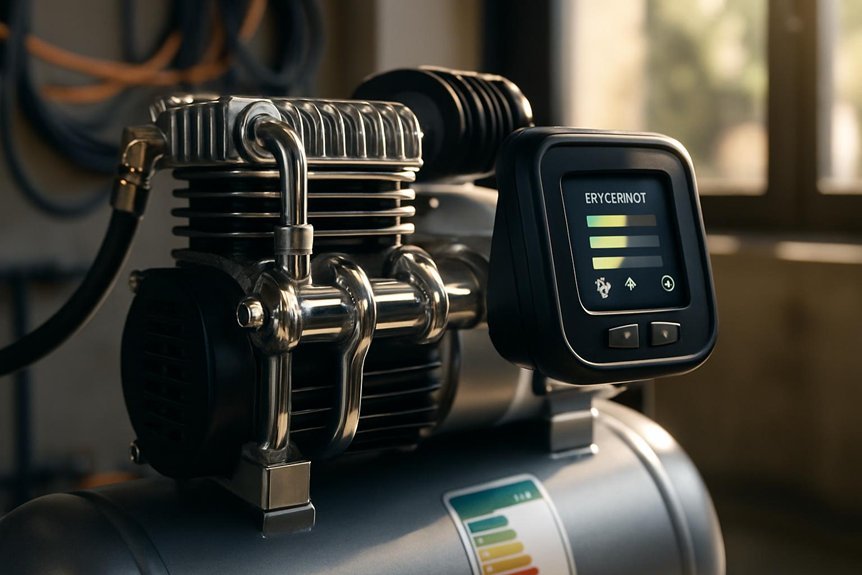
To performance, several efficiency features matter most, and we can separate them into electrical, mechanical, and control domains. We focus on how each domain translates to real-world output, reliability, and energy policy implications. Electrical efficiency reflects motor sizing, VFD usage, and power factor; mechanical efficiency hinges on compressor design, leakage control, and rotor friction; control efficiency covers pressure cascades, modulation schemes, and scheduling. Together, these determine actual delivered CFM per kW and audible impact, i.e., noise reduction. Below is a quick frame:
| Domain | Feature | Impact on performance |
|---|---|---|
| Electrical | VFD, power factor | Modulates load, lowers peak demand |
| Mechanical | Seal integrity, bearings | Reduces leakage, drag, heat |
| Control | Optimal modulation, soft start | Improves stability, reduces cycling |
How to Calculate Long-Term Savings vs Upfront Costs

We’ll outline how to compare long-term cost savings to upfront investment by quantifying energy use, maintenance, and downtime reductions. We’ll translate these into a clear payback timeline, net present value, and internal rate of return, so you can see real value beyond sticker price. By framing upfront tradeoffs against year-by-year savings, we establish a practical basis for decision-making.
Long-Term Cost-Savings
Understanding long-term cost-savings requires a clear comparison between upfront investment and ongoing operating costs. We quantify energy use by power draw (kW), load factor, and annual hours of operation, then translate that into kilowatt-hours and cost. We also account for maintenance, parts replacement, and potential downtime. By modeling a compressor’s efficiency curve and duty cycle, we determine annual energy savings when choosing an energy-efficient unit. We factor in service life, escalation in utility prices, and potential grant or tax incentives to refine the net present value. Practical gains often show reduced energy bills, shorter payback, and lower total cost of ownership. We highlight how noise reduction and portable design influence site practicality, maintenance ease, and utilization rates, impacting long-run value.
Upfront Cost Tradeoffs
Are upfront cost tradeoffs worth the long-term payoff when selecting an energy-efficient air compressor? We quantify true cost by combining purchase price, installation, and operating expenses with service life. We project annual energy use, maintenance intervals, and downtime impact, then discount to present value over the expected life. We compare baseline and high-efficiency models using a common duty cycle and load profile, ensuring apples-to-apples assumptions. Payback period is essential, but we also assess net present value, internal rate of return, and sensitivity to electricity price shifts. Consider ancillary factors like accessories and control options, yet avoid irrelevant focus that clouds judgment. In our analysis, we avoid unrelated topic distractions and keep calculations transparent, reproducible, and aligned with the reader’s practical decision-making needs.
Choosing the Right Energy-Efficient Compressor (Type and Size) for Your Shop
We’ll start by outlining the Type Selection Guide and the Optimal Compressor Sizing to ground our recommendations in real shop use. We’ll explain how a given workload, duty cycle, and air-demand profile drive whether a reciprocating, scroll, or rotary screw model best matches efficiency goals. Then we’ll connect size choices to runtime, pressure stability, and energy use to help you make a precise, cost-effective selection.
Type Selection Guide
Choosing the right energy‑efficient compressor starts with matching type and size to your shop’s demands and duty cycle. We’ll compare scroll, piston, and rotary screw options for reliability, maintenance, and efficiency, focusing on how each aligns with typical usage patterns. We evaluate startup surge, load/unload behavior, and cooling needs to prevent bottlenecks. A compact design can fit tighter spaces without sacrificing performance, while noise reduction strategies improve workflow. In practice, we trade off initial cost against annual energy savings and service intervals. Our guide emphasizes predictable performance, controlled duty cycles, and modular upgrades.
| Type | Pros | Key Considerations |
|---|---|---|
| Piston/Reciprocating | Low initial cost | Higher maintenance, more noise |
| Scroll | Quiet, compact design | Moderate efficiency gains |
| Rotary Screw | Steady flow, scalable | Higher upfront cost |
Optimal Compressor Sizing
Optimal sizing starts with a clear map of demand: identify peak and average air consumption, duty cycle, and the number of tools or stations that will run simultaneously. We quantify flow requirements, pressure targets, and transient peaks to avoid undersizing or oversizing. A correctly sized unit preserves efficiency by aligning compressor displacement, motor load, and receiver storage with actual usage, reducing cycling and energy waste. We evaluate whether a single high-capacity unit or a staged approach with multiple smaller units best suits your shop’s demand profile. Consider precedence of compressed-air quality, maintenance access, and future growth. Be mindful of grinding noise and the potential for oil leaks during setup, monitoring, and routine service. Clear sizing decisions minimize noise, leaks, and wasted energy while sustaining reliable performance.
Practical Tips to Maximize Daily Efficiency
Are you maximizing every hour of operation with your air compressor? We should. We align daily workflow with repeatable, measurable practices that cut waste and boost reliability. Practical tips focus on planning, monitoring, and disciplined execution to sustain performance. Recurring maintenance isn’t optional—it’s the foundation that preserves efficiency, reduces energy spikes, and lowers downtime. We schedule off peak operation when feasible to minimize concurrency losses and avoid peak-demand penalties. Real-time sensors, data logs, and threshold alerts guide adjustments before problems escalate. Below is a compact matrix to frame decisions, risks, and actions.
| Decision/Action | Expected Impact |
|---|---|
| Schedule downtime for maintenance | Consistent efficiency gains |
| Run only essential loads during peak | Lower energy use |
Common Trade-Offs: When Efficiency-First Isn’t Ideal
While efficiency-first practices drive steady gains, real-world operations reveal scenarios where strict energy optimization can conflict with reliability, throughput, or cost constraints. In these cases, we trade some energy savings for predictable performance and uptime. We evaluate trade-offs by mapping total cost of ownership across usage profiles, not just kW reductions. For example, aggressive downsizing or high-efficiency models may alter response time or cycling patterns, affecting downstream tools or processes. We also examine pricing models that reward peak efficiency but penalize readiness during demand spikes. Maintenance intervals become critical; longer intervals can save on preventive costs yet risk unexpected failures. Our approach weighs marginal energy gains against risk exposure, serviceability, and schedule certainty, delivering recommendations that balance energy efficiency with operational reliability.
Frequently Asked Questions
How Do Noise Levels Impact Overall Cost and Productivity?
We’ll note that noise levels markedly affect productivity and total cost due to fatigue, alerts, and machine wear; higher noise often correlates with increased maintenance frequency, reducing uptime and increasing maintenance costs, while quieter units improve efficiency and reliability.
Will Energy-Efficient Models Require More Maintenance?
Answer: No—energy-efficient models don’t inherently demand more maintenance; they require careful monitoring of maintenance tradeoffs. We’ll balance component wear and reliability with efficiency longevity, ensuring proactive service minimizes downtime while preserving improved performance.
Do Warranties Differ for Efficient Compressors?
We’ll say: yes—Warranty differences exist for efficient compressors, reflecting upgraded components; however, reputable models match standard terms. Efficient durability often carries comparable coverage, with extended periods on critical parts and proactive service options for reliability.
Are There Rebates or Incentives for Efficient Units?
We can’t ignore the whisper of progress: there are rebate eligibility and incentive programs for efficient units. We’ll verify eligibility, compare programs, and document deadlines, ensuring precise, practical guidance for choosing and applying within our technical framework.
How Reliable Are Variable-Speed Vs Fixed-Speed Systems?
Variable-speed systems are more reliable overall due to slower motor ramps and smoother pressure control; fixed-speed units excel in simple duty with predictable maintenance. We assess performance, failures, and lifecycle costs to guide your selection.
Conclusion
We’re convinced that energy-efficient compressors pay off when we tally life-cycle costs, not just sticker price. Like Icarus learning from the sun’s pull, we acknowledge higher upfronts but reap cooler operation, steadier pressure, and fewer tune-ups over time. By matching size to demand and embracing smart controls, we glimpse reliable performance and measurable savings. So yes—we stay the course: efficiency trims hours, costs, and downtime, leaving our shop with steadier power and clearer profitability.