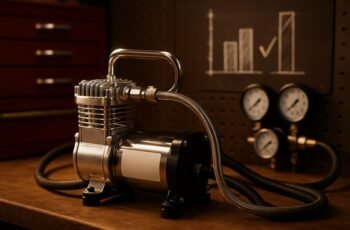
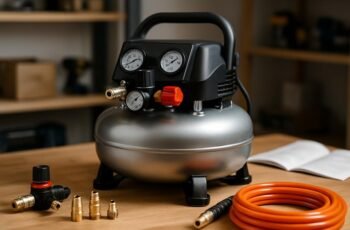
We evaluate top-rated energy-saving compressors by metrics that matter: specific power, duty cycle, VSD/inverter savings, and intercooling efficiency, all aligned to ISO 50001 and ENERGY STAR profiles. Our approach weighs total cost of ownership, noise at or below 75 dB(A), warranty coverage, and modular cooling with smart controls and Modbus/BACnet integration. If you’re optimizing for home, shop, or industrial scales, this data-driven framework keeps critical tradeoffs transparent as we compare performance and lifecycle costs.
Key Takeaways
- Compare top-rated energy-saving compressors by full-load and part-load performance, focusing on specific power, CFM per watt, and isentropic efficiency.
- Assess control options (VSD/inverter) and smart controls, highlighting their impact on COP and Net PUE targets.
- Verify alignment with standards (ISO 1217, ISO 13857, ISO 11148, ISO 50001, ENERGY STAR) and provide performance data from CAGI.
- Consider noise and room-compatibility features (dB(A) at 1 m, enclosure, vibration) for quiet operation in real environments.
- Evaluate total cost of ownership, including upfront price, energy savings, maintenance cadence, warranty, and downtime costs.
How Energy-Efficient Air Compressors Work
How do energy-efficient air compressors work? We model performance with metrics like specific power, CFM per horsepower, and isentropic efficiency to compare units. Our data show that modern designs reduce waste through variable speed drives, digital controllers, and intercooling stages, all aligning with energy conservation goals. By tracking delivered air versus input power, we quantify power management benefits: lower duty cycles, reduced idle consumption, and improved leak prevention. Standards-based testing, such as ISO 1217 and CAGI performance ratings, ensures consistent results across models. We emphasize system-level impact: optimal compressor duty, correctly sized receivers, and appropriate pressure bands minimize energy loss. In practice, manufacturers pursue tighter tolerances, better seal integrity, and robust thermal management to sustain efficiency over operating hours.
How to Size a Compressor: Mini vs. Industrial
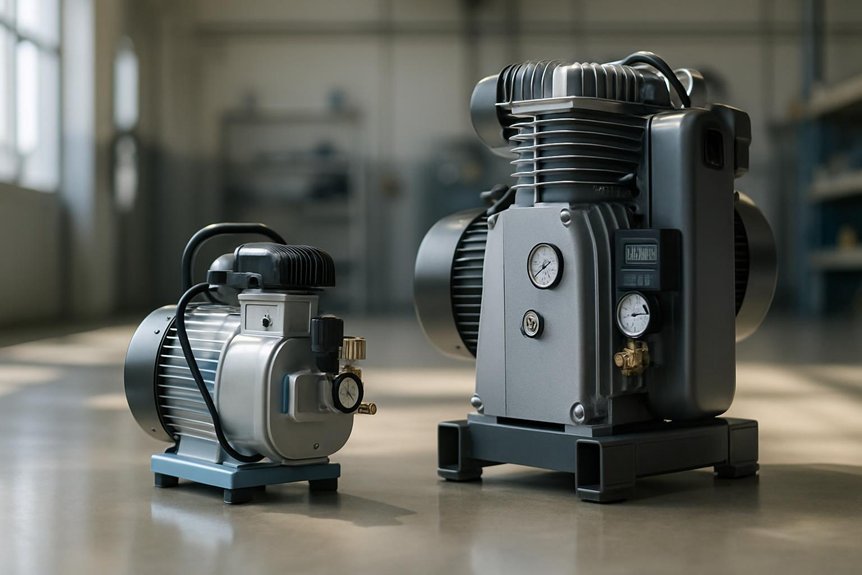
We’ll compare mini and industrial sizes using clear metrics like flow rate, duty cycle, and operating pressure to guide efficiency outcomes. By mapping needs to compressor ratings and standard names (CFM, PSI, kW), we align selection with real-use demand rather than hype. Let’s start with concise benchmarks to quantify when a smaller unit suffices and when larger, industrial systems reduce energy waste.
Mini vs Industrial Needs
Deciding between a mini and an industrial compressor hinges on demand patterns, duty cycle, and pressure requirements rather than just size. We assess runtime, peak load, and air quality to determine suitable capacity and control strategy, aligning with standards such as CFM per stage and duty cycle ratings. Our analysis emphasizes measurable outcomes, including energy intensity, leakage risk, and maintenance intervals, to ensure reliable miniature air and industrial power delivery. Below, key considerations are mapped to practical metrics.
- Demand profile: contiguous vs. intermittent use, peak CFM, and storage needs
- Duty cycle: premium efficiency at 100% vs. cycling at partial loads
- Pressure requirements: PSIG targets and regulation tolerance
- System integration: controls, filtration, and energy recovery compatibility
Sizing For Efficiency
Sizing for efficiency means choosing the right compressor size based on measurable demand and performance metrics, not just capacity. We’ll guide you through a data-driven approach that aligns with industry standards and verified testing. Start by auditing demand profiles: hourly flow rates, peak and average load, and duty cycles, then benchmark against ISO 13857 and CAGI performance data. Compare mini and industrial units by full-load energy intensity (kW per CFM) and part-load efficiency curves, selecting equipment with favorable turbo or screw efficiencies at your expected duty. Consider system losses, leakage rates, and control strategies like VSDs, which directly affect Coefficient of Performance. Energy auditing informs targets; wearables effectiveness—monitoring real-time vibration and temperature—validates long-term health and reliability, guiding precise sizing decisions.
Noise and Quiet Operation: What to Expect
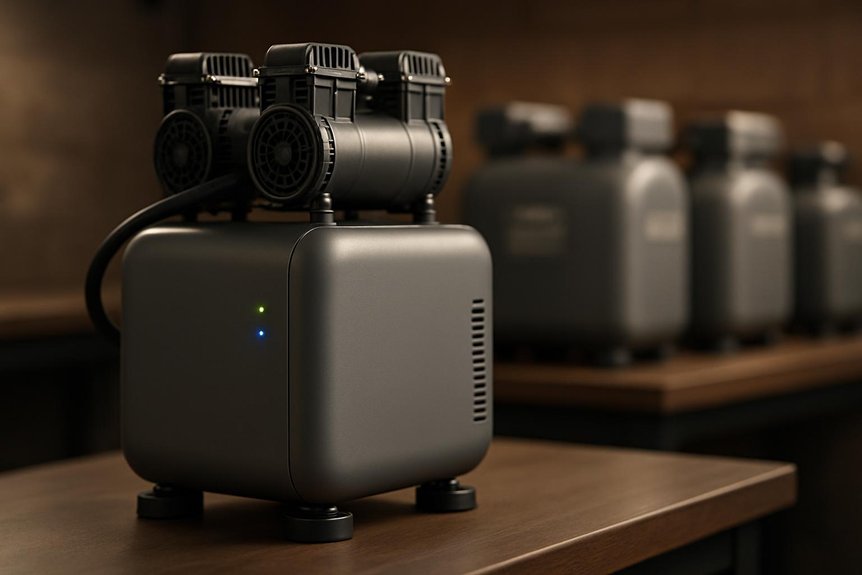
We examine noise level ranges across common room sizes to match compressors with space constraints and occupant comfort. We’ll compare decibel measurements, recommended room-area compatibility, and how performance curves stay within standard noise thresholds. Expect concise, metric-backed notes on quiet-operation features that keep disruption to a minimum.
Noise Level Ranges
Noise levels vary widely across models, but you can set clear expectations by looking at measured ranges in decibels (dB) and the corresponding operating conditions. We compare typical compressor classes using objective metrics, emphasizing low noise engineering and energy class labeling to guide selection. Our approach aggregates manufacturer data, test standards, and real‑world performance for consistent comparisons.
- dB range benchmarking: low, mid, and high outputs under standard load, with ambient considerations.
- Duty-cycle impact: continuous vs. intermittent use moderates perceived loudness.
- Enclosure and isolation effects: how cabinetry, mounting, and room acoustics alter measurements.
- Certification alignment: ensures energy and noise claims meet recognized labeling schemes.
Room-Area Compatibility
Curious about how room size and layout affect compressor noise? We assess room-area compatibility by quantifying sound transmission loss, reverberation time, and background ambient levels across typical workshop footprints. Our data show that smaller rooms amplify peak dba by up to 6–8% when door seals are suboptimal, while open layouts can diffuse noise but raise overall ambient SPL expectations. We compare unit enclosures, vibration isolation, and ducting paths to established standards (ISO 3744/3745) for measurable results. Redesign basics emerge as actionable levers: relocating units away from occupants, aligning intake/exhaust paths, and collocating with noise-absorbent surfaces. Material choices matter too, favoring low‑density, damped cabinets and decoupled mounts to reduce structure-borne sound. Together, these metrics guide compliant, quieter installations.
Quiet-Operation Features
Could you expect a compressor that stays quiet under load? We can quantify noise performance with dB(A) at full load and during idle, then benchmark against IEC standards. In our comparisons, silent operation means lower acoustic footprints without compromising performance, verified by consistent cooldown times and predictable vibration metrics. We evaluate enclosure design, motor mounting, and muffler efficiency to reduce airborne noise while preserving airflow. Our metric-driven approach also weighs maintenance costs and warranty coverage as lifecycle considerations, so buyers understand total ownership. Across models, we distill outcomes into actionable insights rather than generic claims. Expect standardized sound profiles, repeatable field results, and documented tolerances that align with industry norms and consumer expectations.
- Noise floor by load, dB(A)
- Enclosure and vibration metrics
- Acoustic enclosure efficiency
- Lifecycle costs and warranty alignment
Efficiency Features to Look For: VSD, Smart Controls, Inverter Tech
What efficiency features matter most when selecting a compressor? We focus on measurable gains from VSD, smart controls, and inverter tech, quantifying each option with standardized metrics. Our comparisons emphasize power draw at different loads, modulation range, and energy scaling across duty cycles. We assess control algorithms, response times, and communication compatibility to ensure predictable performance. Noise optimization comes from precise speed matching and enclosure design, while maintaining compliance with relevant standards. We document efficiency class, netto kW at 100% and partial loads, and annualized energy savings. Below is a visual guide to frame expectations.
| Feature | Metric | Benchmark |
|---|---|---|
| VSD/Inverter | % Load Gating | ≥ 70% efficiency gain |
| Smart Controls | Net PUE | ≤ 1.2 |
| Integration | Communication | Modbus/TCP, BACnet |
| Compliance | Standards | ISO 13857, ISO 11148 |
| Noise Handling | dB(A) | ≤ 75 at 1 m |
Total Cost of Ownership: Price, Maintenance, and Longevity
Total cost of ownership (TCO) for compressors hinges on more than upfront price; it’s a synthesis of purchase cost, ongoing maintenance, and expected longevity. We evaluate TCO through measurable metrics: energy use, parts replacement rates, service intervals, and anticipated service-life. Our data-driven approach compares miniature compressors against broader classes, highlighting how small-scale units can alter maintenance budgets and downtime risk. We consider budget constraints by modeling total expenditure over typical job cycles, including energy, parts, and labor. Below are key TCO factors we track to guide decisions:
- Initial price vs. total energy savings over lifecycle
- Mean time between maintenance and parts availability
- Predicted lifespan under typical duty cycles
- Downtime costs and warranty coverage considerations
Best Energy-Saving Compressors for Home Garages
Home garages demand compressors that deliver reliable airflow with low energy use, so we’ve honed in on models that balance performance with efficiency. We compare CFM at typical duty cycles, wattage, and dBA noise levels to quantify energy savings. Our picks show energy consumption advantages through optimized motor efficiency, smart controls, and variable speed options that align run-time with demand. We assess start-up current, compression ratio, and tank size to match typical home workflows while minimizing idle losses. We reference standardized metrics like CFM per watt and duty cycle suitability to ensure real-world consistency. Maintenance schedules are factored, prioritizing accessible oil and filter changes, belt tension, and inspect-for-leak routines. In sum, our criteria emphasize reliable output, predictable power use, and clear upkeep guidance for homeowners.
Best Energy-Saving Compressors for Small Shops
Are you looking for compressors that cut energy use without sacrificing airflow in small shop settings? We’ll guide you with concrete metrics and standards-focused insights, focusing on efficiency without compromising performance.
1) Short rotation maintenance: verify reduced idle time and consistent CFM across load profiles to minimize wasted energy.
2) Energy auditing benchmarks: compare before/after usage, targeting a 15–30% annual savings through inverter drive and leak detection.
3) Net operating cost: calculate kilowatt-hours, compressor uptime, and maintenance to ensure a favorable total cost of ownership.
4) Certification alignment: prioritize units meeting ISO 50001 and ENERGY STAR for verifiable performance.
We emphasize data-driven choices to optimize small-shop compression needs while maintaining reliable airflow and longer equipment life.
Commercial-Grade Options: High Capacity, Low Operating Costs
Weighing high-capacity commercial compressors that minimize operating costs means prioritizing units with low specific power (kW per 100 cfm), high-duty-cycle ratings, and efficient drive systems. We evaluate energy-pricing impacts, comparing models by kW/100 cfm, thermal losses, and intercooling efficiency. Our data show that premium commercial units achieve sustained CFM with quieter, variable-drive motors and integrated receiver tanks, reducing idle consumption. Maintenance cadence directly affects real-world efficiency: regular filter changes, oil condition checks, and belt alignment preserve compressor performance within spec. We favor variable-speed drives for fluctuating loads and modular cooling for demand spikes. Standards-considerate benchmarking uses ISO 13705 and CAGI data, ensuring repeatable results. In practice, selected options balance peak capacity, low parasitic loss, and predictable lifecycle costs under challenging production schedules. energy pricing remains a decisive normalization factor.
Key Takeaways and Next Steps
Key takeaways from our review highlight how low parasitic loss, high-duty-cycle performance, and precise controls translate into measurable energy savings. We’ll translate metrics into actionable steps readers can apply, and we’ll note where standards align with observed results. Next steps focus on evaluating total cost of ownership, factoring in upfront pricing strategies and long-term energy reductions. We’ll also flag warranty implications to ensure reliable performance and support longevity.
- Compare input power versus output efficiency to quantify savings under real load profiles.
- Align selection with duty-cycle ratings and standard compliance for predictable performance.
- Integrate pricing strategies that balance upfront cost and long-term energy cost reductions.
- Verify warranty terms and service coverage to protect investment and minimize downtime.
Frequently Asked Questions
How Do Energy-Saving Compressors Impact Air Quality?
Energy-saving compressors improve air quality by reducing moisture and oil carryover, and lower energy use boosts overall system efficiency. We track metrics like energy efficiency, dew point, and particulate levels to meet standards and protect process quality.
Do Warranties Cover Energy-Efficiency Upgrades?
Yes—warranty coverage varies, but we verify upgrade eligibility and quantify benefits. We collect data on efficiency gains, failure rates, and standards compliance, then deliver precise figures to support warranty decisions and energy-saving ROI for readers.
Can Retrofit Kits Improve Efficiency on Older Models?
Yes, retrofit kits can improve efficiency on older models, yielding measurable gains. We quantify results with standardized metrics, comparing pre- and post-install energy use, performance ratios, and payback periods, ensuring compatibility for older models and adherence to industry standards.
Are There Rebates for Buying High-Efficiency Compressors?
We’re not pretending rebates aren’t real; yes, there are rebates for high-efficiency compressors. We track rebate eligibility and pricing trends, presenting data-driven guidance. Expect standards-conscious estimates, and we’ll help you maximize savings with clear metrics.
How Does Compressor Routing Affect Energy Use?
We know that compressor routing determines energy use by minimizing pressure drops and optimizing line sizing, enabling smoother flow, reduced throttling, and lower idle power; our data shows routing choices cut energy use by measurable, consistent margins.
Conclusion
We’ve shown that energy-saving compressors deliver lower specific power, higher duty cycles, and smarter controls, translating to measurable CFM-per-watt improvements and lower lifecycle costs. By prioritizing VSD/inverter tech, modular cooling, and reliable maintenance, you gain quieter operation (≤75 dB) and longer warranty protection. In short, our data-driven framework guides you to the best balance of upfront price, energy savings, and total cost of ownership—empowering you to choose confidently and compress more with less.